
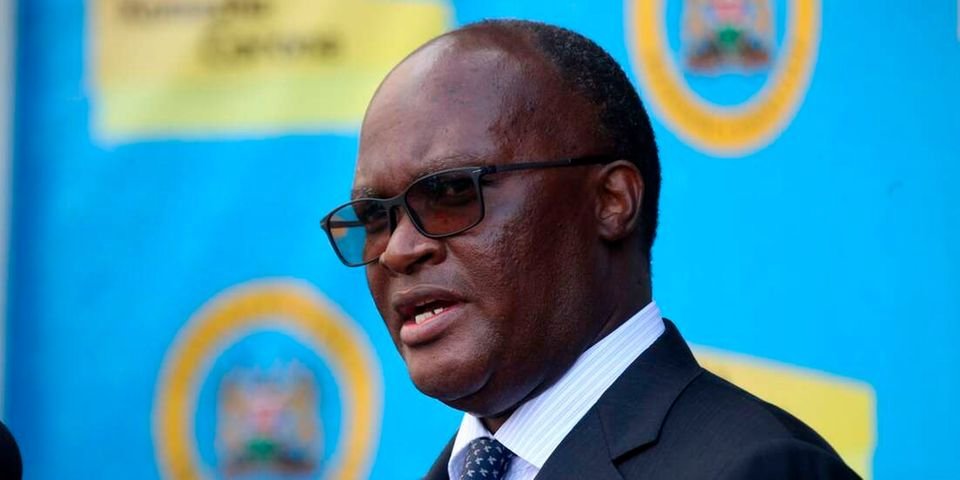
Most government job appointments in Kenya attract scrutiny, not for the qualifications of the individuals chosen, but for their ethnicity, and the latest ones by Transport Cabinet Secretary James Macharia are no exception.
A Gazette notice surfaced this week of Mr Macharia’s appointment of three people to the Nairobi Metropolitan Area Transport Authority Board.
Mr Macharia, in his capacity as the chairperson of the Nairobi Metropolitan Area Council, appointed three individuals from one ethnic group.
The three are Mary Waithiegeni Choge, Zachariah Karenge Mungai and Ronald Ndirangu Ndegwa, who will serve the board for three years.
“In the exercise of the powers conferred by paragraph 8(2) of the Nairobi Metropolitan Authority Order, 2017, the Nairobi Metropolitan Area Council appoints…to be members of the Nairobi Metropolitan Area Transport Authority Board for a period of three years with effect from February 10, 2021,” read the Gazette notice.
The appointments did not sit well with a section of Kenyans who raised concerns over the lack of diversity.
Lack of inclusion in State appointments continues to be an issue in Kenya, the general view being that only a few tribes are benefiting as marginalised ethnic groups are left out.
This is despite a push to ensure that offices funded by taxpayers have the ‘face of Kenya’, with all communities given an opportunity to serve.
PSC report
A report by the Public Service Commission (PSC) presented to Parliament late last year revealed that the Kikuyu and Kalenjin communities dominate top jobs in the government and embassies, as well as chief executive positions in parastatals.
The report showed that Kikuyus and Kalenjins account for 29 per cent and 11 per cent of the 417 top jobs in government, respectively, including the offices of directors and principal secretaries.
The Kikuyu community accounted for 27 per cent of Kenya’s 66 ambassadors with Kalenjins taking 14 per cent.
On CEOs of parastatals, Kikuyus took 20 per cent of the positions followed by Kalenjins at 19.4 per cent, Luos at 14.4 per cent and Luhyas at 10 per cent.
The Kikuyu and Kalenjin dominance mirrors the two tribes’ presence at the highest office in Kenya since Independence.
President Uhuru Kenyatta succeeded Mwai Kibaki, both Kikuyus. President Daniel arap Moi, who ruled for 24 years before Mr Kibaki, was a Kalenjin. Deputy President William Ruto is also a Kalenjin.
Representation
The PSC data indicates central Kikuyu is over-presented among the top officers in government with 120 positions that accounted for 29 per cent of the senior jobs against their 17 per cent share of the population based on 2019 census.
They accounted for 20 per cent of parastatal CEO jobs and 27 per cent of top positions in foreign missions.
The Kalenjin community’s share of the population stood at 13 per cent but it controlled 19.4 per cent of CEO jobs in State-owned firms and 14 per cent of top embassy jobs. The community has 11 per cent of senior jobs in the civil service.
Luos account for 11 per cent of Kenya’s population but control 14.4 per cent CEO positions in parastatals and 10 per cent of top government jobs.
Merus account for four per cent of Kenya’s population but are overrepresented among the top jobs in government and chief executive positions in parastatals.
The Luhya community, which forms 14 per cent of the Kenyan population, accounted for eight per cent of senior positions in the civil service and 10 per cent of top jobs in the foreign missions.
Other underrepresented communities include the Mijikenda, Kisii, Njemps, Kenyan Arabs, Kenyan Asians and Ogiek.

more recommended stories
 MZIMA II WATER PROJECT: KSh 50.6 BILLION COASTAL PIPELINE MOVES CLOSER TO IMPLEMENTATION
Chinese firm identified as proposed developer.
 Nairobi in Darkness as Government Billing Dispute Leaves Residents Paying the Price
NAIROBI — As darkness descends on.
 RUTO CONTRADICTS HIMSELF ON FOREIGNERS: FROM “VISA-FREE AFRICA” TO A CRACKDOWN ON SMALL TRADERS
President William Ruto’s latest crackdown.
 NEW UNIFORMS, SAME OLD PROBLEMS: YOU CAN’T TAILOR INTEGRITY
President William Ruto has proudly unveiled.
 SHARON’S JUSTICE CANNOT BE BOUGHT
The latest developments in the.
 HOMA BAY VIOLENCE RAISES TROUBLING QUESTIONS ABOUT KENYA’S DEMOCRACY
The shocking violence that engulfed the.
 JUSTICE AT LAST: WHAT THE SHARON OTIENO MURDER CONVICTION MEANS FOR KENYA
After nearly eight years of.
 ALBERT OJWANG CASE: THE QUESTIONS KENYA REFUSES TO LET DIE
The death of Albert Ojwang in.
 RELIEF FOOD SCANDAL RAISES SERIOUS QUESTIONS AS INVESTIGATIONS CONTINUE
The reported recovery of hundreds.
 THE HALIMA NGACHE CASE: A COSTLY ASSAULT ON DIGITAL FREEDOM THAT DEMANDS ACCOUNTABILITY
The collapse of the case against.
 WHY FIKIRINI JACOBS MUST STEP ASIDE AS THE CECIL OUMA PROBE CONTINUES
The tragic death of 28-year-old youth.
 STOP THE KILLING, NOT MERELY COMPENSATE THE DEAD
As Kenya approaches the second.
 PRESIDENT RUTO’S FREQUENT FLYER PRESIDENCY: ARE KENYANS GETTING VALUE FOR MONEY?
President William Ruto has returned to.
 THE SINGAPORE ILLUSION: A REALITY CHECK ON THE STATE OF OUR NATION
There is an increasingly persistent.
 Could the Proposed Ebola Quarantine Facility Cost Kenya More Than It Gains?
The proposed establishment of a United.
-
RUTO’S HAMMER POLITICS: WHY KENYA CANNOT BE GOVERNED THROUGH ENDLESS PUBLICITY TOURS
“If your only tool is.
Leave a Comment