
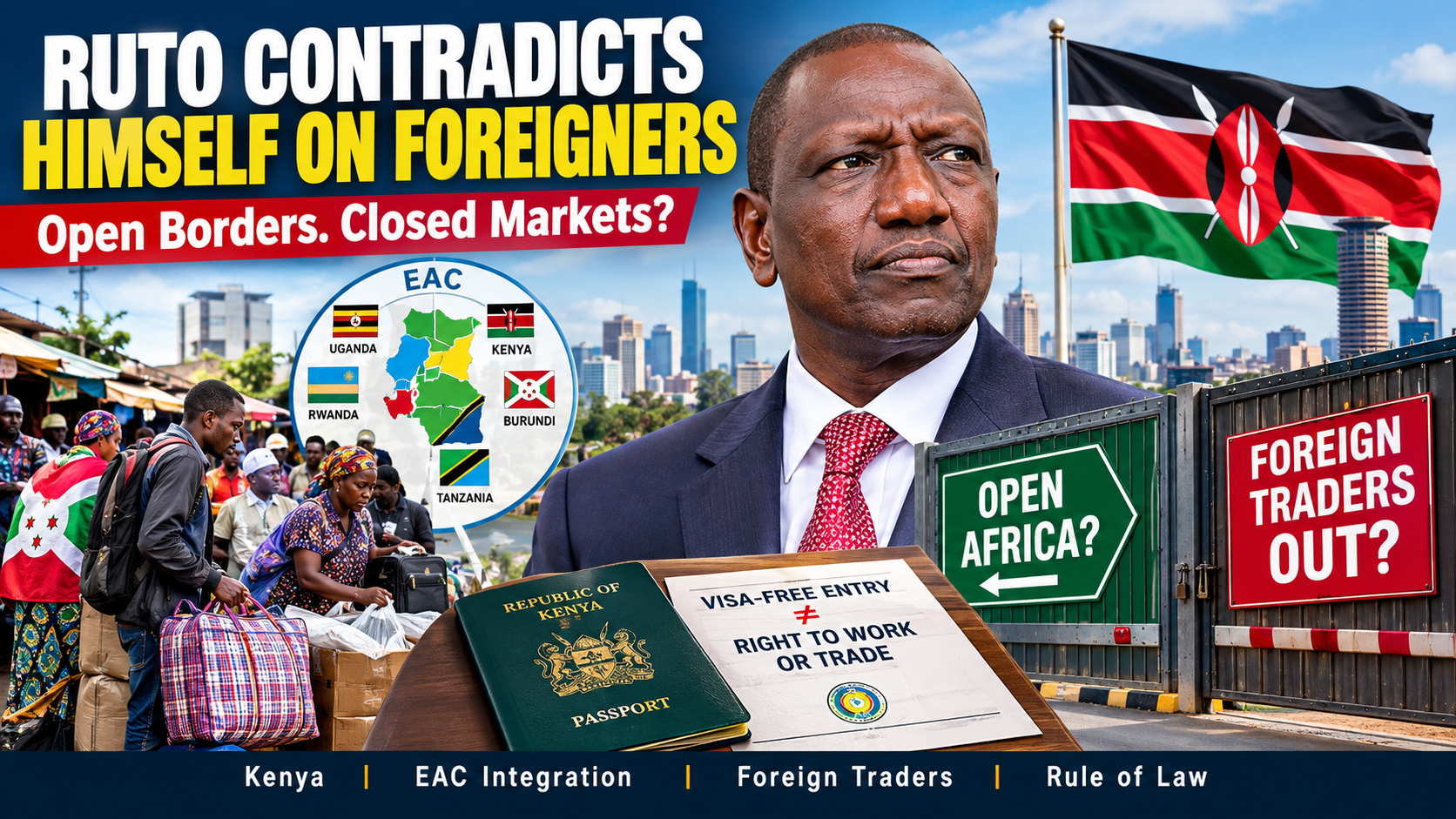
President William Ruto’s latest crackdown on foreign-owned small businesses has opened a much bigger debate than the government may have anticipated: Can Kenya promote an integrated, borderless East Africa while simultaneously restricting ordinary East Africans from participating in its informal economy?
The question has become particularly urgent after hundreds of Burundians rushed to their embassy in Nairobi seeking passports and travel documents amid fears that they could be forced out of Kenya. The panic followed Ruto’s directive that foreigners operating small-scale businesses and hawking enterprises should close those businesses from September 7.
Yet, barely had the enforcement deadline arrived than the government moved to reassure the region that there is no blanket deportation policy.
That apparent reversal is at the heart of the controversy.
A PRESIDENTIAL DIRECTIVE — FOLLOWED BY A GOVERNMENT CLARIFICATION
Ruto’s September 2 directive was presented as a measure to protect Kenyan entrepreneurs from foreign competition in low-level retail and hawking.
The government now insists that the target is not foreigners as such, but foreigners operating businesses without the necessary permits, licences or legal authorisation.
Foreign Affairs PS Korir Sing’oei even apologised to Burundians following reports of harassment and confusion, while Government Spokesperson Charles Owino announced a temporary registration window for undocumented EAC nationals. Those who register are to receive temporary protection while their status is regularised.
The government has therefore attempted to draw a distinction between:
- Entering Kenya without a visa;
- Having the right to reside in Kenya;
- Having the right to work; and
- Having the right to operate a business.
Those are legally different questions.
And the government is correct on one important point: visa-free entry does not automatically amount to a work or business licence.
But that does not completely resolve the larger political and regional question.
THE CONTRADICTION: OPEN AFRICA, CLOSED MARKET?
Ruto has repeatedly positioned Kenya as a champion of African integration and freer movement across the continent.
His administration has promoted the idea of an increasingly connected African market in which Africans should be able to move, work, invest and trade more easily across borders.
But the current crackdown creates an uncomfortable contradiction.
What message does Kenya send to its East African neighbours when a Burundian, Ugandan, Tanzanian or Rwandan trader who has spent years building a livelihood in Kenya suddenly fears that his or her business may be closed because of nationality?
The East African Community is not merely a political talking shop. Its Common Market Protocol provides for the free movement of workers and services and the right of establishment and residence, subject to the applicable legal framework.
That means Kenya certainly retains the sovereign authority to regulate immigration, licensing, taxation and commercial activity.
But regional integration also imposes obligations on partner states.
This is precisely why lawyers and civil-society organisations have questioned the manner in which the directive is being implemented.
THE DANGEROUS DIFFERENCE BETWEEN ENFORCEMENT AND XENOPHOBIA
There is a legitimate argument for enforcing Kenyan laws.
If a foreign national is operating a business without a required permit, licence or immigration status, the government is entitled to enforce the law.
But law enforcement must be based on conduct, not nationality alone.
This distinction is critical.
A Kenyan business competing with another Kenyan business can be subjected to licensing, taxation and labour regulations.
A Burundian business should likewise be subjected to applicable Kenyan laws.
But simply saying:
“You are foreign, therefore you cannot participate in this economic activity”
raises a fundamentally different legal and constitutional question—particularly where regional treaties are involved.
The danger becomes even greater when a presidential announcement is interpreted on the ground as permission for ordinary citizens, landlords, local traders or security officers to identify and chase away foreigners.
The events at the Burundi Embassy demonstrate how quickly uncertainty can become panic.
Hundreds of Burundians reportedly sought documents amid fears of expulsion. (Pulse Kenya)
That is precisely why the government’s subsequent warning against harassment and xenophobia is important.
RUTO’S BIGGER POLITICAL PROBLEM
The controversy also exposes a political dilemma for the President.
Kenya’s economic problems are real: unemployment, high taxation, expensive living costs, pressure on small businesses and growing frustration among young people.
But foreign traders are an easy political target because they are highly visible.
A struggling Kenyan trader can see a foreign-owned kiosk, shop or hawker and conclude that the foreigner has taken a Kenyan opportunity.
Sometimes that perception may reflect genuine competition.
But the broader economic problem is considerably more complicated.
Kenya’s informal economy has millions of participants. Its problems include:
- inadequate access to affordable credit;
- taxation and regulatory burdens;
- limited purchasing power;
- expensive premises;
- weak manufacturing;
- unemployment;
- corruption;
- inadequate market infrastructure; and
- limited opportunities for young people.
Removing a Burundian, Ugandan or Tanzanian trader does not automatically solve those structural problems.
A government that blames foreigners for every economic frustration risks treating the symptom rather than the disease.
AND THEN THERE IS RUTO’S OWN HISTORY
This is where the controversy becomes particularly uncomfortable for President Ruto.
It is important, however, to get the historical record right.
Ruto was not convicted by the ICC for violating international law. He was prosecuted before the International Criminal Court in connection with alleged crimes against humanity arising from Kenya’s 2007–08 post-election violence. The ICC confirmed charges against him and Joshua arap Sang in 2012. The case ultimately collapsed and was formally terminated in 2016 after the Prosecutor withdrew the case, citing serious evidentiary and witness-related problems. (icc-cpi.int)
The distinction matters.
But politically, the irony remains striking.
Ruto knows better than many Kenyan politicians how international scrutiny can follow government conduct when questions of human rights, discrimination, violence and accountability arise.
He therefore has an especially strong reason to ensure that today’s foreign-trader crackdown does not descend into collective punishment or xenophobic harassment.
THE REAL TEST IS HOW THE DIRECTIVE IS IMPLEMENTED
There is nothing inherently unlawful about Kenya insisting that commercial activities comply with Kenyan law.
There is also nothing inherently unreasonable about protecting Kenyan micro and small enterprises from businesses operating illegally.
The problem arises if enforcement becomes:
Foreign nationality → presumed illegality → business closure → harassment → forced departure.
That would be a dangerous progression.
The government must instead demonstrate:
Specific violation → individual investigation → notice → due process → lawful enforcement.
That is the difference between immigration and commercial regulation on one hand and collective punishment on the other.
RUTO CANNOT HAVE IT BOTH WAYS
Kenya cannot simultaneously present itself as a champion of African integration and then send a contradictory message to its immediate neighbours without clearly explaining the legal basis and limits of the restrictions.
If the government’s position is that foreigners without the appropriate permits cannot operate certain businesses, then say exactly that.
Publish the rules.
Identify the affected economic activities.
Explain the licensing requirements.
Give affected traders an opportunity to regularise their status.
And enforce the law individually and fairly.
But if nationality itself becomes the determining factor, Kenya risks undermining the very regional integration project it claims to support.
The government’s emergency registration window and its warnings against xenophobia are therefore welcome. (Pulse Kenya)
But they also reveal just how badly the original message was communicated.
The sight of hundreds of Burundians rushing to their embassy should be a warning—not merely to foreigners living in Kenya, but to the Kenyan government itself.
The question is no longer simply whether foreigners should be allowed to trade in Kenya.
It is whether Kenya will enforce its laws through transparent, individual and lawful procedures—or whether political pressure will turn economic frustration into nationality-based exclusion.
And for a President whose own political history includes an ICC prosecution arising from one of Kenya’s darkest periods of violence, Ruto should understand better than most that inflammatory political rhetoric can have consequences far beyond the original intention.
Kenya must protect Kenyan traders—but it must do so without turning its neighbours into scapegoats.
That is not weakness.
That is the rule of law.

more recommended stories
 MZIMA II WATER PROJECT: KSh 50.6 BILLION COASTAL PIPELINE MOVES CLOSER TO IMPLEMENTATION
Chinese firm identified as proposed developer.
 Nairobi in Darkness as Government Billing Dispute Leaves Residents Paying the Price
NAIROBI — As darkness descends on.
 NEW UNIFORMS, SAME OLD PROBLEMS: YOU CAN’T TAILOR INTEGRITY
President William Ruto has proudly unveiled.
 SHARON’S JUSTICE CANNOT BE BOUGHT
The latest developments in the.
 HOMA BAY VIOLENCE RAISES TROUBLING QUESTIONS ABOUT KENYA’S DEMOCRACY
The shocking violence that engulfed the.
 JUSTICE AT LAST: WHAT THE SHARON OTIENO MURDER CONVICTION MEANS FOR KENYA
After nearly eight years of.
 ALBERT OJWANG CASE: THE QUESTIONS KENYA REFUSES TO LET DIE
The death of Albert Ojwang in.
 RELIEF FOOD SCANDAL RAISES SERIOUS QUESTIONS AS INVESTIGATIONS CONTINUE
The reported recovery of hundreds.
 THE HALIMA NGACHE CASE: A COSTLY ASSAULT ON DIGITAL FREEDOM THAT DEMANDS ACCOUNTABILITY
The collapse of the case against.
 WHY FIKIRINI JACOBS MUST STEP ASIDE AS THE CECIL OUMA PROBE CONTINUES
The tragic death of 28-year-old youth.
 STOP THE KILLING, NOT MERELY COMPENSATE THE DEAD
As Kenya approaches the second.
 PRESIDENT RUTO’S FREQUENT FLYER PRESIDENCY: ARE KENYANS GETTING VALUE FOR MONEY?
President William Ruto has returned to.
 THE SINGAPORE ILLUSION: A REALITY CHECK ON THE STATE OF OUR NATION
There is an increasingly persistent.
 Could the Proposed Ebola Quarantine Facility Cost Kenya More Than It Gains?
The proposed establishment of a United.
-
RUTO’S HAMMER POLITICS: WHY KENYA CANNOT BE GOVERNED THROUGH ENDLESS PUBLICITY TOURS
“If your only tool is.
 LAUNCHES WITHOUT LEGACY: THE GROWING GAP BETWEEN PROMISE AND DELIVERY
In recent years, President William.
Leave a Comment