
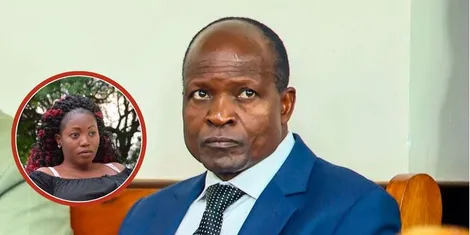
The latest developments in the Sharon Otieno murder case have left many Kenyans deeply troubled.
After nearly eight years of waiting for justice, the focus of public discussion appears to be shifting from accountability for a brutal murder to questions of compensation, houses, vehicles, and financial support.
According to reports presented through a probation report, Sharon’s family does not oppose a non-custodial sentence for former Migori Governor Okoth Obado and has reportedly sought various forms of compensation, including housing, transport assistance, and support for Sharon’s children.
While the pain and suffering endured by Sharon’s family cannot be overstated, the developments raise a difficult but necessary question:
Whose justice is this?
Is it Sharon’s justice, or is it becoming a negotiation over compensation?
Sharon Otieno was not a property dispute. She was not a contract. She was not a financial transaction.
She was a human being whose life was violently taken away.
No house can bring her back.
No vehicle can restore the years she lost.
No amount of money can replace a daughter, a mother, a sister, or the future that was stolen from her.
That is why many Kenyans are struggling to understand how a murder conviction can be followed by discussions that appear to place economic considerations ahead of accountability.
The purpose of criminal justice is not merely to compensate victims’ families. It is to hold offenders accountable for their actions and to protect society by demonstrating that serious crimes carry serious consequences.
Murder is among the gravest offences recognized by law.
When a court finds a person guilty of murder, the primary question should be what sentence justice demands—not what price can be placed on the victim’s life.
This is not to dismiss the hardships Sharon’s family has endured. Eight years of court appearances, legal proceedings, emotional trauma, and financial strain would take a heavy toll on any family.
Support for the welfare of Sharon’s children is a legitimate concern.
Compensation can play an important role in helping victims’ families rebuild their lives.
But compensation and accountability are not the same thing.
One should never replace the other.
A society that allows murder to be resolved through financial arrangements risks sending a dangerous message: that justice can be negotiated if the right compensation package is offered.
That is a message Kenya cannot afford to send.
The Sharon Otieno case became a national symbol because it represented something bigger than one family. It became a test of whether powerful individuals could be held accountable under the law.
The guilty verdict delivered by the High Court was widely celebrated because it reinforced a fundamental constitutional principle: no one is above the law.
That principle should not be weakened at the sentencing stage.
The victim at the center of this case is Sharon Otieno.
Not politicians.
Not lawyers.
Not commentators.
Not even her family.
Sharon herself.
The justice system owes a duty to her memory and to the broader public interest.
Sentencing should therefore reflect the seriousness of the offence, the court’s findings, and the need to uphold public confidence in the rule of law.
The country is watching closely because the outcome will resonate far beyond this single case.
It will influence how Kenyans view accountability in other high-profile cases.
It will shape public confidence in the criminal justice system.
And it will determine whether the principle that “no one is above the law” is merely a slogan or a reality.
Sharon Otieno is gone forever.
Nothing can change that tragic fact.
But one thing remains within the reach of the courts:
Justice.
Not a settlement.
Not a bargain.
Not a transaction.
Justice.
Because Sharon’s life was priceless, and justice for her should never be measured in houses, vehicles, or money.
JUSTICE AT LAST: WHAT THE SHARON OTIENO MURDER CONVICTION MEANS FOR KENYA

more recommended stories
 MZIMA II WATER PROJECT: KSh 50.6 BILLION COASTAL PIPELINE MOVES CLOSER TO IMPLEMENTATION
Chinese firm identified as proposed developer.
 Nairobi in Darkness as Government Billing Dispute Leaves Residents Paying the Price
NAIROBI — As darkness descends on.
 RUTO CONTRADICTS HIMSELF ON FOREIGNERS: FROM “VISA-FREE AFRICA” TO A CRACKDOWN ON SMALL TRADERS
President William Ruto’s latest crackdown.
 NEW UNIFORMS, SAME OLD PROBLEMS: YOU CAN’T TAILOR INTEGRITY
President William Ruto has proudly unveiled.
 HOMA BAY VIOLENCE RAISES TROUBLING QUESTIONS ABOUT KENYA’S DEMOCRACY
The shocking violence that engulfed the.
 JUSTICE AT LAST: WHAT THE SHARON OTIENO MURDER CONVICTION MEANS FOR KENYA
After nearly eight years of.
 ALBERT OJWANG CASE: THE QUESTIONS KENYA REFUSES TO LET DIE
The death of Albert Ojwang in.
 RELIEF FOOD SCANDAL RAISES SERIOUS QUESTIONS AS INVESTIGATIONS CONTINUE
The reported recovery of hundreds.
 THE HALIMA NGACHE CASE: A COSTLY ASSAULT ON DIGITAL FREEDOM THAT DEMANDS ACCOUNTABILITY
The collapse of the case against.
 WHY FIKIRINI JACOBS MUST STEP ASIDE AS THE CECIL OUMA PROBE CONTINUES
The tragic death of 28-year-old youth.
 STOP THE KILLING, NOT MERELY COMPENSATE THE DEAD
As Kenya approaches the second.
 PRESIDENT RUTO’S FREQUENT FLYER PRESIDENCY: ARE KENYANS GETTING VALUE FOR MONEY?
President William Ruto has returned to.
 THE SINGAPORE ILLUSION: A REALITY CHECK ON THE STATE OF OUR NATION
There is an increasingly persistent.
 Could the Proposed Ebola Quarantine Facility Cost Kenya More Than It Gains?
The proposed establishment of a United.
-
RUTO’S HAMMER POLITICS: WHY KENYA CANNOT BE GOVERNED THROUGH ENDLESS PUBLICITY TOURS
“If your only tool is.
 LAUNCHES WITHOUT LEGACY: THE GROWING GAP BETWEEN PROMISE AND DELIVERY
In recent years, President William.
Leave a Comment