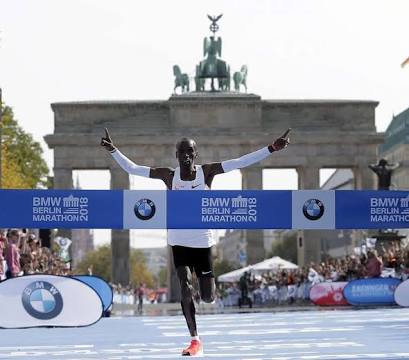
Eliud Kipchoge sets new world record in Berlin marathon win

Eliud Kipchoge has cemented his position as the greatest marathoner ever by winning his third Berlin Marathon and setting a new world record of 2:01:40.
Kipchoge ran at the front from the very first metre, and despite some turbulent times in the first third of the race when his pacers faltered, stormed home to take another win and lower the world record by a remarkable 76 seconds.
With three pacemakers in front of him, Kipchoge ran the first kilometre in just 2:43 – gapping the rest of the elite field immediately.
As was planned ahead of the race, Kipsang ran more conservatively, aiming to go through halfway 30 seconds slower than his countryman.
Kipchoge ran 5km in 14:24 – which was 1:26 faster than world record pace – and passed under the 10km barrier in 29:01.
That 10km time was 23 seconds faster than Dennis Kimetto’s world record pace, but Kimetto ran an incredibly fast second half.
Things looked to have fallen apart for Kipchoge’s world record hopes after 15km.
Within the space of a kilometre, he lost two pacemakers, forcing him to reassess and re-organise with just Josphat Boit to guide him.
At 15km, Kipchoge was on pace to run 2:02:44, but that mark would be highly unlikely if Boit couldn’t hold on until at least the 25km banner.
The good news, in terms of the race rather than the record, was that Kipsang seemed to be gassed, having lost contact momentarily with his own pacers through 15km.
Up front, the race was in control, but the world record was slowly slipping from Kipchoge’s grasp.
With Boit doing a stellar job of maintaining his solitary charge at the front, the pair passed through 20km in 57:56 and the halfway mark at 61:06 – almost on par with the target of 61 minutes for the first half.
Kipsang, who still had three pacemakers, went through halfway in 61:07 – well outside his target time.
The leading duo went through 25km in 1:12:24, and as Kipsang continued to fade in the second group, Kipchoge left Boit, who dropped out of the race.
A bold move with 17km still to race – and it wasn’t just the commentary team questioning whether Kipchoge could possibly maintain the pace on his own.
Boosted after leaving Boit, he surged, running the 27th kilometre in just 2:51 – seven seconds faster than necessary.
But, at the 30km mark Kipchoge was 52 seconds ahead of WR pace and the magic 2:02:57 mark was within sight again.
With his customary wry smile affixed, Kipchoge never looked like faltering in the final 5km.
The 33-year-old Olympic marathon champion had the world record in the bag with plenty of room left to run. It was just a matter of how much time he could take off Kimetto’s record.
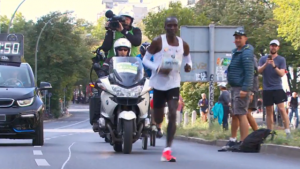
“It’s a breathless leap in the world of marathon running,” said one excited commentator as Kipchoge passed 40km in 1:55:32. That’s 50 seconds inside world record pace, and the previously unimaginable time of two hours and two minutes was a real possibility.
Kipchoge passed under the Brandenburg Gate with 400m to run and powered down the finishing chute to complete the greatest marathon ever run in 2:01:40.
Kipchoge now adds the official world record to his extensive list of achievements. Last year he set the fastest ever time over the marathon distance on the Monza race track in Italy for Nike’s Breaking2 project.
With rolling pacers, Kipchoge ran 2:00:26, but the run isn’t considered a world record because of the controlled conditions.
Kipchoge has now won 10 of the 11 marathons he has run. Ironically, it took a world record setting run by Kipsang in 2013 in Berlin to beat Kipchoge in what was just his second marathon since moving from the track.

 KENYA TO CLOSE EMBASSY IN SWITZERLAND: WHAT THE DIPLOMATIC RESTRUCTURING MEANS FOR KENYANS
The closure of the Kenyan Embassy.
 TANZANIA: TUNDU LISSU AFUNGWA MIAKA MINNE — SAMIA SULUHU HASSAN NA JARIBIO LA KUZIMA DEMOKRASIA
Hukumu ya Lissu ni pigo kwa.
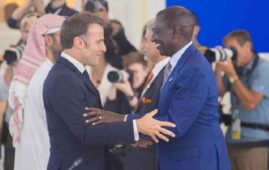 FRANCE’S NEW VISA EXEMPTION PROGRAM: WHY WAS KENYA LEFT OUT DESPITE RUTO-MACRON FRIENDSHIP?
France’s recent decision to extend.
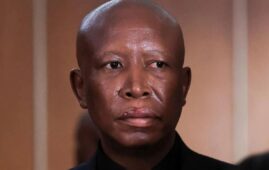 JUSTICE OR POLITICS? THE CASE AGAINST MALEMA’S SENTENCE — AND THE CONTRADICTIONS IN HIS VISION
The five-year prison sentence handed down.
 UNDERSTANDING THE AFRICAN NUCLEAR-WEAPON-FREE ZONE TREATY (PELINDABA TREATY)
The African Nuclear-Weapon-Free Zone Treaty, widely.
 KAZI NA UTU? – MASWALI MAZITO BAADA YA KAULI YA RAIS SAMIA KUHUSU VURUGU za OKTOBA 29, 2025
Rais wa Jamhuri ya Muungano wa.
 MILITARY SEIZES POWER IN 2025 GUINEA-BISSAU COUP AMID POST-ELECTION TENSIONS
By Kwaela News Network | Bissau,.
 THE ICC AND AFRICA: IMPUNITY, BROKEN CASES, AND THE HIGH COST OF FAILED INTERNATIONAL JUSTICE
The International Criminal Court (ICC),.
 JUSTICE MUST PREVAIL: A CALL TO ACTION ON TANZANIA’S POST-ELECTION KILLINGS
By Kwaela News Network |.
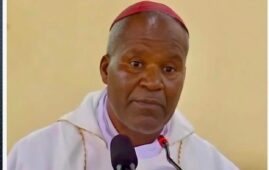 TAMKO KUU LA BARAZA LA MAASKOFU KATOLIKI TANZANIA (TEC) JUU YA MAUAJI, MAADHIMISHO NA KIFO KUFUATIA UCHAGUZI WA 29 OKTOBA 2025
Dar es Salaam – 15.
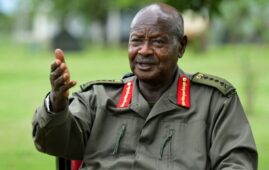 MUSEVENI’S WAR RHETORIC RAISES TENSION AHEAD OF 2026 ELECTIONS
Uganda’s long-serving president hints at future.
 UJUMBE KWA GEN Z WA TANZANIA 🇹🇿
Ninyi ndio kizazi cha sasa.
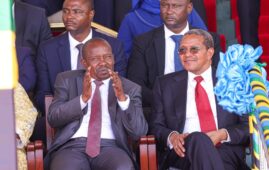 DIPLOMATIC MOVES AMID CONTROVERSY: KENYAN DEPUTY REPRESENTS RUTO AT SAMIA’S SWEARING-IN AS REGIONAL TENSIONS RISE
Nairobi, Kenya – President Samia Suluhu.
 TANZANIA: POST-ELECTION UNREST HIGHLIGHTS TENSIONS BETWEEN POWER AND FREE SPEECH
Following the 29 October 2025 presidential.
 JE, ZANZIBAR INAIKALIA TANGANYIKA KICHWANI?
Wapo Watanzania wanaoanza kuhoji usawa.
 UJUMBE KWA GEN Z WA TANZANIA 🇹🇿
Kama kuna jambo moja la.
Leave a Comment