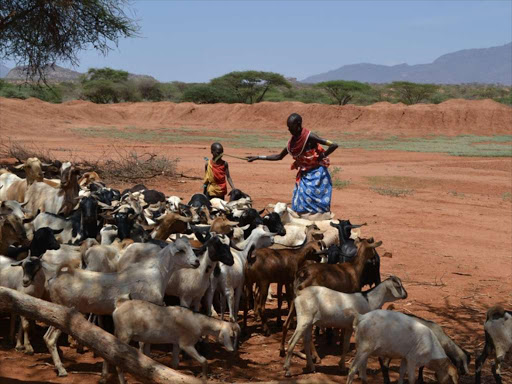
SOURCE OF LIVELIHOOD: A woman and a child with goats while searching for water in northern Kenya on September 28, 2017

Parliament has been urged to fast-track the enactment of the Equalisation Fund Bill, 2019 now that the National Treasury has published regulations to administer it.
Once enacted, the Treasury will unlock the Fund for marginalised counties. The amount has accumulated to Sh26 billion.
Cabinet Secretary Ukur Yatani said the publication of the regulations for administering the Fund is part of the Treasury’s commitment to release the money for use by the 14 counties.
The regulations will come into force once ratified by Parliament.
The Fund beneficiaries are Garissa, Isiolo, Kilifi, Kwale, Lamu, Mandera, Marsabit, Narok, Samburu, Tana River, Turkana, Taita Taveta, Wajir, and West Pokot counties.
The Council of Governors has over the years lamented the delayed release of the funds, maintaining that the monies have been with the Treasury since the advent of devolution.
Governors sued over the initial guidelines, which a court ruled were unconstitutional but the government is yet to release the funds.
CoG chairman Wycliffe Oparanya (Kakamega governor) on Tuesday said it was time the fund was operationalised to stem revenue shortfalls in the arid and semi-arid counties.
The regulations provide that the fund, into which 0.5 per cent of national revenue is deposited, will be administered by a board comprising a chairperson appointed by the Treasury CS.
Other members will be Devolution Principal Secretary, a nominee of the Parliamentary Pastoralist Group, Senate nominee, two CoG nominees from ASAL counties, two persons nominated by organisations working in beneficiary counties, and a chief executive officer appointed by the board.
Members will be holders of degree from recognised universities in Kenya. Each will have at least five years professional experience and meet Leadership and Integrity requirements.
The board will evaluate projects and make recommendations on priority areas for funding in the recipient counties.
Each eligible county will be required to establish a county technical committee chaired by the respective county commissioners.
Other members will be Finance CECs, Constituency Development Fund managers, representatives of county assemblies and representatives of the implementing sectors.
Allocations to the Equalisation Fund, as spelled in the Constitution, are to facilitate services such as water, roads, health facilities and electricity.
Each county shall form a subcounty technical committee chaired by subcounty commissioner, four technical officers from ministries relevant to funding priorities, and chairpersons of project identification and implementation committees.
The committee will receive project proposals from the respective PIICs and assess the feasibility and cost of submitted proposals.
PIICs will be formed at the ward level comprising assistant county commissioner as chairperson, village administrators of areas defined by Commission on Revenue Allocation, and women, youth and persons with disabilities representatives.
The PIICs will publicise in beneficiary areas, identify and prioritise projects, and provide oversight on project implementation.
The Equalisation Bill is due for second reading and was queued in the Senate’s Tuesday business.
However, its progress was hampered by the debate on the contentious revenue sharing formula whose stalemate portends a cash crisis for the counties.
The Equalisation Fund is set to lapse 20 years after the effective date, hence the call for urgency by governors.
However, Parliament may enact legislation suspending the lapse for a further fixed period as long as the proposal is backed by more than half of National Assembly and Senate members.
There have been calls to increase the allocation to the Fund, most recently by Wiper leader Kalonzo Musyoka, who said this would compensate counties that might lose money in the contentious revenue sharing formula.
“We urge a speedy enactment of the subsidiary legislation on the Equalisation Fund both in the National Assembly and the Senate to ensure that the funds are significantly increased,” Kalonzo said.
~ The Star

 TAITA TAVETA: SEVEN DAYS HAVE ELAPSED — HAS SENATOR KAJWANG SENT WAKUJAA’S GOVERNMENT FILES TO EACC?
By Kwaela News Network (KNN).
 MZIMA II WATER PROJECT: KSh 50.6 BILLION COASTAL PIPELINE MOVES CLOSER TO IMPLEMENTATION
Chinese firm identified as proposed developer.
 Nairobi in Darkness as Government Billing Dispute Leaves Residents Paying the Price
NAIROBI — As darkness descends on.
 RUTO CONTRADICTS HIMSELF ON FOREIGNERS: FROM “VISA-FREE AFRICA” TO A CRACKDOWN ON SMALL TRADERS
President William Ruto’s latest crackdown.
 NEW UNIFORMS, SAME OLD PROBLEMS: YOU CAN’T TAILOR INTEGRITY
President William Ruto has proudly unveiled.
 SHARON’S JUSTICE CANNOT BE BOUGHT
The latest developments in the.
 HOMA BAY VIOLENCE RAISES TROUBLING QUESTIONS ABOUT KENYA’S DEMOCRACY
The shocking violence that engulfed the.
 JUSTICE AT LAST: WHAT THE SHARON OTIENO MURDER CONVICTION MEANS FOR KENYA
After nearly eight years of.
 ALBERT OJWANG CASE: THE QUESTIONS KENYA REFUSES TO LET DIE
The death of Albert Ojwang in.
 RELIEF FOOD SCANDAL RAISES SERIOUS QUESTIONS AS INVESTIGATIONS CONTINUE
The reported recovery of hundreds.
 THE HALIMA NGACHE CASE: A COSTLY ASSAULT ON DIGITAL FREEDOM THAT DEMANDS ACCOUNTABILITY
The collapse of the case against.
 WHY FIKIRINI JACOBS MUST STEP ASIDE AS THE CECIL OUMA PROBE CONTINUES
The tragic death of 28-year-old youth.
 STOP THE KILLING, NOT MERELY COMPENSATE THE DEAD
As Kenya approaches the second.
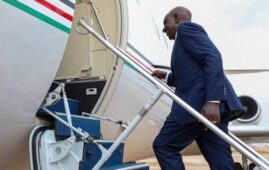 PRESIDENT RUTO’S FREQUENT FLYER PRESIDENCY: ARE KENYANS GETTING VALUE FOR MONEY?
President William Ruto has returned to.
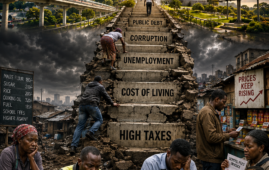 THE SINGAPORE ILLUSION: A REALITY CHECK ON THE STATE OF OUR NATION
There is an increasingly persistent.
 Could the Proposed Ebola Quarantine Facility Cost Kenya More Than It Gains?
The proposed establishment of a United.
Leave a Comment