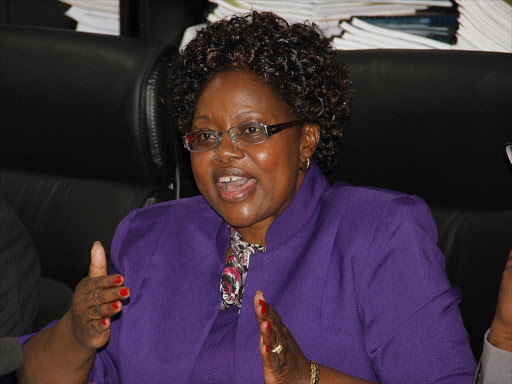
Controller of Budget Agnes Odhiambo

The gains of devolution have been put to question following a report revealing county governments spent over Sh80 billion on salaries in the first six months of the current financial year.
The report by Controller of Budget Agnes Odhiambo for July-December 2018 shows county governments are about salaries to the detriment of development.
Of major concern to Odhiambo is the fact that county governments are engaged in an uncontrolled hiring spree in total violation of applicable laws.
The situation, as captured in the report, exposes a glaring imbalance between money spent on recurrent activities versus budgets for growth projects, which are the entire point of devolution.
The report says the 47 devolved units spent a further Sh32.23 billion on operations and maintenance, leaving only Sh24.73 billion for development activities.
The personnel emoluments were an increase from Sh66 billion spent in a similar period last financial year, a situation Odhiambo says hampers execution of county budgets.
Staff pay gobbled up over 58 per cent of total expenditure.
Odhiambo reprimands county governments for violating the law which has set the limit of county expenditure on wages and benefits at 35 per cent of revenue.
We recommend that county governments should establish an optimal staffing level to ensure that personnel expenditure is within 35 per cent of the County’s total revenue.
Controller of Budget Agnes Odhiambo
“County governments should ensure that expenditure on personnel emoluments is contained at sustainable levels and in compliance with the Public Finance Management (County Governments) Regulations, 2015,” the budget controller said.
Odhiambo says the situation is made worse in the face of many counties failing to meet their revenue targets to supplement disbursements from the national treasury.
“The under-performance of own source revenue collection implies that some planned activities may not be implemented in the financial year as budgets will not be fully financed,” she says.
The budget controller has asked County Public Service Boards to establish and adopt an optimal staffing structure to ensure a sustainable wage bill.
In Bungoma, the county’s wage bill increased to Sh2.72 billion from Sh1.84 billion reported in the first half of the financial year 2017-18.
The budget controller flagged slow implementation of development activities after the county spent a paltry Sh500 million.
Governor Wycliffe Wangamati’s administration spent Sh4.28 billion, which was above the approved exchequer issues of Sh3.81 billion, “an indication that the county may be spending own revenue at source.”
In Elgeyo Marakwet, the county’s total recurrent expenditure hit Sh1.48 billion of which Sh1.19 billion was spent on staff salaries.
“The high wage bill, which accounted for 65.8 per cent of the total expenditure during the reporting period constrained funding to other programmes,” Odhiambo said.
Other cases are Taita Taveta (Sh1.15 billion), Tharaka Nithi (Sh1.05 billion), Nyandarua (Sh1.05 billion), Vihiga (Sh925 million), West Pokot (Sh912 million), Samburu (Sh912 million), and Lamu which spent Sh579 million and a paltry Sh55 million on development.
The amount spent on salaries was an increase from Sh66 billion incurred in the same period last year, signaling that more staff were hired by incoming governors.
The report reveals that Wajir, Baringo, and Nyamira recorded the highest percentage at 89.3 per cent, 76.5 per cent and 75.7 per cent respectively.
BIGGEST SALARIES’ SPENDERS
Nairobi leads the pack after spending Sh7 billion in the period under review compared with the Sh1.4 billion it spent on projects.
It is followed by Nakuru (Sh3 billion), Meru (Sh2.6 billion), Mombasa (Sh2.3 billion), Machakos (Sh2.52 billion), Kisii (Sh2.52 billion), Garissa (Sh2.16 billion), with Kitui and Turkana spending Sh2 billion each on salaries.
The bloated wage bill has also been flagged in Nyamira (Sh1.73 billion), Muranga (Sh1.68 billion), Uasin Gishu (Sh1.49 billion), Laikipia (Sh1.48 billion), Uasin Gishu (Sh1.49 billion), Homa Bay (Sh1.46 billion), Kericho (Sh1.36 billion), Migori (Sh1.35 billion), Trans Nzoia (Sh1.29 billion) and Kirinyaga (Sh1.16 billion).
Odhiambo’s caution comes amid findings that counties are not absorbing funds meant for development as required. The report singles out Wajir and Isiolo for not spending any money on projects.
Others spent less than a billion on projects. During the period, Garissa spent Sh544 million on development, Homa Bay (Sh302m), Kericho (Sh34m), Kirinyaga (Sh277m), Laikipia (Sh498m), Lamu (Sh55m), Migori (Sh432m), Nyamira (Sh190m) and Nyandarua (Sh110m).
The budget controller also reprimands the National Treasury for delays in disbursement of funds to the devolved units.
“The National Treasury should disburse funds to the counties on a timely basis to ensure budget implementation is not adversely affected,” she recommends.
The budget boss further cautions county governments against delaying the submission of their financial statements, which leads to late approval of county budgets.
The report reveals that counties spent an aggregate Sh112 billion on recurrent expenses – on salaries and running offices.
Nairobi led with Sh9.26 billion followed by Kiambu and Nakuru at Sh4.25 billion and Sh4.06 billion respectively.
Odhiambo further highlights an unusual increase in absorption of funds meant for sitting allowances for MCAs.
County lawmakers gobbled up Sh1.08 billion in committee sitting allowances, being an increase by 156 per cent compared with Sh422 million incurred in the financial year 2017-18. Sh2.7 billion was allocated for the allowances in the current year.
“Kakamega county assembly recorded the higher expenditure on sitting allowances compared to the Salaries and Remuneration Commission’s recommended average monthly ceiling of Sh124,800 per MCA,” Odhiambo says. The county spent Sh126,700.
Foreign and domestic trips are also underlined as a threat to development which shot up by 89 per cent.
Counties spent Sh6.51 billion during the period under review, which is a huge increase from the Sh3.77 billion incurred in a similar period last year.
Kisii county made most trips, spending Sh323 million, followed by Turkana (Sh253.9 million), Migori (Sh250.94 million), Taita Taveta (Sh250.87 million), Garissa (Sh229 million), Narok (Sh204.29 million). Nairobi and Kiambu spent Sh199 million and Sh197.79 respectively.
~ The Star

 TAITA TAVETA: SEVEN DAYS HAVE ELAPSED — HAS SENATOR KAJWANG SENT WAKUJAA’S GOVERNMENT FILES TO EACC?
By Kwaela News Network (KNN).
 MZIMA II WATER PROJECT: KSh 50.6 BILLION COASTAL PIPELINE MOVES CLOSER TO IMPLEMENTATION
Chinese firm identified as proposed developer.
 Nairobi in Darkness as Government Billing Dispute Leaves Residents Paying the Price
NAIROBI — As darkness descends on.
 RUTO CONTRADICTS HIMSELF ON FOREIGNERS: FROM “VISA-FREE AFRICA” TO A CRACKDOWN ON SMALL TRADERS
President William Ruto’s latest crackdown.
 NEW UNIFORMS, SAME OLD PROBLEMS: YOU CAN’T TAILOR INTEGRITY
President William Ruto has proudly unveiled.
 SHARON’S JUSTICE CANNOT BE BOUGHT
The latest developments in the.
 HOMA BAY VIOLENCE RAISES TROUBLING QUESTIONS ABOUT KENYA’S DEMOCRACY
The shocking violence that engulfed the.
 JUSTICE AT LAST: WHAT THE SHARON OTIENO MURDER CONVICTION MEANS FOR KENYA
After nearly eight years of.
 ALBERT OJWANG CASE: THE QUESTIONS KENYA REFUSES TO LET DIE
The death of Albert Ojwang in.
 RELIEF FOOD SCANDAL RAISES SERIOUS QUESTIONS AS INVESTIGATIONS CONTINUE
The reported recovery of hundreds.
 THE HALIMA NGACHE CASE: A COSTLY ASSAULT ON DIGITAL FREEDOM THAT DEMANDS ACCOUNTABILITY
The collapse of the case against.
 WHY FIKIRINI JACOBS MUST STEP ASIDE AS THE CECIL OUMA PROBE CONTINUES
The tragic death of 28-year-old youth.
 STOP THE KILLING, NOT MERELY COMPENSATE THE DEAD
As Kenya approaches the second.
 PRESIDENT RUTO’S FREQUENT FLYER PRESIDENCY: ARE KENYANS GETTING VALUE FOR MONEY?
President William Ruto has returned to.
 THE SINGAPORE ILLUSION: A REALITY CHECK ON THE STATE OF OUR NATION
There is an increasingly persistent.
 Could the Proposed Ebola Quarantine Facility Cost Kenya More Than It Gains?
The proposed establishment of a United.
Leave a Comment