
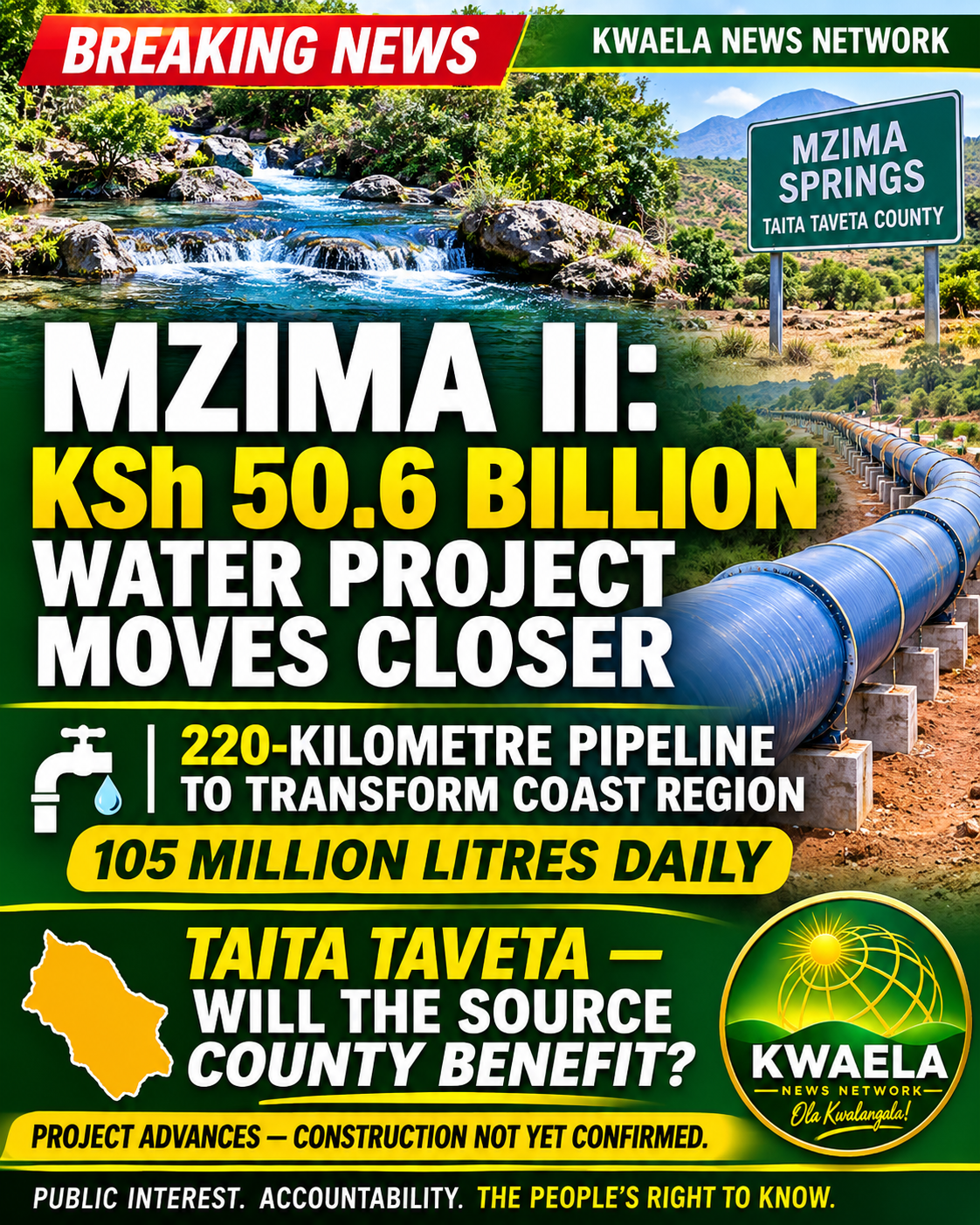
Chinese firm identified as proposed developer of 220-kilometre water pipeline expected to deliver 105 million litres daily — but Taita Taveta residents await answers on local water access.
The long-awaited Mzima II Water Supply Pipeline Project, a multibillion-shilling infrastructure development expected to transform water supply across Kenya’s Coast region, is advancing through the government’s Public-Private Partnership (PPP) framework, with Chinese state-owned infrastructure firm Sichuan Roads and Bridges Group identified as the proposed private developer.
The project, valued at approximately KSh 50.6 billion (US$389 million), is expected to deliver an additional 105 million litres of water daily from Mzima Springs in Taita Taveta County to the coastal region through a proposed 220-kilometre transmission pipeline.
According to the National Treasury’s PPP Directorate, the project is structured under a 30-year Build-Operate-Transfer (BOT) arrangement, with three years allocated for construction and a subsequent 27 years for operation and maintenance.
However, despite the latest developments, the project remains in the development and feasibility-study phase, with final construction clearance yet to be confirmed.
The announcement marks another significant milestone in a project that has remained central to the Coast region’s water infrastructure ambitions for decades.
A KSh 50.6 BILLION INVESTMENT — BUT WHAT EXACTLY IS BEING FINANCED?
The project’s financial framework presents two distinct figures that require careful interpretation.
The National Treasury’s PPP Directorate lists the overall estimated project value at KSh 50.6 billion. Separately, government documentation identifies a base construction estimate of US$335.338 million, equivalent to approximately KSh 43.5 billion.
The difference reflects the broader financial and project framework, although the precise breakdown of financing costs, regulatory expenses and distribution-system integration will require further disclosure.
The proposed infrastructure includes:
- – A 220-kilometre water transmission pipeline with a diameter of 1,200 millimetres.
- – Water abstraction facilities at Mzima Springs.
- – Bulk transmission infrastructure.
- – Pumping stations and storage reservoirs.
- – Connections to downstream distribution networks.
The project is expected to supplement the ageing Mzima I pipeline, which has served the Coast region since 1957 and has increasingly struggled with leaks, bursts and rising water demand.
The PPP Directorate identifies the Coast Water Works Development Authority (CWWDA) as the contracting authority and Sichuan Roads and Bridges Group as the proposed private developer.
The project proposal was approved in August 2024 to proceed to the development and feasibility-study stage.
Importantly, approval to undertake feasibility studies is not equivalent to final approval for construction.
TAITA TAVETA: THE SOURCE OF THE WATER, BUT WILL THE COUNTY BENEFIT?
For Taita Taveta residents, the Mzima II project carries a significance that extends beyond its engineering specifications.
The county hosts Mzima Springs, the source of the water that has sustained the coastal water supply system for generations.
Yet, communities within Taita Taveta continue to experience persistent water shortages, with households in several areas relying on unreliable supplies, boreholes, seasonal rivers and water vendors.
The proposed pipeline is expected to serve Mombasa, Kilifi, Kwale and Taita Taveta counties.
But the central question remains:
Will Taita Taveta receive a guaranteed and equitable share of the water originating from its own territory?
The project’s design capacity of 105 million litres daily represents a substantial expansion of bulk water infrastructure. Nevertheless, the actual benefits to individual communities will depend on the final distribution arrangements, local network investments and the terms governing water allocation.
The county government, CWWDA and the national government must therefore clarify how communities in Voi, Mwatate, Taveta, Wundanyi and other water-stressed areas will benefit.
A pipeline passing through or originating in Taita Taveta cannot, by itself, be considered a solution to the county’s water insecurity.
THE KSh 30 BILLION INFRASTRUCTURE PLEDGE
The proposed Mzima II development is also being discussed alongside a KSh 30 billion government infrastructure commitment intended to support the expansion of the Mzima water system and related infrastructure.
The proposed investment is significant because the delivery of bulk water alone cannot resolve shortages where downstream distribution networks remain inadequate.
The government must clarify how the KSh 30 billion commitment relates to the KSh 50.6 billion PPP framework.
Are these separate investments? Will the infrastructure pledge finance distribution networks that complement the proposed pipeline? What portions will benefit Taita Taveta?
These questions are particularly important given the proposed 30-year concession.
The public deserves a transparent explanation of how the two financial frameworks will interact, how public resources will be deployed and what obligations will ultimately fall upon consumers and taxpayers.
A 30-YEAR CONCESSION: WHO WILL PAY, AND WHO WILL CONTROL THE ASSET?
Under the proposed BOT arrangement, the private developer is expected to finance, design, construct, operate and maintain the infrastructure before transferring it to the public authority at the end of the concession.
This model can accelerate infrastructure delivery, but it also requires strong public oversight.
The government must disclose the proposed tariff framework, revenue arrangements, financing obligations, performance standards and safeguards against excessive costs being transferred to consumers.
The March 2026 Kenya Investment Projects Catalogue also identifies a requirement for viability gap funding (VGF), indicating that public financial support may be necessary to make the project commercially viable.
The amount of VGF required, its source and the conditions attached to it remain important questions.
For a project of this magnitude, transparency must begin before construction — not after the public has already committed itself to decades of financial obligations.
THE REAL TEST: WILL THE PROJECT FINALLY DELIVER WATER?
The Mzima II project has the potential to improve water security across Kenya’s Coast region.
But its success will not be measured by the value of the investment, the length of the pipeline or the number of official announcements.
It will be measured by whether households receive reliable, affordable and safe water.
For Taita Taveta, the stakes are particularly high.
The county must not remain merely the geographical source of a resource whose benefits are concentrated elsewhere.
As the project advances through the PPP process, the national government, CWWDA and Taita Taveta County Government must provide clear answers on local water allocations, distribution infrastructure, project financing and implementation timelines.
The people of Taita Taveta have waited for decades.
They deserve more than another promise.
They deserve a transparent project, a credible implementation schedule and a guaranteed place in the water future being built from their own land.
KWAELA NEWS NETWORK — PUBLIC INTEREST. ACCOUNTABILITY. THE PEOPLE’S RIGHT TO KNOW.

more recommended stories
 Nairobi in Darkness as Government Billing Dispute Leaves Residents Paying the Price
NAIROBI — As darkness descends on.
 RUTO CONTRADICTS HIMSELF ON FOREIGNERS: FROM “VISA-FREE AFRICA” TO A CRACKDOWN ON SMALL TRADERS
President William Ruto’s latest crackdown.
 NEW UNIFORMS, SAME OLD PROBLEMS: YOU CAN’T TAILOR INTEGRITY
President William Ruto has proudly unveiled.
 SHARON’S JUSTICE CANNOT BE BOUGHT
The latest developments in the.
 HOMA BAY VIOLENCE RAISES TROUBLING QUESTIONS ABOUT KENYA’S DEMOCRACY
The shocking violence that engulfed the.
 JUSTICE AT LAST: WHAT THE SHARON OTIENO MURDER CONVICTION MEANS FOR KENYA
After nearly eight years of.
 ALBERT OJWANG CASE: THE QUESTIONS KENYA REFUSES TO LET DIE
The death of Albert Ojwang in.
 RELIEF FOOD SCANDAL RAISES SERIOUS QUESTIONS AS INVESTIGATIONS CONTINUE
The reported recovery of hundreds.
 THE HALIMA NGACHE CASE: A COSTLY ASSAULT ON DIGITAL FREEDOM THAT DEMANDS ACCOUNTABILITY
The collapse of the case against.
 WHY FIKIRINI JACOBS MUST STEP ASIDE AS THE CECIL OUMA PROBE CONTINUES
The tragic death of 28-year-old youth.
 STOP THE KILLING, NOT MERELY COMPENSATE THE DEAD
As Kenya approaches the second.
 PRESIDENT RUTO’S FREQUENT FLYER PRESIDENCY: ARE KENYANS GETTING VALUE FOR MONEY?
President William Ruto has returned to.
 THE SINGAPORE ILLUSION: A REALITY CHECK ON THE STATE OF OUR NATION
There is an increasingly persistent.
 Could the Proposed Ebola Quarantine Facility Cost Kenya More Than It Gains?
The proposed establishment of a United.
-
RUTO’S HAMMER POLITICS: WHY KENYA CANNOT BE GOVERNED THROUGH ENDLESS PUBLICITY TOURS
“If your only tool is.
 LAUNCHES WITHOUT LEGACY: THE GROWING GAP BETWEEN PROMISE AND DELIVERY
In recent years, President William.
Leave a Comment