
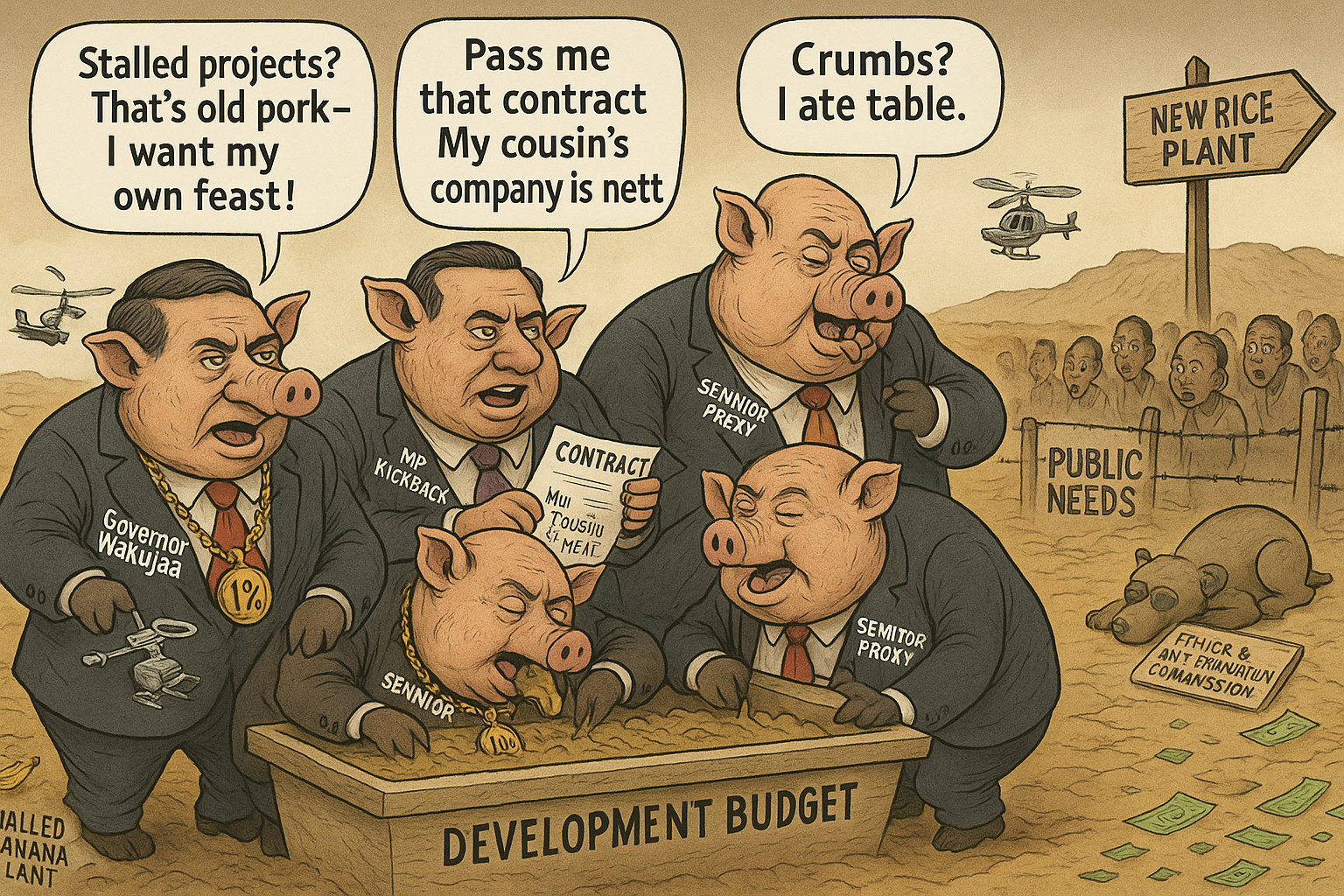
In 2024, President William Ruto was named by the Organized Crime and Corruption Reporting Project (OCCRP) as the second most corrupt person on the planet, after former Syrian President Bashar Al-Assad. Despite this, Ruto received a record-breaking 40,000 public nominations for the title. The OCCRP award highlights individuals or institutions that advance organized crime and corruption globally.
This situation is clearly illustrated by the political and economic conditions in Kenya. As ordinary people struggle to make ends meet, many in the political arena are swimming in excess cash. We have seen how some influential politicians and public officials flaunt their wealth. Apparently, some of them were living in poverty just before they got into leadership positions, but a few months after being elevated, they accumulate wealth at an unprecedented rate.
It is not uncommon to see Kenyan politicians and leaders owning luxury items like personal helicopters and properties overseas. They are so inhuman that they misappropriate Kenyan resources and invest them overseas, away from local public scrutiny, while Kenyans struggle for basic needs.
Is the problem nepotism and tribalism?
Although nepotism and tribalism play a major role in making our systems dysfunctional, they are not the only problems we face. While it’s true that most of these corrupt leaders are close friends and relatives of decision-makers, that alone does not explain all the mismanagement we see in development and system failure. In addition to corruption, incompetence and greed are major contributors to our country’s decline.
They use their positions to secure major contracts. Once the contracts are signed, they immediately divert the funds into their accounts through proxies. Instead of starting the work, they make no effort to fulfill their promises, leading to stalled projects with funds that have disappeared. This puts the nation into an economic crisis. No work gets done, and funds are squeezed. Wouldn’t it be a bit fairer if they delivered the job with acceptable quality while they shared the nation’s resources by dividing the major contracts among themselves as they wished?
The corrupt are milking the country dry. They are not only stealing resources but also failing to deliver on their mandates, which makes systems nonfunctional. Rather than just taking what is on the table and leaving the rest for others, they take everything beyond their needs—a clear sign of outright greed. They even go so far as to ensure that farmers don’t produce food anymore, leading to a man-made food shortage. What a tragedy.
With devolution, the same bad habits have moved into county governments.
Taita Taveta County has had three governors since devolution started, meaning the first two governors each served a single term. This is a scenario likely to be repeated by the third governor if he doesn’t improve his performance in the war on corruption and incompetence.
Governor Wakujaa, just like his predecessor, won the Taita Taveta County gubernatorial seat with a landslide. Three years in, it appears that he will have a hard time defending his position. He might be in a more difficult position for re-election than his predecessors. We saw Governor Wakujaa abandon the stalled Banana Processing Plant in Taveta and opt to start a Rice Processing Plant from scratch in the same vicinity. I wondered what advised him to do so. At first, I thought it was because he didn’t want to be seen as being planless by not having his own projects and clinging to his predecessor’s projects, but there is more to the matter. Governors are abandoning stalled projects started by their predecessors because the contractors for these projects were already procured. This means the governor not only cannot decide who does the project, but also misses the 10% kickbacks leaders illegally receive from contractors. Awarding new contractors a stalled project is next to impossible since the project was already awarded. So, to avoid legal battles, governors choose to keep stalled projects stalled. Selfish, isn’t it? Some residents claim that, apart from corruption, mismanagement of resources, and incompetence, there is nothing valuable that can be attributed to Governor Wakujaa as the leader of the county.
Will he save his political future within the one year left before campaigns heat up?
In conclusion, I would argue that even if our leaders are corrupt and practice nepotism and tribalism during the recruitment of decision-makers, they must still be competent and deliver what is expected of them. If they delivered on projects as stipulated in contractual documents, very few people would be interested in who the contractors are. Whether they are close relatives or the leaders themselves, it would matter less if they delivered efficiently and with the best quality.

more recommended stories
 TAITA TAVETA: KSh 9.86 MILLION IN SALARIES, TWO ALLEGED FORGED DEGREES — WHO VERIFIED THE QUALIFICATIONS?
KNN INVESTIGATIVE EDITORIAL | PUBLIC.
 GODOMA FINALLY GETS ITS TITLE DEEDS — A RIGHT LONG OVERDUE
The issuance of title deeds.
 CHURU CHURU PROJECTS VS REAL DEVELOPMENT
Why Taita Taveta Must Stop.
 CORRUPTION: THE SILENT TAX CRUSHING ORDINARY KENYANS
A Nation Paying Twice for.
 SUMMARY OF THE TAITA TAVETA COUNTY FY 2026 / 2027 BUDGET ESTIMATES
The County Government of Taita Taveta.
 WHOEVER FEEDS YOU CONTROLS YOU: SANKARA’S WARNING AFRICA REFUSES TO HEAR
“He who feeds you, controls you.”.
 Universality and the Rise of a New African Political Consciousness: How Kenyan Gen Z is Reshaping African Politics
Across Africa, the concept of universality.
 PARIS ON OUR PAIN: TAITA TAVETA MCAs STILL FEEDING WHILE THE COUNTY BLEEDS
They say the more things.
 DRAIN THE SWAMP OR GO HOME: TAITA TAVETA DEMANDS ACCOUNTABILITY
When Governor Andrew Mwadime—popularly known as.
 Beyond Personalities: What Taita-Taveta Must Demand in 2027
By Pastor Cassian Ngotho Mwachanya Taita-Taveta.
 Mzima Phase II: A Promise Delayed, A Region Thirsty
For more than six decades, millions.
 THE ACCOUNTABLE AND THE ACCUSED: MWAMBURI, MAGANGA, AND THE RECKONING AT TAITA TAVETA COUNTY ASSEMBLY
By Pastor Cassian Ngotho Mwachanya The.
 HON. DORCAS MLUGHU: THE VOICE THAT REFUSED TO BOW
The court’s decision declaring the impeachment.
 THE CLERK AT THE HEART OF COUNTY ASSEMBLY BUSINES: WHY ADMINISTRATIVE RESPONSIBILITY CANNOT BE ESCAPED
The recent court decision in.
 WHY KENYA WILL NOT BECOME THE “SINGAPORE OF AFRICA” ANYTIME SOON
For more than a decade,.
 CORRUPTION — THE ENEMY IN THE ROOM: HOW IT IS STRANGLING DEVELOPMENT IN TAITA-TAVETA COUNTY (2025)
Taita-Taveta is a county of.
This article by Mwachere Shuma serves as a powerful reminder that while nepotism and tribalism are indeed serious impediments to good governance, they are only part of a broader and more dangerous malaise i.e. institutionalized corruption and leadership greed. For the leadership of Taita Taveta County, this should serve as a wake-up call and a call to action.
Today as a son of this soil I would therefore not hesitate to offer further free advice to the leadership of our great county. I think we the professionals of this county have sat on the fence for so long thinking that the political leadership would think right for this county but it’s like all the leaders are just lining their pockets and minding about their families only and not the welfare of the larger community. Consequently allow me to offer the following eight (8) Key Points of Advice to the leadership of TTC:
1. Broaden the Accountability Agenda
Focusing solely on nepotism and tribalism as the root causes of dysfunction risks ignoring the deeper, systemic issue- corruption. County leadership must adopt a zero-tolerance policy towards corruption at all levels—from procurement and staffing to service delivery and project implementation.
2. Lead by Example
The County Executive and Assembly leadership must model ethical leadership. Public declarations of assets, lifestyle audits, and transparent procurement processes are just the beginning. Personal integrity from the Governor and downwards will trickle down through all county departments.
3. Institutionalize Performance Management
Introduce a strict results-based performance framework that holds all departments accountable. Public officials should be evaluated based on the impact of their work, not their political affiliations or community background. Forget about what is happening right now which seems like just an academic exercise. The Head of County Public service ought to grasp the correct tenents of performance contracting and ensure it’s done rightly. The boardroom meetings we are seeing taking place in Taveta- Green park hotel will not help unless the correct methodologies of performance management are adopted and implemented.
4. Strengthen Internal Audits and Citizen Oversight
Create and empower an independent County Ethics and Anti-Corruption Committee with teeth to investigate complaints and recommend strict action. Also, ensure citizen participation platforms (e.g., public barazas, budget sectorial hearings, and ward development committees) are not tokenistic but meaningful.
5. Educate and Empower the Public
Corruption thrives in secrecy and silence. Invest in civic education so that wananchi understand their rights, recognize maladministration, and know how to report it. Launch community watchdog programs and link them to county ombudsman services. To this end the CSOs should be involved. Further, Wananchi who report corruption cases e.g. stealing of pharmaceuticals should be protected.
6. Reinforce Procurement Integrity
Most public resource leakages happen in procurement. Digitize all tendering, publish contracts and contractors, and involve independent observers in large-value project bids. Avoid last-minute spending at the end of financial years (ati Kufunga mwaka) which often leads to wastages.
7. Promote Meritocracy Over Patronage
While inclusion and diversity are important, the county must promote competence and merit in hiring and appointments. I don’t see how the CPSB should hire a Teacher over someone who has done sociology and community development in a position of a gender development officer-it is completely absurd. When such errors are corrected, public trust will be restored and service delivery improved.
8. Communicate Progress Transparently
Let the public see what the leadership is doing to combat corruption and improve governance. Regular updates, community scorecards, and independent media engagement are critical.
Conclusion:
Corruption, as Mwachere rightly points out, is an even more destructive force than tribalism or nepotism because it erodes public trust, drains resources, and paralyzes systems. The leadership of Taita Taveta must take bold, decisive, and visible steps to confront it head-on. A county built on integrity, transparency, and accountability will not only deliver services effectively but also inspire pride and confidence in its people.
“Corruption is not just a moral failing—it is a policy failure. Taita Taveta deserves better. Be the leadership that delivers that promise.”