
By Owaahh
About a month after President Uhuru Kenyatta launched his flagship
project, the new railway line, I joined a group of fellow merry makers on a
trip to Diani. It was my first time on the new train, and it was symbolic for
me because I had unknowingly joined the last ride of the Lunatic Express.
That last ride was a literal party train, and because the train was slow, it
was more chaotic than a night out in Nairobi.
The first thing anyone told me about the new railway wasn’t that there
would be about six security checks between the gate and the train. It was
that you couldn’t carry alcohol onto the train, and their bar only opens once
you get to Mtito Andei. It was a surprise to me because just four months
earlier, I had walked into a train that had a bottle of terrible whiskey
with my name on it, and there had been a full party in the third class
carriage. It also didn’t make sense, to me as a libertarian, why a
government and its proxy would have such oddly specific rules about what
adults choose to do with time they have little else to do with.
At the second check, I noticed a pile of matchboxes at the feet of two
Chinese men supervising the security guards. Then one of them bent, took
three of the matchboxes, and stuffed them in his pocket. I hadn’t seen any
signboard saying you couldn’t go in with a matchbox, which meant this was
actually theft. As was almost everything else about this railway, and the
governments that built it. Theft, not just by the two Chinese men and their
helpers who were only there for a salary, but by everyone involved in this
project. Even us, we were robbing ourselves of the simple choice of carrying
perfectly legal things onto a train we had bought tickets to board.
After what felt like unnecessary checks, I was on the train. But I had come
all this way with white rum in a clear water bottle. No one had noticed,
through six thorough security checks that involved humans and canines,
that I was carrying contraband. It didn’t hit me that this was actually a
security loophole until the next day. It turns out that the entire experience
here was just built on recklessness, and we were all paying for an
experience that belongs in a primary school more than for a service where
you have to prove you are an adult before you even buy tickets. After the
rush was gone, I noticed something else. There were no dustbins. I can’t
remember seeing any throughout the station, or on the train, during the
entire ride that day. It looks like a small oversight until you consider
everything we now know about Uhuru Kenyatta’s flagship project. It
belongs in the trash can, but someone ate the money for that too. And we
are paying for it, and the thing it should have designated to the dumpsite of
ideas.
Like it though, the Lunatic Express was a mess from the beginning. It was a
railway that wasn’t meant to be, crossing a country that didn’t exist even as
an idea yet. It built a country by force, and killed, stole, and raped everyone
and everything it could find.The new railway was meant to herald the start
of something similar, but maybe more positive. It was defended as the
legacy of our time, and not the cartel idea it was. It’s not just about the
railway or dustbins or even the Prohibition-like rules, but about almost
every decision the people we have given this country to run have taken in
the past six years.
If Kenya was married to Uhuru Kenyatta, and everything he represents as a
man and a president, it would be the spouse who hurts, who is emotionally
abused, physically abused, threatened with death, distracted with relatives
and reckless debts and robbed during the day. It would be the spouse who’s
told she’s being taxed because she’s growing too fat, and that because cows
don’t run on fuel, the price of milk shouldn’t go up. Even when it is pretty
much run by the President’s family , which is legendary in its single-minded
pursuit to treat Kenya as a jar that never runs out.
But the beginning of this story should have been about the fact that the
most prominent art piece in the entire project is not its architecture, but a
Chinese man who visited what’s now Kenya more than seven centuries ago.
It’s signs are foreign, it’s English bad, it’s Kiswahili worse, its terms
completely ridiculous. But the men who signed us up believed they were
doing their job, and perhaps this is where this story begins. That everything
happening to us now is deserved because when we should have done better,
we actively didn’t. In fact, we ran to the other side of the room. We gave an
interviewee a job he didn’t want, and then hoped for the best.
There are a few things that are clear about Uhuru Kenyatta as a human
being. He is indecisive, inexperienced, impulsive, reckless, and he has a
well-developed persecution complex. He asked us “Mnataka Nifanye” as if
he was a panel beater in Muthurwa on a Monday morning, or a shoe shiner
in Eldoret wishing he ran the country for a day. That question was an
insult. He has scratched his ass in public while threatening the judiciary,
which sounds like multitasking at an advanced level. He has fled when he
should have been here answering questions, and he has built around him a
bubble around which Kenya is fine. And will be fine. And debts and illegal
taxes exist on paper and don’t actually affect the people who live here.
We can only love if we know fear, and it is clear now that Uhuru Kenyatta,
and the entire political class he heads, does not love or fear us. He, and it,
have never learnt to fear us. Not the power of the people. Not our suffering.
Not our fears. It simply does not give a fuck. No one does. Even we really
don’t. Our politicians are employees who only do the job because it pays the
bills and nothing more. They have no plan, no direction, no convictions,
and no unrealistic belief that this cow they suck from will survive for long.
***
If you think about it, we don’t know Uhuru Kenyatta. We don’t know who
he is as an individual, or what he stands for. We don’t even know the truth
about his college education, or even about his lost years, or his personal life.
We know the truth, at least in bars and in our homes, but not as part of the
national story. We talk about his marriage loudly in bars, and joke about his
heavy drinking as we drink heavily to forget just how much shit we are in.
To forget that as we order the next round, he could be selling a part of the
country and we would still have to pay for it somehow.
The man in charge of this country has never had to fight or beg for thing in
his life. Everything he, and even his Hustler partner, has has been handed
to them. It has not been handed by the delicate balance we common folk try
to maintain so that we make a living without harming each other. As a
Kenyatta, especially one born after the war, Uhuru has lived a sheltered and
privileged life. His elder step brother was already a man when the war
began, and he eventually joined the gulags as an interrogator, with blessings from the old man. His sister was the first female mayor of Nairobi
until her dad got her another job (she was voted out by the Murang’a cabal,
for a man who proceeded to begin Kenya’s unending story of collapsing
banks), and his mother, also born into privilege, has decided that her legacy
will be the wealth of her family. She, and the family she heads, only want
this country for what it’s worth.
There’s no difference between Uhuru Kenyatta the man and Uhuru
Kenyatta the presidency. In the Kenyatta clan, these came as a package. He
has never had to be a human being with no family name, no family wealth,
no connections, no privilege, no empty fridge, no fridge at all, no electricity,
no random bullets flying around. That reality, which most of us have lived,
is as foreign to him as his lack of self-awareness of it is to us. He lost his
first job interview for a public interview in 1997 not because his
ideas didn’t make sense, but because he had that Kenyatta name. His rival
brilliantly kidnapped himself to remind the electorate that if the old
dynasty got one foot back into power, it would never let go.
In this clan from Ichaweri, we are an idea. We don’t exist. Jomo the man
made sure of that, by dragging a family that was suspicious of his heritage
into his own looting spree. Jomo the man believed he was a king, and acted
like one, and refused to build a nation. He maintained the state as it had
been, only changing the skin color of office holders. He made it illegal to be
broke, and gifted himself more than handsomely for simple things like
travelling to resettle landless people. He, like his son after him, actually
became an adult in office. And this is our problem. Or at least one of many.
In fact, even after producing two of our presidents, the first female mayor
of Nairobi, and owning a large chunk of the country and its future, we don’t
know enough about the entire Kenyatta Clan. We wouldn’t even know if the
houses we rent or the things we buy somehow make them money. Right
now, on a laptop and online and with a word processor begging me to stop,
I could be making Ichaweri money and I would never know. If the Kenyatta
Clan are not to be our eternal dynasty, the relatives who have our country’s
name in their name to remind us they own us and not the other way round,
then something must give.
There is only one biography on Uhuru Kenyatta, and very few articles that
actually question the man’s thinking. There’s no knowledge about the man
an overwhelming majority of this country decided should run this ship (this
is sarcasm, if you hadn’t noticed). And he has not only failed, he has
reminded us that the entire political class is a self-serving mess. It is
putting on a show to keep us distracted, in a time when we have TVs and
Netflix for exactly that. We need to eat. We need to take our kids to school.
We need to not fear dying in Nairobi because we are young men and
women. We need to go home and know we won’t be touched inappropriately, and then get home, or into the bus, or into the cab, and
find we are being touched inappropriately by the government.
At some point, this stupidity needs to stop. Just because it’s happening
almost everywhere in Black Africa does not mean its normal. We are law-
abiding, tax-paying, living citizens. Before we are black or Kenyan, we are
living human beings. And even if you believe in an afterlife, somewhere
inside you you must entertain the fact that this is it. That there’s nothing
beyond this. No better life. That if this one doesn’t work, there’s no doing it
again. That the same way you have broken up with people who treated you
badly, you must see this country, and the man who runs it, as your abuser.
A daily threat to your mental and physical health. That every day of silence
and servitude is an act of consent.
China is not the problem. And this is a surprise coming from me because I
have written quite a bit on Chinese racism and economic conquest. China is
an empire on a journey others have taken before. It is following the natural
progression of history, to win at home, and then seek others to rule and
take your excess and give you raw materials. In fact, if you had forgotten,
that is exactly how we became a country. That empire fell too, and now its
on its knees, blinded by its own inability to cope with its loss of power.
China will fall too, someday. We will never be an empire, that’s clear, and
even the point of being a functional country exists more on paper than it
does in our lives.
If Zambia and Sri Lanka don’t suffice as examples about what it means to
mortgage a country, then nothing ever will. In the next decade, many other
nations will have to bow to China’s predatory debt conquest. Black people
will remain at the bottom of every racial hierarchy that exists because, to
rephrase a Katt Williams joke, we are willing to let the driver get lost even
when we know he’s lost. We are more worried about losing face or being
rude than about the physical and mental anguish that will follow when it
crashes.
When you think about it, none of Kenya’s top three politicians experienced
the ‘90s the way almost everyone did. Uhuru Kenyatta was still rich, and
doing things we know nothing about, until he was forced into an election he
lost. Losing turned out to have been the plan all along, because the rebel
son would eventually become the greatest defender of the family kitty.
William Ruto was far from selling chicken, and when you read any story on
his rise, you realise he began making money when no one else in the
country was.
At the time, the country was being robbed dry by the president, and a 25-
year-old from Mombasa, and a spy chief from Limuru. And anyone else
who could. Ruto was a small cog in a wheel we have never broken, that only exists to serve itself. Raila Odinga was finally an MP, in the same
Parliament as his father, and the darkness of the ‘80s must have begun
fading. Anyone else you could mention for the 2022 elections, which are
meant to be the harbinger of a better Kenya, at least among eternal
optimists, made it in these years. Or just before. They do not know
suffering, and they do not care. They don’t need to. We don’t ask it of them.
If this was a nation, then there would be love and fear. Not our well-
deserved apathy. Not our desire to maintain status quo even when it’s clear
we are losing our money and our minds.
To love this country is to die a slow death, because if it wasn’t China this
time, it would be someone else. If it wasn’t Uhuru Kenyatta, someone
would still have sold the country. Signed on the dotted line in pages written
in Mandarin with diabolically-terrible English translations, as if our initial
conqueror’s language is not one of the things that connects us now. As if we
need to learn the language of our new conquerors while handing them the
keys to the city, the freedom of future generations, and our endless loyalty
to funding a corrupt and thieving political class through taxes, debt, and the
meh.
If you leave the house today, everyone you meet will tell you just how bad
things are getting. If you are a realist, you should probably tell them that if
this was a story, we wouldn’t even be anywhere near the climax. That things
will get worse because on paper, we owe money we didn’t need to borrow,
that a select few wasted and stole, and that we, our kids, and any one who
makes the mistake of becoming a Kenyan citizen, will pay for. That Kenya
today is not the result of some random chance. Or even weather. Or a thief.
It is us walking in the dark towards our worst possible present and future.
Seeing just how far down any rabbit hole we can go in a lifetime. Elections
are an impossible choice when your political class is made up of actors and
actresses who fake fights publicly and then take bribes through glory holes
in the toilet. Who kill Sharon Otieno and somehow the story becomes
about a big man eating sukuma wiki and sleeping in a cell.
The man who sold this country didn’t do it because he actually cared about
the job he wanted. He did it for almost every other reason, and in 2013 he
realised it, momentarily, and tried to back out. He had shown us his
perspective when years before, he switched from the opposition like he had
been playing in a friendly match in the village all along. When he stood in
front of cameras and blamed the Devil and his clergy of demons, we should
have seen the resignation into the most important job we have. The one job
we have to actually be something other than a short-lived idea in the sands
of time.
To be a young woman in this country is to be forgotten, to be harrased,
molested, and misused. It is to die because you refused to have an abortion,
or because you had one. To be a young man in this country is to be broke,
hurt, silenced, and just waiting to be arrested for literally anything in the
book, past or present. To be alive, young, ambitious, and hungry in Kenya
today is to set yourself up for lifelong mental health complications. To have
the optimism of youth is to be stupid, because by the times things get even
remotely better, bones will hurt and we will still owe someone else money
for things we didn’t actually need. Then we will tell our kids that actually,
our prime years were not as bad as the history books say. We were alive, at
least, and we still worshipped a deity who needed money whose source he
didn’t care about, and we survived.
To be a human being in this country is to forget how to be alive. It is to be
robbed of your childhood long before two people meet and agree to engage
in sexual congress. It is to wake up one morning, as a sleepy child fresh out
of the uterus, owing money, trying not to get killed, and hoping you don’t
have to learn that you, and the government, killed your mother. There’s
simply no childhood in Kenya, and so there’s no adulthood. Everything
feels violated, and us with it.
We have convinced ourselves that this is normal, that in any story there are
twists and turns. But it’s not true. A story is essentially a series of decisions,
and ours are unfortunate and reckless ones that one learns about during a
vicious hangover. But what can we do, we all ask? Tell us what to do,
everyone who cares enough to point out that this is an abusive relationship
is told. We have resigned to a fate worse than being an adult in a 2 year
old’s body. Where we do not trust our own instincts and reactions because
we have been told that no matter what happens, no matter what kind of
starvation we suffer, we will somehow survive long enough to die a
disappointing death. Like Alex Madaga, who died in an ambulance
because Kenya is held together by capitalism and nothing else. That the
only thing that must survive is the state, by all means. Preferably run by
someone from the mountain, his qualifications for the job notwithstanding.
***
We are not even like this in our daily lives. Matatu drivers get beaten all the
time for driving badly or doing stupid shit on the road. We walk out of
restaurants that give us bad service. We fight each other in bars over
disrespect. We fight each other in church over money. We burn thieves
publicly even when they’ve stolen a chicken to feed their families. In our
daily lives, we denounce mediocrity. But with the state, we accept it in its
most rotten form. Who are we really, that we can let a minority run this
country aground while just sitting quiet in the back seat, talking among My point is, there’s a difference between the Kenya on the ground and the
one that we have agreed is a country. We are not bringing ourselves to the
story of the nation, and we have not only accepted mediocre rule for far too
long, we have actually defended the very same political class that
continuously gives us reason not to. It might never end, actually. It is a real
possibility that when the nation called Kenya eventually dies, as it will
inevitably, the story of its people will not exist. It will not only not have
been told, it will not have been lived. Not by its people, its animals, its land,
its laws, or even its own hallucinations about itself. We are a nation actively
committing suicide, and the sad part of it is that we are not only in the
room, we are the ones tying the rope around our own necks.
We can process any trauma so seamlessly that no one would ever know we
weren’t okay. Even we don’t. Everything that’s happening to us is as strange
as it would be if it was happening to anyone else, but we are eternal
optimists. We are competitive with our neighbors even when they actually
aren’t. When their wars are far greater than their regional fight with a
nation called Kenya. We use it to tell us ourselves we are better than
everyone else around us, as if the economy is the beginning of the human
experience, because it helps us sleep at night. We get angry, we work hard,
we get paid, we pay taxes, we pay more than we should for everything, we
budget for corruption, we teach our kids to live with our trauma, and then
we die.
That’s how this story ends, where we all die and then this idea of a country
dies, or dies before. But we are in this story now, we are in the paragraphs,
either as loud commentators or as subservient slaves. I am actually not as
worried about our debt to China as I am about our psyche as a nation. We
are broken, and we don’t know it. As individuals and as a collective. We
carry trauma that has nothing to do with our personal experience, and we
see our experience through it. We refuse to learn, even when we accept
knowledge as a vital part of our experience. We refuse to be afraid of the
fact that the one thing that connects us is shortlived, and what will remain
is not Kenya as a country, but its people. We are brave and strong, but we
also willing to let the car crash because it’s bad manners to tell the driver
he’s drunk, and driving us into a ditch. We were raised well, and authority
can never be questioned, even when it’s actively doing the wrong thing.
If you are even a half-interested student of history, then you already know
how this story goes. Soon, we will be distracted with shenanigans that do
not bring our cost of living down or fix our economy or society. There will
be a lot of God in our lives, and fake political and social contests, and
Ezekiel Mutua, and downright bullshit. There will be handouts to anyone
competent enough to host a Harambee, and an underlying hope that
someday, maybe soon, things will improve by themselves. They won’t.
Like his father, Uhuru Kenyatta is the least experienced president we have
had. In fact, the only thing his father has on him was age and prison,
although he almost caught up on the latter. Otherwise, the two of them
were untried and untested for the job of their presidency. They hadn’t even
had to run their own households, or struggle to fight for a position.
Everything was handed to them like ripe bananas from a farm, ready to be
peeled, eaten, and forgotten. Used to simply satisfy whatever hunger they
felt that day. The two presidents between them had that experience,
although they processed it in different ways. One used his experience to
build a legacy of corruption and every possible crime possible of an
individual and a government. He also got worried he wouldn’t survive, so
he actively sought and taught others how to, and they are now in charge of
the nation.
The other one did the same, but he was an academic who had spent nearly a
decade fighting off IMF and trying to balance the books in a country
running on fumes and autocracy. He decided to go the senile way, choosing
not to seek longterm prosperity as to act as if his decisions were
independent of the constructs of time and space.
***
Kenya did not have a Lunatic Express. It is the Lunatic Express. We are a
slow, rickety, rusty, badly run and maintained train. The space between
cabins is small, but we are in silos with the only common thing being that
we are all on the train. We have gone off the rails several times, and killed
people while at it, but somehow we still run. Until the day we won’t.
We are the train that follows. Promised it would be faster, cheaper, and
more comfortable. But on the train ride you kinda miss the adventures of
the old mess, rickety as it was. Then you realise it is just a well-painted
version of the old train. Your work here is to pay for tickets.
We have normalised nonsense, and our own misery, and this needs to stop.
We are the adults now, sadly.
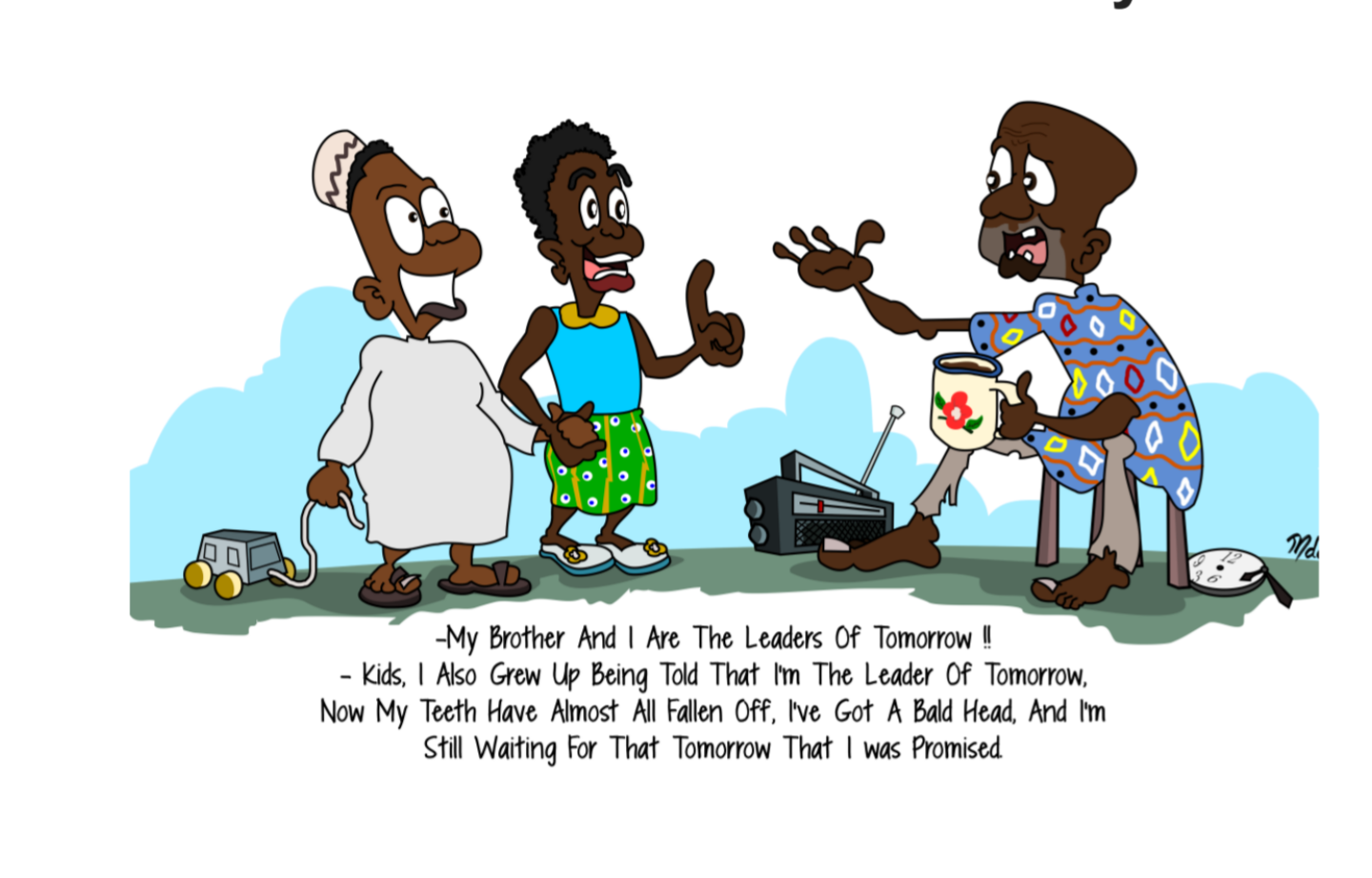
Cartoon by Bwana Mdogo.

more recommended stories
 TAITA TAVETA: SEVEN DAYS HAVE ELAPSED — HAS SENATOR KAJWANG SENT WAKUJAA’S GOVERNMENT FILES TO EACC?
By Kwaela News Network (KNN).
 MZIMA II WATER PROJECT: KSh 50.6 BILLION COASTAL PIPELINE MOVES CLOSER TO IMPLEMENTATION
Chinese firm identified as proposed developer.
 Nairobi in Darkness as Government Billing Dispute Leaves Residents Paying the Price
NAIROBI — As darkness descends on.
 RUTO CONTRADICTS HIMSELF ON FOREIGNERS: FROM “VISA-FREE AFRICA” TO A CRACKDOWN ON SMALL TRADERS
President William Ruto’s latest crackdown.
 NEW UNIFORMS, SAME OLD PROBLEMS: YOU CAN’T TAILOR INTEGRITY
President William Ruto has proudly unveiled.
 SHARON’S JUSTICE CANNOT BE BOUGHT
The latest developments in the.
 HOMA BAY VIOLENCE RAISES TROUBLING QUESTIONS ABOUT KENYA’S DEMOCRACY
The shocking violence that engulfed the.
 JUSTICE AT LAST: WHAT THE SHARON OTIENO MURDER CONVICTION MEANS FOR KENYA
After nearly eight years of.
 ALBERT OJWANG CASE: THE QUESTIONS KENYA REFUSES TO LET DIE
The death of Albert Ojwang in.
 RELIEF FOOD SCANDAL RAISES SERIOUS QUESTIONS AS INVESTIGATIONS CONTINUE
The reported recovery of hundreds.
 THE HALIMA NGACHE CASE: A COSTLY ASSAULT ON DIGITAL FREEDOM THAT DEMANDS ACCOUNTABILITY
The collapse of the case against.
 WHY FIKIRINI JACOBS MUST STEP ASIDE AS THE CECIL OUMA PROBE CONTINUES
The tragic death of 28-year-old youth.
 STOP THE KILLING, NOT MERELY COMPENSATE THE DEAD
As Kenya approaches the second.
 PRESIDENT RUTO’S FREQUENT FLYER PRESIDENCY: ARE KENYANS GETTING VALUE FOR MONEY?
President William Ruto has returned to.
 THE SINGAPORE ILLUSION: A REALITY CHECK ON THE STATE OF OUR NATION
There is an increasingly persistent.
 Could the Proposed Ebola Quarantine Facility Cost Kenya More Than It Gains?
The proposed establishment of a United.
Leave a Comment