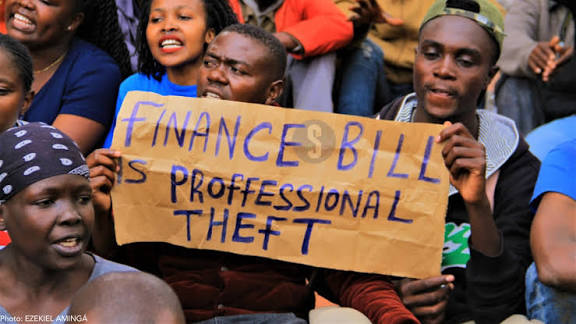
Finance Bill 2024 Protests - KENYA

When the Finance Bill, 2024 was tabled before Parliament, it was framed as a fiscal necessity — a painful but unavoidable step toward stabilising Kenya’s mounting public debt and widening budget deficit.
But for millions of ordinary Kenyans, especially young people, it felt less like reform and more like extraction.
Though the Bill was ultimately withdrawn in its original form after unprecedented nationwide protests, many of its most controversial provisions did not disappear. They resurfaced — repackaged and passed separately — through amendments to key laws such as the Income Tax Act, Value Added Tax Act, Excise Duty Act, and Tax Procedures Act.
The legislative strategy shifted. The economic burden largely remained.
And some Members of Parliament voted YES.
The youth-led protests that erupted were not spontaneous chaos. They were a constitutional expression of economic frustration.
Young Kenyans are navigating:
Against that backdrop, proposals to expand VAT, introduce eco-levies, increase excise duties, and strengthen enforcement powers of the Kenya Revenue Authority felt like a direct assault on survival.
Peaceful protest is protected under the Constitution. Violence is not. But the core grievance was grounded in reality: the cost of living was rising faster than opportunity.
No serious economist argues that taxation is inherently destructive. Governments need revenue to function. But context matters.
In a fragile economy, aggressive or poorly timed tax expansion can create indirect drag:
It reduces business expansion.
When VAT and compliance burdens increase, small and medium enterprises — the main absorbers of youth labour — delay hiring and cut investment.
It reduces household savings.
Higher consumption taxes shrink disposable income. Lower savings mean fewer resources for startup capital, education, or resilience against shocks.
It increases operational costs.
From transport to digital services to imported inputs, layered taxation squeezes margins and discourages scaling.
Taxation is rarely the sole cause of economic stagnation. Governance inefficiencies, debt servicing pressures, and global economic conditions also play major roles. But taxation can amplify existing strain — especially when trust in public spending is low.
Consider a young entrepreneur launching a small digital service, agribusiness venture, or retail startup.
They face:
The theoretical result is predictable: higher entry barriers, lower reinvestment capacity, and slower scaling.
Some retreat into informality. Others abandon expansion plans altogether.
If we are serious about youth empowerment, fiscal policy must encourage risk-taking — not penalise it.
Why, then, did some MPs vote YES?
One explanation is fiscal necessity. Kenya’s debt obligations are real. Revenue must be raised somehow.
But another explanation — perhaps more uncomfortable — is political calculation.
Party discipline, executive pressure, and the assumption that backlash would fade may have influenced decisions. Some may have believed that development funds under the National Government Constituencies Development Fund Act and the National Government Affirmative Action Fund Act would offset public anger.
That logic, however, creates a troubling paradox:
Support policies that increase extraction from citizens.
Return to the constituency distributing selective empowerment funds.
Brand it development.
Development funded by heavier taxation on the same struggling population risks becoming circular relief rather than structural progress.
Representation is not symbolic. It is fiduciary.
An MP’s primary duty is to the constituents — not to party hierarchies or executive convenience.
If an MP voted YES:
Or was the vote a matter of alignment rather than analysis?
These questions are not about political rivalry. They are about democratic responsibility.
The Finance Bill 2024 saga exposed a deeper tension in Kenya’s political economy: the struggle between fiscal consolidation and lived economic reality.
Tax policy is not abstract. It shapes whether businesses expand, whether households save, and whether youth see opportunity at home or abroad.
MPs who voted YES cannot detach themselves from the downstream effects of that decision — even if the provisions were later fragmented into separate laws.
Youth empowerment cannot exist in isolation from fiscal policy. One cannot advocate entrepreneurship while endorsing measures that increase the cost of enterprise without offering a clear and convincing justification.
The ultimate accountability mechanism is the ballot. But democracy also demands informed scrutiny between elections.
If leaders claim to champion youth development, their legislative record must align with that promise.
A “YES” vote carries weight. It carries economic consequences. And it carries responsibility.
The question is not whether revenue was needed. The question is whether the burden was fairly designed, transparently defended, and responsibly weighed against the realities of ordinary Kenyans.
That is the standard by which representation should be judged.

 TAITA TAVETA: SEVEN DAYS HAVE ELAPSED — HAS SENATOR KAJWANG SENT WAKUJAA’S GOVERNMENT FILES TO EACC?
By Kwaela News Network (KNN).
 MZIMA II WATER PROJECT: KSh 50.6 BILLION COASTAL PIPELINE MOVES CLOSER TO IMPLEMENTATION
Chinese firm identified as proposed developer.
 Nairobi in Darkness as Government Billing Dispute Leaves Residents Paying the Price
NAIROBI — As darkness descends on.
 RUTO CONTRADICTS HIMSELF ON FOREIGNERS: FROM “VISA-FREE AFRICA” TO A CRACKDOWN ON SMALL TRADERS
President William Ruto’s latest crackdown.
 NEW UNIFORMS, SAME OLD PROBLEMS: YOU CAN’T TAILOR INTEGRITY
President William Ruto has proudly unveiled.
 SHARON’S JUSTICE CANNOT BE BOUGHT
The latest developments in the.
 HOMA BAY VIOLENCE RAISES TROUBLING QUESTIONS ABOUT KENYA’S DEMOCRACY
The shocking violence that engulfed the.
 JUSTICE AT LAST: WHAT THE SHARON OTIENO MURDER CONVICTION MEANS FOR KENYA
After nearly eight years of.
 ALBERT OJWANG CASE: THE QUESTIONS KENYA REFUSES TO LET DIE
The death of Albert Ojwang in.
 RELIEF FOOD SCANDAL RAISES SERIOUS QUESTIONS AS INVESTIGATIONS CONTINUE
The reported recovery of hundreds.
 THE HALIMA NGACHE CASE: A COSTLY ASSAULT ON DIGITAL FREEDOM THAT DEMANDS ACCOUNTABILITY
The collapse of the case against.
 WHY FIKIRINI JACOBS MUST STEP ASIDE AS THE CECIL OUMA PROBE CONTINUES
The tragic death of 28-year-old youth.
 STOP THE KILLING, NOT MERELY COMPENSATE THE DEAD
As Kenya approaches the second.
 PRESIDENT RUTO’S FREQUENT FLYER PRESIDENCY: ARE KENYANS GETTING VALUE FOR MONEY?
President William Ruto has returned to.
 THE SINGAPORE ILLUSION: A REALITY CHECK ON THE STATE OF OUR NATION
There is an increasingly persistent.
 Could the Proposed Ebola Quarantine Facility Cost Kenya More Than It Gains?
The proposed establishment of a United.
Leave a Comment