
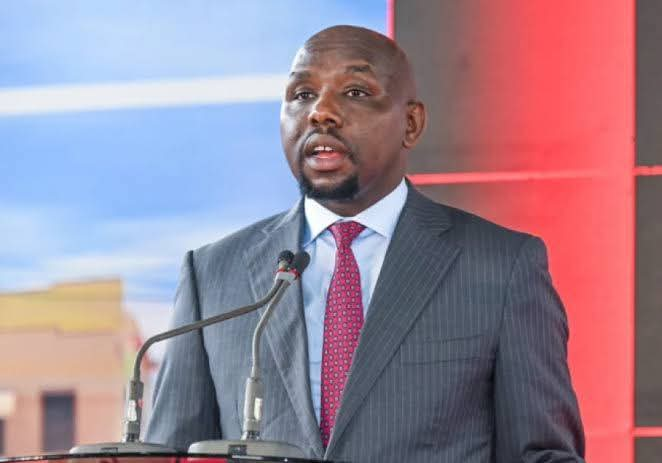
When Kipchumba Murkomen declared that police brutality “did not start three years ago… it started in 1963,” he may have intended to provide historical context. Instead, he exposed a troubling instinct: to look backward for excuses while the country bleeds in the present.
Yes, Kenya’s policing system has deep colonial roots dating back to independence in Kenya in 1963. That history is real. But invoking it now—amid fresh graves and grieving families—is not analysis. It is evasion.
Words That Carry Weight — and Consequences
During the Gen-Z protests that swept the country over economic hardship and governance concerns, Murkomen was widely reported as instructing police to shoot protesters who approached police stations. Even if later clarified, the damage was done. In a nation already tense from allegations of excessive force, such rhetoric does not calm the waters—it electrifies them.
The controversy intensified when President William Ruto publicly stated:
“They shouldn’t kill them but they should shoot their legs so they break and they can go to hospital on their way to court.”
That remark alone should have triggered immediate constitutional alarm. Kenyan law does not authorize police to maim suspects as punishment. Firearms are permitted only as a last resort to protect life. Anything beyond that crosses into illegality.
When leaders speak casually about shooting citizens—whether in the chest or in the leg—they erode the constitutional line between law enforcement and state violence.
The Law Is Clear
The High Court has previously barred unlawful use of live ammunition and excessive force during protests. Human-rights organizations such as Amnesty International and the Kenya National Commission on Human Rights have documented deaths, gunshot wounds, and allegations of extrajudicial conduct.
Against this backdrop, historical lectures about 1963 sound painfully detached.
If police brutality has existed since independence, as Murkomen argues, then that is not a defense of his tenure. It is an indictment of it. Leadership is measured not by how well one explains inherited problems, but by how decisively one confronts them.
Grief Is Not a Political Talking Point
Families who lost sons and daughters during the protests are not debating constitutional theory. They are burying children.
To them, the “1963” remark feels less like historical reflection and more like abdication. It suggests a government more comfortable distributing blame across six decades than accepting responsibility for today.
No administration inherits a perfect system. But every administration owns its response.
A Test of Accountability
If Murkomen believes police brutality predates him, then he should be leading the charge for:
- Independent investigations into protest deaths
- Transparent publication of findings
- Swift prosecution of officers who violated the law
- Clear, unambiguous directives prohibiting unlawful force
Anything less confirms the critics’ charge: that history is being used as a shield.
Kenya does not need rhetorical toughness. It needs moral clarity.
When state officials normalize the language of shooting citizens, even conditionally, they risk normalizing the act itself. And when they invoke 1963 to explain 2024 and 2025, they forget a fundamental truth:
History explains a problem.
It does not excuse its continuation.
If police brutality truly began at independence, then six decades later, the question is no longer when it started.
The question is:
Why, under your watch, does it continue?

more recommended stories
 MZIMA II WATER PROJECT: KSh 50.6 BILLION COASTAL PIPELINE MOVES CLOSER TO IMPLEMENTATION
Chinese firm identified as proposed developer.
 Nairobi in Darkness as Government Billing Dispute Leaves Residents Paying the Price
NAIROBI — As darkness descends on.
 RUTO CONTRADICTS HIMSELF ON FOREIGNERS: FROM “VISA-FREE AFRICA” TO A CRACKDOWN ON SMALL TRADERS
President William Ruto’s latest crackdown.
 NEW UNIFORMS, SAME OLD PROBLEMS: YOU CAN’T TAILOR INTEGRITY
President William Ruto has proudly unveiled.
 SHARON’S JUSTICE CANNOT BE BOUGHT
The latest developments in the.
 HOMA BAY VIOLENCE RAISES TROUBLING QUESTIONS ABOUT KENYA’S DEMOCRACY
The shocking violence that engulfed the.
 JUSTICE AT LAST: WHAT THE SHARON OTIENO MURDER CONVICTION MEANS FOR KENYA
After nearly eight years of.
 ALBERT OJWANG CASE: THE QUESTIONS KENYA REFUSES TO LET DIE
The death of Albert Ojwang in.
 RELIEF FOOD SCANDAL RAISES SERIOUS QUESTIONS AS INVESTIGATIONS CONTINUE
The reported recovery of hundreds.
 THE HALIMA NGACHE CASE: A COSTLY ASSAULT ON DIGITAL FREEDOM THAT DEMANDS ACCOUNTABILITY
The collapse of the case against.
 WHY FIKIRINI JACOBS MUST STEP ASIDE AS THE CECIL OUMA PROBE CONTINUES
The tragic death of 28-year-old youth.
 STOP THE KILLING, NOT MERELY COMPENSATE THE DEAD
As Kenya approaches the second.
 PRESIDENT RUTO’S FREQUENT FLYER PRESIDENCY: ARE KENYANS GETTING VALUE FOR MONEY?
President William Ruto has returned to.
 THE SINGAPORE ILLUSION: A REALITY CHECK ON THE STATE OF OUR NATION
There is an increasingly persistent.
 Could the Proposed Ebola Quarantine Facility Cost Kenya More Than It Gains?
The proposed establishment of a United.
-
RUTO’S HAMMER POLITICS: WHY KENYA CANNOT BE GOVERNED THROUGH ENDLESS PUBLICITY TOURS
“If your only tool is.
Leave a Comment