
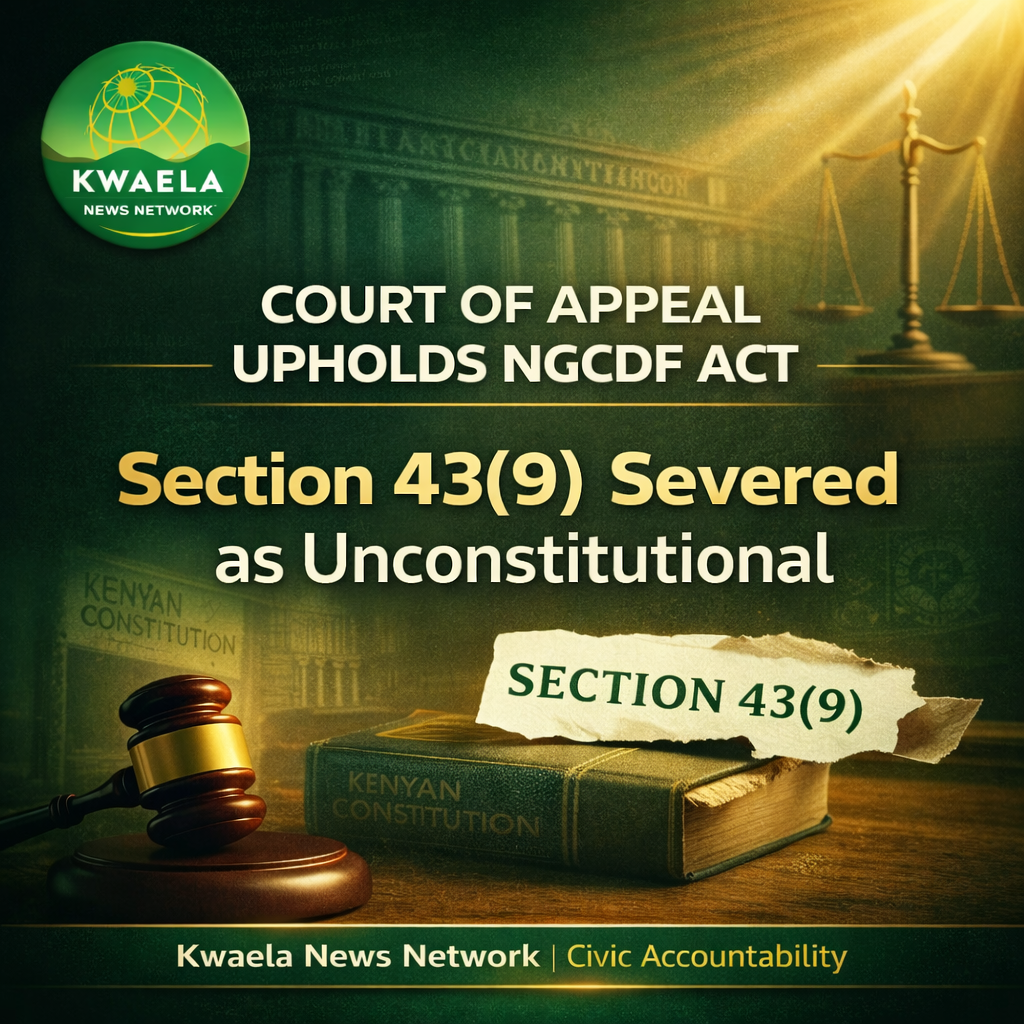
Nairobi — The Court of Appeal has delivered a far-reaching judgment affirming that the National Government Constituencies Development Fund (NGCDF) framework is unconstitutional, dealing a major blow to one of Kenya’s most entrenched development financing instruments.
In a detailed judgment delivered by a three-judge bench comprising Justice Daniel Musinga (P), Justice Sankale Ole Kantai Tuiyott, and Justice Fatuma Sichale Muchelele, the Court dismissed appeals filed by the National Assembly and the National Government Constituencies Development Fund Board, effectively upholding the High Court’s September 2024 decision that invalidated the NGCDF Act, 2015 — even after its 2022 and 2023 amendments.
Background of the Case
The litigation originated from Constitutional Petition No. 178 of 2016, filed by governance advocates Wanjiru Gikonyo and Cornelius Oduor Opuot, who challenged the constitutionality of the NGCDF Act, 2015. The petition argued that the Fund was merely a repackaged version of the earlier Constituencies Development Fund (CDF) which had already been declared unconstitutional.
The High Court agreed with the petitioners and ruled that the NGCDF Act violated core constitutional principles, including devolution, separation of powers, public finance management, and division of functions between national and county governments. That ruling suspended the invalidity of the Act until 30 June 2026 to allow ongoing projects to conclude.
The National Assembly and the NGCDF Board appealed the decision, arguing that amendments made in 2022 and 2023 had cured all constitutional defects.
Key Issues Before the Court of Appeal
The Court of Appeal framed seven central issues, including:
-
Whether the 2022 and 2023 amendments rendered the case moot
-
Whether the Fund undermines devolution and creates a parallel governance structure
-
Whether Members of Parliament still exercise unconstitutional influence over the Fund
-
Whether the Fund violates public finance principles
-
Whether Senate concurrence was required during enactment
-
Whether striking down the entire Act was excessive
Court Rejects “Mootness” Argument
The appellate court firmly rejected the argument that the amendments had rendered the petition moot. It held that although some contested provisions were repealed, the core constitutional controversy remained unresolved.
The Court noted that:
-
The National Assembly still retained approval and veto powers over appointments to the NGCDF Board
-
Constituency-level structures remained politically tethered to the life of Parliament
-
Parliamentary influence over budgeting and governance of the Fund persisted
These features, the Court found, meant that parliamentary control over an executive development fund continued in substance, if not in form.
Devolution and Division of Functions Undermined
The Court reaffirmed that Kenya’s Constitution recognizes only two levels of government — national and county. It held that the NGCDF framework effectively introduces the constituency as a third, informal service-delivery unit, resulting in:
-
Confusion over responsibility for projects
-
Duplication of county and national functions
-
Wasteful use of public resources
-
Weak accountability mechanisms
The Court emphasized that development and service delivery are constitutionally vested in executive structures, not legislators.
Separation of Powers Violated
On separation of powers, the Court was unequivocal:
Parliament’s role is legislation, representation, and oversight, not implementation.
Even indirect or “shadow” involvement of Members of Parliament in development projects was found to:
-
Compromise Parliament’s oversight role
-
Create conflicts of interest
-
Erode constitutional checks and balances
The Court warned that allowing legislators to influence project implementation “from the shadows” fundamentally undermines constitutional governance.
Public Finance Principles Breached
The Court further held that the NGCDF violates Articles 201 and 218 of the Constitution, particularly by:
-
Allowing allocation of funds to a national agency before the vertical division of revenue between national and county governments
-
Creating parallel administrative and project-implementation structures
-
Encouraging duplication of funding and expenditure
It reaffirmed that all national government agencies must be funded strictly from the national government’s equitable share, after the Division of Revenue Act is passed.
Senate Participation Was Mandatory
Despite arguments to the contrary, the Court held that the NGCDF Act affects the architecture of devolution and therefore required Senate participation during enactment. Failure to involve the Senate rendered the legislative process unconstitutional.
Final Orders
The Court of Appeal dismissed both appeals and upheld the High Court’s orders in full:
-
The NGCDF Act, 2015 (as amended) is unconstitutional
-
The NGCDF and all its programmes must cease operations by midnight, 30 June 2026
-
Funds already allocated for the current financial cycle may be utilized as scheduled
-
Each party shall bear its own costs
Why This Judgment Matters
This decision is one of the most consequential rulings on governance since the 2010 Constitution. It firmly closes the door on legislative-driven development funds and reasserts:
-
The supremacy of devolution
-
The strict separation between law-making and execution
-
Fiscal discipline and accountability in public finance
For communities long accustomed to MP-controlled development projects, the ruling signals a major structural shift — one that places responsibility squarely back on constitutionally mandated executive institutions.
Kwaela News Network will continue to track the implications of this ruling and its impact on governance, accountability, and service delivery across the country.

more recommended stories
 TAITA TAVETA: SEVEN DAYS HAVE ELAPSED — HAS SENATOR KAJWANG SENT WAKUJAA’S GOVERNMENT FILES TO EACC?
By Kwaela News Network (KNN).
 MZIMA II WATER PROJECT: KSh 50.6 BILLION COASTAL PIPELINE MOVES CLOSER TO IMPLEMENTATION
Chinese firm identified as proposed developer.
 Nairobi in Darkness as Government Billing Dispute Leaves Residents Paying the Price
NAIROBI — As darkness descends on.
 RUTO CONTRADICTS HIMSELF ON FOREIGNERS: FROM “VISA-FREE AFRICA” TO A CRACKDOWN ON SMALL TRADERS
President William Ruto’s latest crackdown.
 NEW UNIFORMS, SAME OLD PROBLEMS: YOU CAN’T TAILOR INTEGRITY
President William Ruto has proudly unveiled.
 SHARON’S JUSTICE CANNOT BE BOUGHT
The latest developments in the.
 HOMA BAY VIOLENCE RAISES TROUBLING QUESTIONS ABOUT KENYA’S DEMOCRACY
The shocking violence that engulfed the.
 JUSTICE AT LAST: WHAT THE SHARON OTIENO MURDER CONVICTION MEANS FOR KENYA
After nearly eight years of.
 ALBERT OJWANG CASE: THE QUESTIONS KENYA REFUSES TO LET DIE
The death of Albert Ojwang in.
 RELIEF FOOD SCANDAL RAISES SERIOUS QUESTIONS AS INVESTIGATIONS CONTINUE
The reported recovery of hundreds.
 THE HALIMA NGACHE CASE: A COSTLY ASSAULT ON DIGITAL FREEDOM THAT DEMANDS ACCOUNTABILITY
The collapse of the case against.
 WHY FIKIRINI JACOBS MUST STEP ASIDE AS THE CECIL OUMA PROBE CONTINUES
The tragic death of 28-year-old youth.
 STOP THE KILLING, NOT MERELY COMPENSATE THE DEAD
As Kenya approaches the second.
 PRESIDENT RUTO’S FREQUENT FLYER PRESIDENCY: ARE KENYANS GETTING VALUE FOR MONEY?
President William Ruto has returned to.
 THE SINGAPORE ILLUSION: A REALITY CHECK ON THE STATE OF OUR NATION
There is an increasingly persistent.
 Could the Proposed Ebola Quarantine Facility Cost Kenya More Than It Gains?
The proposed establishment of a United.
Leave a Comment