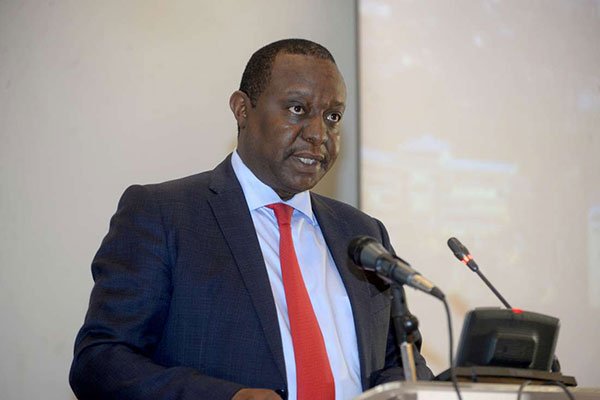
Former National Treasury Cabinet Secretary Henry Rotich.

By JAINDI KISERO
The mystery surrounding the Arror and Kimwarer dams keep deepening by the day. The latest revelations of the scam is contained in a new edition of the external debt register tabled before the Senate Committee on Budget and Planning last week.
STAGGERING AMOUNT
The register is usually a well-guarded secret in the National Treasury, only giving the information in drips and drabs. As a matter of fact, what was tabled before the Senate was a mere summary. It fell way short of disclosing specific projects funded by specific borrowings.
I found myself diving into the register to scrutinise the disclosures on one of the most burning issues of the day — the multi-billion-shilling Arror and Kimwarer dam loans.
Before I say what I discovered, here is some background on some of the things the National Treasury had disclosed on the loans before that latest version of the register came out.
On February 28, then-National Treasury Cabinet Secretary Henry Rotich put out a widely publicised statement in which he disclosed the names of Italian banks that had lent the government money for the two dams.
According to Mr Rotich, the four banks were BNP Paribas, Fortis SAINV, Intesa San Paolo Spa and Uni Credit SPS, as well as Unit Credit Bank AG of Australia.
I looked through the external debt register to see the amount of money which the government withdrew from these four Italian banks last year. The numbers I found there were staggering, to say the least.
SYNDICATED LOANS
As at September 30, Kenya had withdrawn a whopping Sh66.3 billion from these four banks. It seems the amount of money at risk in the Arror and Kimwarer scandal may turn out to be much more than we had all along assumed.
The second disclosure I found pertinent is that, contrary to the information contained in the February 28 statement by the National Treasury, the loans were funded by a syndicate of commercial banks in which the lead syndicate member was a bank by the name Intesa San Paolo.
The register shows clearly that the government withdrew a whopping Sh35.5 billion from the London branch of that bank last year.
In addition, the government withdrew Sh28 billion from UniCredit Spa and Sh991 million from Uni Credit.
Which begs the questions: Can somebody tell us where, and on what, these billions of shillings have been spent in view of the fact that the projects have not commenced?
Where are the revenue-generating assets from which repayments of the Sh66 billion loan will come from?
Other pertinent issues from the new revelations in the register are the following:
BLATANT LIE
First, it has now emerged that, contrary what the government has been saying, the Italian government had very little to do with the loans. Indeed, the name of the entity, SACE, whose name has been touted as the Italian export credit agency involved in the loans, does not appear in our external debt register.
Thus, when they tell you that the Arror and Kimwarer loans were part of a government-to-government arrangement, they are telling you a blatant lie. This was a syndicated loan — plain and simple.
There is a strong case, indeed, for more transparency in negotiation of syndicated loans. The trend in Africa today is that, where looting of funds borrowed from abroad have occurred, the avenue is opaquely negotiated syndicated loans.
In the famous Tuna bond scandal in Mozambique, we saw criminal charges being pressed in a London court on senior bank officials who had participated in arranging a syndicated loan.
The trend is all too familiar. First, an African country borrows a syndicated loan. On maturity, typically in two years, they have no money to pay back. The stage is then set for the syndicate bank to the international capital markets to arrange a Eurobond.
LITTLE IMPACT
On maturity, the African country does not have money to pay back the Eurobond and has to go back to the syndicate banks to arrange for another set of syndicated loans
We have seen it happen in Kenya, Mozambique, Ghana and Angola.
We have been borrowing heavily for projects of little economic impact — such as loans to procure equipment for the National Youth Service (NYS) and purchase drilling materials, as well as buying MRI equipment.
We are taking out expensive commercial loans to procure electricity materials, rehabilitation of technical institutes, modernisation of Kenya Power distribution systems and building Kenyatta University.
The government should slap a freeze on commercial debts until the time when we will have developed an accurate and comprehensive register for all the expensive commercial debts the government has contracted in the past ten years.

 TAITA TAVETA: SEVEN DAYS HAVE ELAPSED — HAS SENATOR KAJWANG SENT WAKUJAA’S GOVERNMENT FILES TO EACC?
By Kwaela News Network (KNN).
 MZIMA II WATER PROJECT: KSh 50.6 BILLION COASTAL PIPELINE MOVES CLOSER TO IMPLEMENTATION
Chinese firm identified as proposed developer.
 Nairobi in Darkness as Government Billing Dispute Leaves Residents Paying the Price
NAIROBI — As darkness descends on.
 RUTO CONTRADICTS HIMSELF ON FOREIGNERS: FROM “VISA-FREE AFRICA” TO A CRACKDOWN ON SMALL TRADERS
President William Ruto’s latest crackdown.
 NEW UNIFORMS, SAME OLD PROBLEMS: YOU CAN’T TAILOR INTEGRITY
President William Ruto has proudly unveiled.
 SHARON’S JUSTICE CANNOT BE BOUGHT
The latest developments in the.
 HOMA BAY VIOLENCE RAISES TROUBLING QUESTIONS ABOUT KENYA’S DEMOCRACY
The shocking violence that engulfed the.
 JUSTICE AT LAST: WHAT THE SHARON OTIENO MURDER CONVICTION MEANS FOR KENYA
After nearly eight years of.
 ALBERT OJWANG CASE: THE QUESTIONS KENYA REFUSES TO LET DIE
The death of Albert Ojwang in.
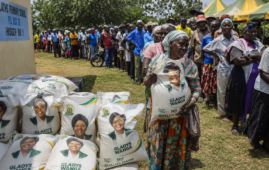 RELIEF FOOD SCANDAL RAISES SERIOUS QUESTIONS AS INVESTIGATIONS CONTINUE
The reported recovery of hundreds.
 THE HALIMA NGACHE CASE: A COSTLY ASSAULT ON DIGITAL FREEDOM THAT DEMANDS ACCOUNTABILITY
The collapse of the case against.
 WHY FIKIRINI JACOBS MUST STEP ASIDE AS THE CECIL OUMA PROBE CONTINUES
The tragic death of 28-year-old youth.
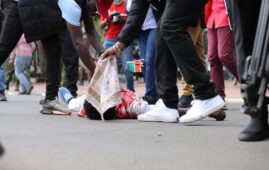 STOP THE KILLING, NOT MERELY COMPENSATE THE DEAD
As Kenya approaches the second.
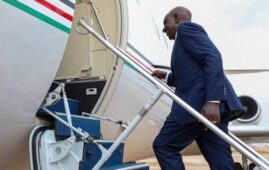 PRESIDENT RUTO’S FREQUENT FLYER PRESIDENCY: ARE KENYANS GETTING VALUE FOR MONEY?
President William Ruto has returned to.
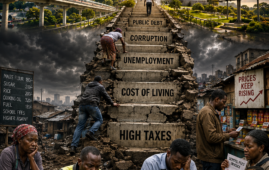 THE SINGAPORE ILLUSION: A REALITY CHECK ON THE STATE OF OUR NATION
There is an increasingly persistent.
 Could the Proposed Ebola Quarantine Facility Cost Kenya More Than It Gains?
The proposed establishment of a United.
Leave a Comment