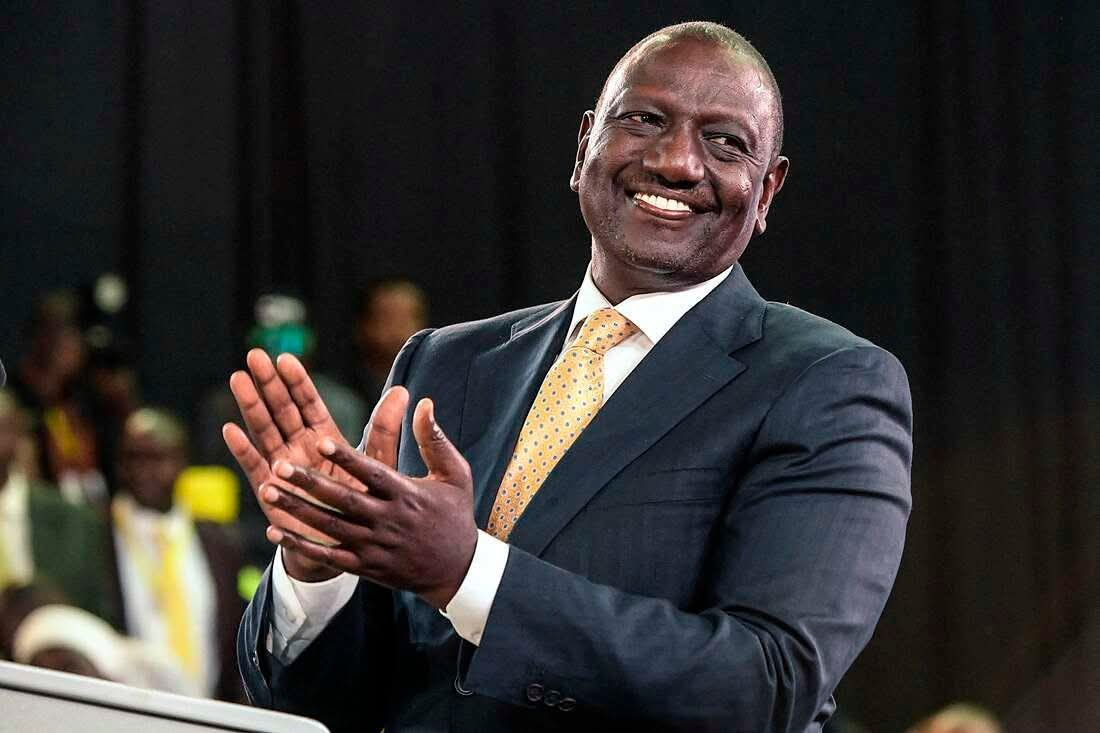
President William Samoei Ruto

In Kenya, the concept of motivation crowding — where external incentives intended to encourage behavior actually undermine intrinsic motivation—can be observed in both political and everyday contexts.
Take the current governance landscape under President William Ruto. While the government touts initiatives like road construction and affordable housing, critics argue these are often used to distract from systemic corruption. The recent SHA scandal, in which millions of shillings meant for public projects were allegedly embezzled by political allies, is a glaring example.
Kenyans must remain steadfast in calling for good governance, demanding accountability, and rejecting attempts to justify mismanagement through development projects. Development alone cannot replace bad governance, and projects undertaken should never be used to obscure corruption, impunity, or neglect of public grievances.
Real, positive change comes from addressing the issues raised by the public — respecting human dignity, upholding transparency, and ensuring justice. On these fronts, President Ruto has largely failed. Citizens must insist that governance focuses on integrity, not mere optics, and that development serves the people rather than the political image of the leadership.
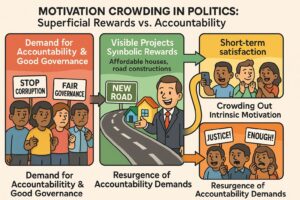
Here, the promise of “visible development” acts as an external incentive meant to boost public support. Yet, it can crowd out citizens’ intrinsic motivation to hold leaders accountable. Ordinary Kenyans, facing rising costs of living, unemployment, and insecurity, may feel manipulated into celebrating token achievements while overlooking deeper governance failures. Reports of abductions of youth participating in peaceful demonstrations, and even targeted killings of outspoken bloggers like Albert Ojwang, highlight how coercion and fear are used alongside incentives to manage public perception.
The concept of motivation crowding is not confined to politics. In everyday life, it manifests in subtler ways. Parents sometimes give children money to read books or complete household chores. While the intention is positive, studies show that external rewards can reduce children’s intrinsic interest in learning or helping at home. In extreme cases, parents may feel pressured to spend money to “buy” compliance, leading to stress and resentment rather than motivation.
Conclusion: Citizens Must Stay Vigilant

 THE POWER OF KSH 50: WHY SIFUNA MUST KEEP ASKING KENYANS TO INVEST IN THEIR POLITICAL FUTURE
The Benjamin Franklin Effect, grassroots financing.
SIFUNA, LINDA MWANANCHI AND THE SEARCH FOR A NEW POLITICAL CHAPTER: IS KENYA WITNESSING THE EMERGENCE OF A DIFFERENT KIND OF LEADERSHIP?KENYA POLITICS | 30 OCTOBER 2026.
 Where the Rain Started Beating President Ruto
By Nathaniel Noti, former Taita.
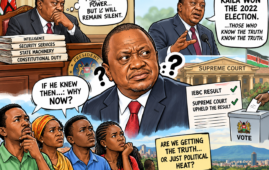 THE QUESTIONS UHURU KENYATTA CANNOT ESCAPE
Former President Uhuru Kenyatta’s declaration.
 THE POLITICS OF DECEPTION, CONTRADICTION AND POLITICAL REINVENTION OF HON MWASHAKO
A couple of days ago,.
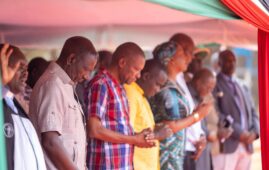 WHEN ELECTIONS NEAR, THE SAINTS RETURN: HOW KENYA’S CHURCHES BECAME CAMPAIGN ARENAS
Every election cycle in Kenya.
 THE VERMIN OF TRIBALISM & POLITICS OF ENTITLEMENT
The word Murima has forced.
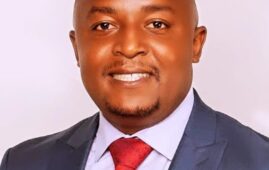 UDA MUST RETHINK, REPLAN AND RE-EXECUTE ITS STRATEGY IN TAITA TAVETA
Over the past several months, the.
 WHEN GOOD POLICIES DON’T DELIVER: WHY IMPLEMENTATION MATTERS MORE THAN WE THINK
Strong policies create direction, but implementation.
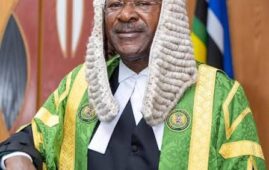 THE 186 MPs WHO ABSCONDED TO VOTE FOR THE FINANCE BILL 2026/27
Every five years, Kenyans troop.
 SOCIAL MEDIA: THE BATTLEGROUND THAT WILL DEFINE THE 2027 ELECTIONS
The digital revolution has fundamentally.
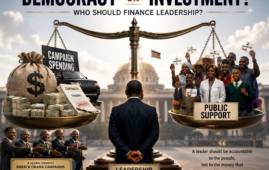 CAMPAIGN FINANCING AND THE MYTH OF THE WEALTHY SAVIOUR: WHAT KIND OF LEADERSHIP DOES DEMOCRACY NEED?
As political campaigns gather momentum,.
 Ulimwengu wa Universalism na Kuibuka kwa Ufahamu Mpya wa Kisiasa Afrika: Jinsi Gen Z wa Kenya Wanavyobadilisha Mwelekeo wa Siasa za Afrika
Barani Afrika, dhana ya universality au.
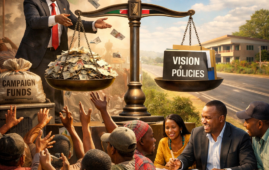 WHEN LEADERSHIP BECOMES AN INVESTMENT: WHY KENYA MUST RETHINK CAMPAIGN SPENDING
In an ideal democracy, leadership.
 THE SENATE NEEDS EXPERIENCE, NOT EXPERIMENTS: WHY ENG. JOHN MTUTA MRUTTU IS THE RIGHT CHOICE
In moments when a county stands.
 Mwadime Joins UDA: Strategic Realignment or Political Gamble in Taita Taveta?
The political landscape of Taita Taveta.
Leave a Comment