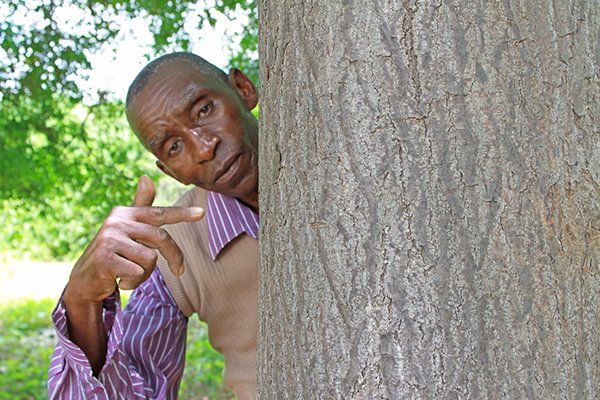
Farmers say while the tree shade stops the sun scorching crops, the dew that falls from the leaves at night keeps soil moist and the branches act as a buffer against wind storms making crops to thrive. And when its leaves fall and rot, they add essential nutrients to the soil.
In Kenya, it grows in Kitui, Machakos, Embu, Taita-Taveta, Samburu, Isiolo, Makueni, Marsabit and Mandera counties.
These ecological zones range from 400 metres to 1,650 metres above sea level and have annual rains of less than 400mm.
Known as mukau in Kamba, this is one of the most important trees in its native lands. It not only provides income to farmers but also plays a key role in food production.
Apart from its quality timber, mukau’s other benefits include offering medicine, fodder, fuel wood, bee forage and manure. It is used for mulching and intercropping and it controls soil erosion.
Medicine
Farmers believe its leaf fodder is of high quality for both cattle and goats. It is pruned for fodder towards the end of the dry season, a time when feeds are scarce.
The fruit pulp and leaves are reported to contain up to 10 per cent fat and 21 per cent protein. Branches are used for firewood although it produces an unpleasant smoke.
The wood is easily worked and shaped, making it suitable for making acoustic drums, containers and mortars and is decay resistant. It is also resistant to attack by borers.
Currently, a foot of the hardwood costs between Sh70 and Sh80 in the market, one of the most expensive. The Kamba use it to make log hives and its flowers provide excellent bee forage.
Food production
The tree is compatible with almost all crops. The Thomson Reuters Foundation has sponsored a mukau intercropping project in eastern Kenya that has been hugely successful.
Farmers say while the tree shade stops the sun scorching crops, the dew that falls from the leaves at night keeps soil moist and the branches act as a buffer against wind storms making crops to thrive. And when its leaves fall and rot, they add essential nutrients to the soil.
Propagation
Mukau is mostly propagated by seedlings. At Kefri, seeds cost Sh6,000 a kilogramme. In private nurseries, seedlings sell at an average of Sh50 each. But its seedlings are difficult to produce due to the hard cuticle that covers seeds.
To improve germination, it is necessary to nip the tip of the seed and soak in cold water for 24 hours. According to Kefri’s Seed Handbook of Kenya, this process, known as scarification, allows the seed embryos to absorb sufficient water for germination.
But it is time-consuming and labour-intensive, so experts have been researching on alternative methods of propagation such as root cuttings, root suckers and wildings. Results have actually shown that the tree grows faster if propagated using root suckers.
A report of a study carried out in Kibwezi, Melia volkensii in Kenya: Current domestication and improvement programme by Kefri scientists Kimondo, J.M., Kigwa, B.K. and Mbuvi, M.T.E. obtained good results. More than 90 per cent success rate was realised and the main limiting factor in the use of the method is the availability of stock.
Another study in Kitui by Kefri with the support of the Japan International Cooperation Agency (Jica), Development of Drought Tolerant Trees for Adaptation to Climate Change in Drylands of Kenya, also led to faster propagation of the tree through vegetation.
Kefri has also attempted to raise mukau through stem cuttings and tissue culture with limited success.
Management
There are no serious pests and diseases known to attack this tree. Indeed, the only natural enemies when it is still young are goats, which damage it through browsing and trampling.
According to Kefri’s Growing Melia volkensii: A guide for farmers and tree growers in the drylands, mukau takes eight to 10 years to be ready for harvesting.
This period can be shortened by up to two years in regions with higher annual rainfalls.
more recommended stories
KEEP SNAKES OUT: PROVEN TIPS TO PROTECT YOUR HOME IN TROPICAL AREASLiving in tropical regions comes with.
EJF Condemns Coast Water Works Over Violations of Taita Taveta Residents’ Water RightsThe Economic Justice Forum (EJF) strongly.
FLOOD DISASTER IN NAIROBI EXPOSES DEEP GOVERNANCE FAILURES AND URBAN PLANNING NEGLECTThe devastating floods that struck.
TSAVO NATIONAL PARK CRISIS: THE JUDICIAL FAILURE PUTTING OUR LAND AT RISK1. Overview Tsavo National Park—one.
TAITA TAVETA’S HUMAN-WILDLIFE CRISIS: A LONG-IGNORED TRAGEDYFor generations, residents of Taita Taveta.
GARBAGE COLLECTION IN VOI SUB COUNTY; A REFLECTION OF ADMINISTRATIVE FAILURETruth be told, Voi, the.
UZEMBE WA GAVANA MWADIME NA BODI ZAKE ZA MANISPAALicha za manispaa ya Taveta.
ICONIC STONE BROUGHT DOWNBy Innocent Kirigha It’s saddening to.
TAITA HILLS ARE ON FIRE; LETS STOP THIS DISASTER!The hills of Taita are on.
IN NGANGAO FOREST, KENYA, ENVIRONMENTAL PROTECTION ON A RIDGE LINEFailing to obtain the support of.
TWO KEY TAITA TAVETA DAMS DRY UP, THREATENING WELLBEING OF HUMANS, WILDLIFEBy Lucy Mkanyika Asworld leaders gather.
WATER SOURCES DRY UP AS DROUGHT RAVAGES TAITA TAVETABy Solomon Muingi The prolonged drought.
LIVESTOCK DEATHS RAISE IN DROUGHT HIT TAITA TAVETABy Arnold Linga Masila In fair.
MINERS SUFFER AS KSH 50 M GEMOLOGY CENTRE LIES IDLEIn the gemstone-mining fields of Taita.
CONCERN OVER ALGAE INFESTATION IN KISHENYI DAMKishenyi Dam in Wundanyi has been.
IT’S NOW MAN VS BEAST AS THOUSFACE STARVATIONANDSIt’s mid-morning at Nkaroni village in.

Leave a Comment