
An Investigative Exposé by Kwaela News Network
The Cost of a Captured Procurement System
Across Kenya, public procurement has quietly become one of the most effective tools for looting public resources. While government rhetoric speaks of development and reform, audit reports, anti-corruption investigations and on-the-ground realities tell a different story: inflated contracts, politically connected contractors, routine kickbacks and projects that stall once money changes hands.
Multiple national audits and investigations consistently identify procurement as the single largest corruption risk in government, accounting for the majority of lost development funds. Allegations that contractors must surrender 10–20 per cent of contract values as kickbacks are not isolated rumours — they are reflected in the outcomes: overpriced projects, poor workmanship, endless variations and outright abandonment.
Taita Taveta County provides a stark, traceable case study of how this system works in practice.
Taita Taveta County: Development on Paper, Failure on the Ground
Official audit reports, county budget documents, media investigations and EACC prosecutions reveal a troubling pattern in Taita Taveta County:
- Projects are budgeted and contracted
- Funds are released and paid
- Works stall, delay or collapse
- Accountability disappears
This exposé documents specific stalled, abandoned and delayed projects, the amounts paid, and the public value lost.
County Audit Trail: Money Spent, Value Missing
Audits of the Taita Taveta County Executive reveal that at least seven development projects were formally classified as stalled, abandoned, incomplete or completed but not in use.
- KSh 44.98 million had already been paid to contractors
- The county failed to provide sufficient documentation to justify the expenditure
- Auditors could not confirm value for money
These figures represent only projects captured in audit schedules — not the full scale of stalled development across the county.
The Projects: Where the Money Went
1. The KSh 2 Billion Road That Took Years to Move
Project: Mtomwagodi–Mbale–Wundanyi–Werugha–Mghange–Bura Road
Contract value: ~KSh 2 billion
Status: Stalled for years, partial resumption
Launched in 2017, this 54-kilometre road was meant to unlock agricultural and economic potential across the county. Instead, it became a case study in procurement failure. Contractors repeatedly downed tools citing non-payment, while communities endured years of impassable roads.
Delays inflated costs, eroded economic benefits and raised serious questions about contract structuring, supervision and cash-flow planning.
2. The KSh 100 Million Banana Factory That Never Opened
Project: Taveta Banana Processing Plant
Value: ~KSh 100–110 million (largely donor-funded)
Status: Incomplete, vandalised, non-operational
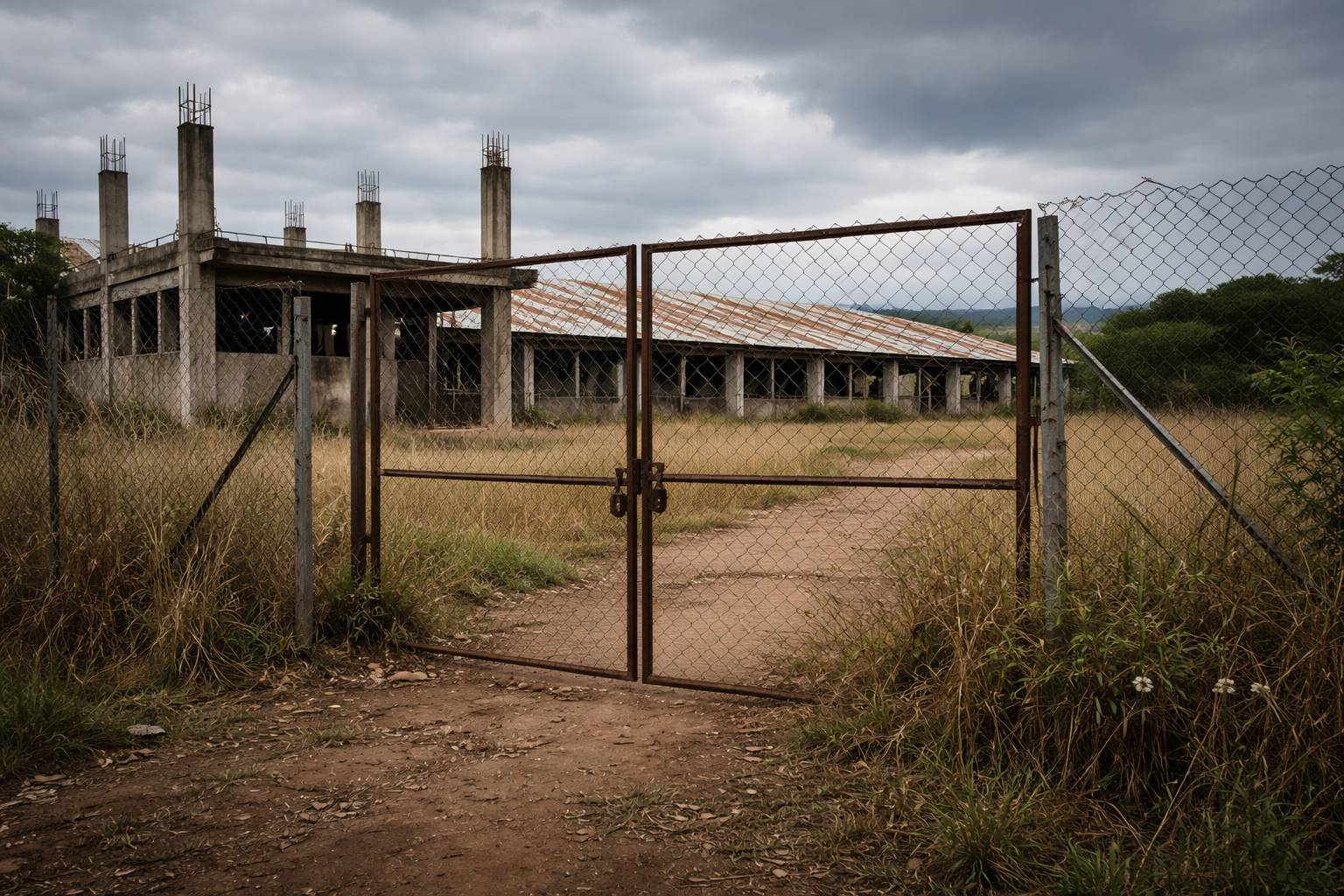
Touted as a game-changer for over 6,000 banana farmers, the Taveta banana processing plant stands today as a concrete shell. Construction stalled at roughly 70–85 per cent completion. Equipment was never installed. Operations never began.
Farmers were left selling produce to brokers at throwaway prices while public assets deteriorated in the open.
3. Kimorigo Rice Milling Plant: Built, Then Abandoned
Value: ~KSh 45 million
Status: Idle
The Kimorigo rice mill followed a familiar script: construction completed, public ceremonies held, and then silence. Years later, the plant remains idle, denying farmers a ready market and value addition while public funds sit locked in unusable infrastructure.
4. Ngerenyi High Altitude Training Centre: A Sports Dream That Stalled
Project: Ngerenyi High Altitude Training Centre
Estimated allocations: KSh 40–50 million across financial years
Status: Incomplete / non-operational
Planned as a high-altitude athletics hub, the Ngerenyi facility received repeated budget allocations. Yet satellite imagery and field assessments show no completed track, no functional training infrastructure and no operational centre.
Money was committed. Outcomes never materialised.
5. University Projects Worth Half a Billion, Still Incomplete
Auditor-General reports on Taita Taveta University expose one of the most serious cases of stalled public investment in the county:
- Administration Block – KSh 345.6 million (started 2017, still incomplete)
- Mines & Mineral Processing Laboratory (Phase III) – KSh 98.85 million, delayed beyond contract period
- Water Treatment Plant & Dairy Shed – KSh 3.59 million, stalled
In total, over KSh 503 million is tied up in delayed university projects, constraining learning, inflating costs and undermining public confidence.
—
6. Mwatate Access Road: 89% Done, 100% Useless
Project: Mwatate Municipality access road and public works
Contract value: KSh 48.16 million
Paid: ~KSh 40 million
Status: Stalled
Despite being nearly complete, the project stalled due to funding and coordination failures, leaving residents without full benefit and exposing weaknesses in project closure and supervision.
7. Mega Projects That Collapsed Before Take-Off
- Taita Taveta–Njukini PPP Roa. Proposed value: KSh 7.9 billion — Cancelled
- State–County Water Project Estimated value: KSh 750 million — Stalled due to disputes
These failures point to deeper issues in planning, governance and inter-governmental coordination.
A Pattern, Not Accidents
Individually, each stalled project could be blamed on funding delays or technical challenges. Collectively, they reveal a pattern:
- Contracts awarded without realistic financing plans
- Weak oversight after payments are made
- No personal consequences for failure
- Communities absorbing the cost
This is not poor luck. It is a system that rewards spending money, not delivering results.
The Real Cost: Citizens Pay Twice
Residents of Taita Taveta pay twice for failed procurement:
1. As taxpayers, funding projects that never work.
2. As citizens, denied services those projects were meant to provide
Farmers lose markets. Students lose facilities. Athletes lose opportunities. Roads remain impassable.
Conclusion: Accountability or Permanent Stagnation
Taita Taveta County is not unique — it is exposed. Its stalled projects mirror failures across Kenya’s counties and ministries.
Until procurement stops being a tool for rent extraction and becomes a system for delivery, stalled projects will remain the country’s most visible monument to corruption.
The evidence is already written in concrete, dust and abandoned buildings.

more recommended stories
 TAITA TAVETA COUNTY GOVERNMENT’S SHAME ON DISPLAY
When a county’s Chief Executive.
 GODOMA TITLE DEEDS: A HISTORIC MILESTONE MARRED BY QUESTIONS OVER ACCURACY
GODOMA – BURA, TAITA TAVETA, Residents.
 QUESTIONS MOUNT OVER APPOINTMENT OF NEW COUNTY INSPECTORATE DIRECTOR IN TAITA TAVETA
A cloud of uncertainty is.
 FROM COUNTY HALL TO PPCK: GRANTON SAMBOJA’S LEADERSHIP RECORD FACES RENEWED SCRUTINY
Former Taita Taveta Governor Granton Samboja.
 WHO IS JUSTICE AMRAPHAEL MBOGHOLI MSAGHA? THE TAITA SON WHO ROSE TO THE SUMMIT OF KENYA’S JUDICIARY
In the hills of Taita Taveta.
 Decisive Leadership, Not Polite Governance, Is What Taita Taveta Needs
By all accounts, leadership is not.
 MWANGEKA WA MALOWA
Kufuma konkala Wadawida ndewerekoghe na.
 TAITA TAVETA LANDS CECM MOVES TO COURT OVER SALARY ARREARS AND REMOVAL DISPUTE
MOMBASA, KENYA — Taita Taveta.
 MRAMBA COMMUNITY LAND: COMMUNITY DEMANDS SWIFT REGISTRATION AS LEGAL AND GOVERNANCE DISPUTES CONTINUE
Residents of the eight communities that.
 WHOSE LAND? WHOSE MONEY?
Members Demand Answers Over Qwetu Sacco’s.
 Analysis of the Auditor-General’s Findings on the County Executive of Taita Taveta (FY 2024/2025)
The Auditor-General issued a Qualified Opinion,.
 SH320 MILLION, SH8,000 A DAY: THE COSTLY FAILURE OF MAUNGU LORRY PARK
The story of Maungu Lorry.
 EACC REPORT EXPOSES IRREGULAR SPENDING AND PROCUREMENT VIOLATIONS AT TAITA TAVETA COUNTY ASSEMBLY
Voi, Kenya – The latest quarterly.
 EXPOSÉ | WATER PAID, SERVICE DENIED
Inside the payment breakdown linking TAVEVO.
 50 YEARS OF DRY TAPS: THE SHAME OF MWASOKO WATER PROJECT
How a 1975 Government Water Scheme.
 KSH 500 MILLION IN QUESTION: AUDIT EXPOSES DEEP FINANCIAL CRACKS AT TAVEVO
By Kwaela News Network Investigations Desk.
Leave a Comment