
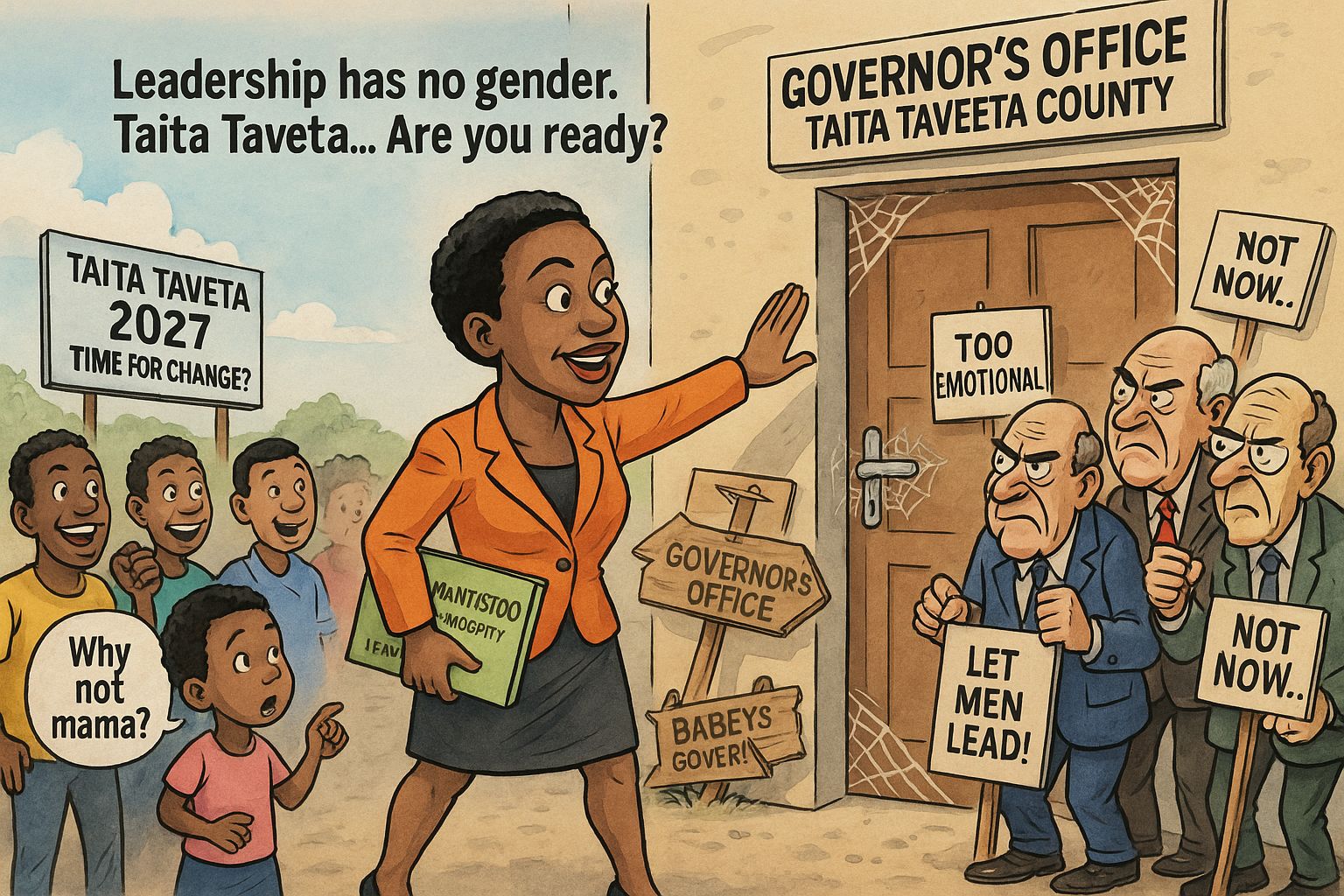
This discourse endeavours not merely to provoke debate but to engender a deeper reflection upon the sociopolitical psyche of Taita-Taveta County as it marches toward the 2027 general elections.
The promulgation of the 2010 Constitution, with its entrenchment of devolved governance, ushered in a new epoch of political pluralism wherein women ostensibly acquired parity of opportunity in contesting elective office. To redress entrenched historical imbalances, the architects of our constitutional order further prescribed the two-thirds gender principle, seeking to ensure that the machinery of governance reflected both equity and inclusivity.
Yet, while legislative fiat may legislate equality, it cannot instantaneously dismantle the subterranean cultural constructs that have, for centuries, delineated gendered roles within the public sphere. Communities, including Taita-Taveta, continue to wrestle with vestiges of patriarchy, often cloaked in the language of tradition and historical legitimacy.
The 2013 gubernatorial election provides a compelling litmus test. Hon. Jacinta Wanjala Mwatela ;an eminent daughter of Taita soil, a consummate technocrat, and the first woman to ascend to the twin heights of Deputy Governor and Acting Governor of the Central Bank of Kenya; offered herself for gubernatorial leadership on a Wiper Party ticket. Despite her sterling pedigree, she was defeated by a narrow margin.
Her credentials were not merely impressive; they were formidable.
She holds a Bachelor of Commerce degree from the University of Nairobi, having graduated in 1977.
She commenced her career at the Central Bank as a graduate trainee and, through unassailable diligence, rose to Deputy Governor in 2005 and Acting Governor in 2006.
She stewarded critical financial directorates; ranging from Banking Supervision and Financial Markets to the National Debt Registry, with a reputation for probity that few in public service can match.
She stood unflinchingly against political machinations in scandals such as Goldenberg and Charterhouse Bank, preserving the sanctity of institutional independence.
It strains credulity to suggest that one capable of presiding over macroeconomic stewardship of a trillion-shilling economy could not, with greater ease, administer a seven-billion-shilling county budget. Her integrity, vision, and moral rectitude were beyond reproach, yet the electorate demurred.
The inference is inescapable: in 2013, Taita-Taveta was not yet intellectually or culturally reconciled with the prospect of female gubernatorial authority. Whether this disposition was a matter of deliberate design or unconscious inheritance, the outcome remained the same ;a principled woman of uncommon competence was denied her rightful ascendancy.
The conversation resurfaces as 2027 looms. Some quarters now moot the candidacy of Hon. Haika Mizighi, the incumbent Woman Representative. The pertinent interrogation is thus: if Jacinta Mwatela ,with unparalleled technocratic gravitas, was repudiated by the electorate, does Hon. Haika possess the requisite acumen to surmount the same entrenched barriers?
This inquiry does not disparage her constitutional right to contest, enshrined in Article One of the supreme law, but rather underscores a sobering reality: the bar has been irrevocably elevated. Taita-Taveta cannot afford mediocrity disguised as representation. What it requires is a leader with the intellectual rigour of a corporate strategist, the moral compass of a steward, and the managerial dexterity to emancipate the county from the suffocating embrace of patronage networks.
The electorate must therefore ask itself : Taita-Taveta matured sufficiently to dismantle the shackles of patriarchal conservatism and elect a woman governor, or will 2027 merely replay the cautionary tale of 2013?
P.S Mndeke
Mkitina

more recommended stories
 TAITA TAVETA: CAN THE DCI CRACK THE NUT? DORCAS MLGHU’S PUBLIC OUTBURST PUTS COUNTY EXECUTIVE UNDER FRESH PRESSURE
The growing controversy surrounding the.
 NDARA B LAND DISPUTE: 63 RESIDENTS SERVED WITH THREE-MONTH EVICTION NOTICE FOLLOWING COURT RULING
Affected families in Mlambenyi, Golani and.
 TAITA TAVETA: WILL DEBORAH WAKESHO SUCCEED THE LATE MARGARET KAWUKI, OR WILL POLITICAL CARTELS INTERFERE?
Questions emerge over Jubilee Party’s.
 CHRISTOPHER MWAMBINGU: EACC INVESTIGATES ALLEGED FORGED DEGREE USED TO SECURE DIRECTOR OF ADMINISTRATION POSITION
A third case raises further.
 MWATATE MP RACE: RICHARD LUKINDO’S AMBITIONS AND THE UNANSWERED DEGREE QUESTION
The political stakes surrounding former.
 TAITA TAVETA: PRISONS OFFICER, NINE OTHERS ARRESTED IN MOTORCYCLE THEFT SYNDICATE PROBE
Serious questions emerge over alleged security.
 ALLEGATIONS OF HARASSMENT RETURN ALONG VOI-CALTEX ROAD CORRIDOR
Residents, motorists, and public transport operators.
 CHURU CHURU PROJECTS HAZIJENGI TAIFA
Kuna tofauti kubwa kati ya.
 BWIRE: ACCESS TO POWER IS NOT A POLITICAL MANDATE
Hon. John Bwire’s declaration that.
 RESIDENTS RAISE CONCERNS OVER ALLEGED MOTORIST HARASSMENT ALONG VOI-MOMBASA ROAD
Residents and motorists in Voi.
 THE TAITA TAVETA COUNTY ASSEMBLY’S VETTING PROCESS MUST UPHOLD THE CONSTITUTION AND PUBLIC TRUST
We, the concerned citizens of Taita.
 THE STRUCTURED POVERTY IN TAITA TAVETA
Residents demand answers after thousands.
 Taita Taveta Workers Demand Immediate Payment of Salaries and Allowances
Frustration is mounting among employees in.
 Nepotism Concerns Intensify as Family Links Dominate Senior Appointments in Taita Taveta County
Calls for transparency and fairness in.
 UNGA, POLITICS AND 2027: PS MWAMODO’S JORA VISIT SPARKS DEBATE
A food distribution exercise led by.
 Taita Taveta Residents Increasingly Question Leaders’ Priorities Amid Unresolved Challenges
What was billed as a development.
Leave a Comment