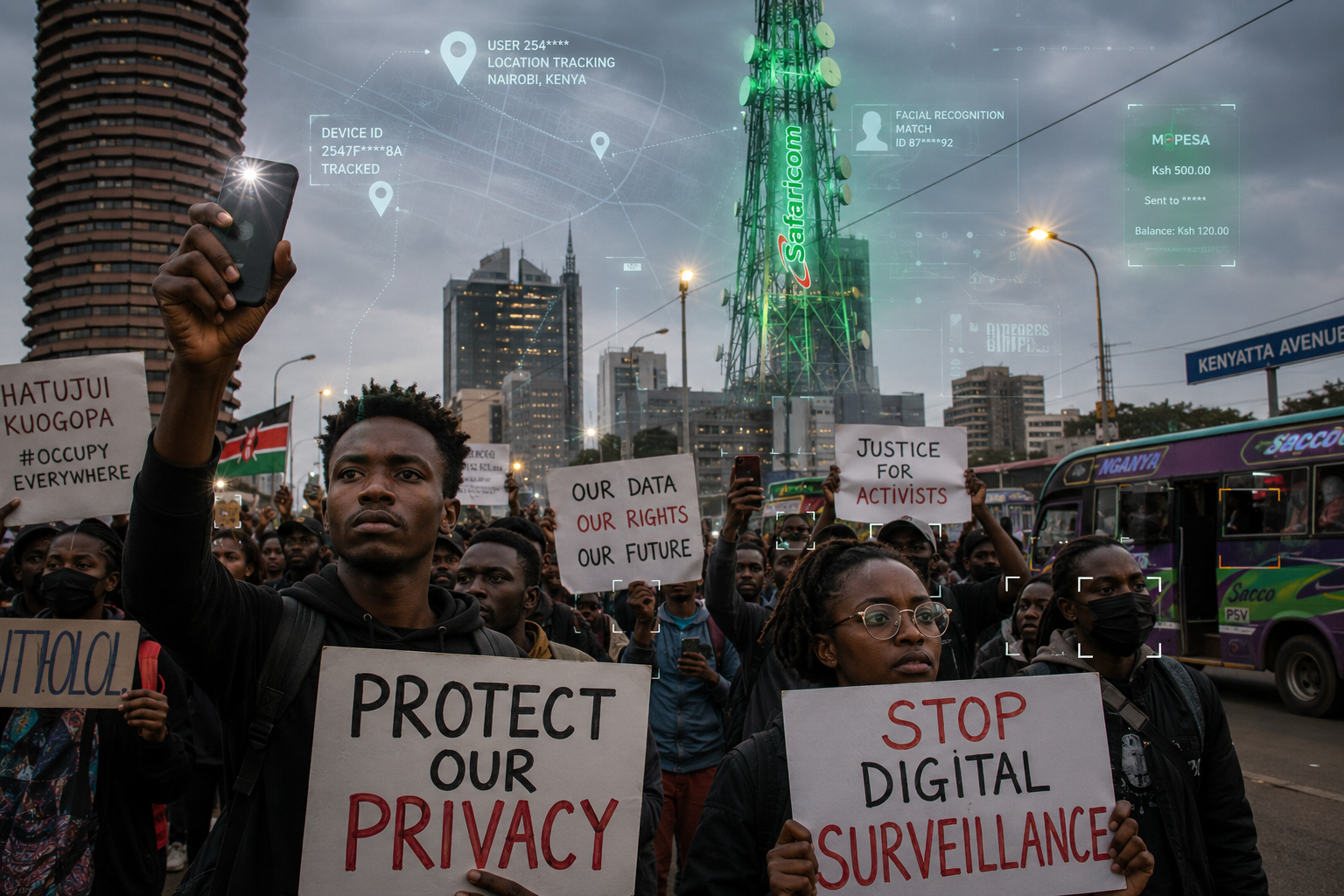
Why Kenyans Are Turning Against Safaricom Over Surveillance Fears

For years, Safaricom has enjoyed enormous public trust as Kenya’s dominant telecommunications and mobile money provider. Through M-PESA, mobile internet, voice communication and digital financial services, the company became deeply woven into the daily lives of millions of Kenyans.
Today, however, that trust is increasingly under pressure.
A growing number of Kenyans — especially young people, activists, bloggers and digital rights campaigners — are openly accusing Safaricom of enabling state surveillance and exposing citizens to security agencies. The accusations have intensified following repeated cases of arrests, alleged abductions and suspicious deaths involving government critics and online activists.
At the centre of the latest public outrage is the death of Albert Ojwang, whose case has triggered widespread anger online. Many social media users claim he was allegedly traced through telecommunications data before being arrested by officers linked to the Directorate of Criminal Investigations. Although no court has conclusively proven Safaricom’s involvement in the case, public suspicion has exploded into a broader national debate about digital privacy, surveillance and corporate accountability in Kenya.
Across social media platforms, many Kenyans now believe mobile phone data is being weaponized against citizens critical of the government.
For many young Kenyans, especially those active in online political spaces, the smartphone is no longer viewed simply as a communication tool. It is increasingly being perceived as a potential surveillance device.
This perception has severely damaged public confidence.
Calls to boycott Safaricom products — particularly M-PESA services — have started circulating online, with some activists urging citizens to:
The proposed boycott is not merely economic. It is symbolic. Many Kenyans want to send a message that privacy rights and civil liberties cannot be ignored without consequences.
Safaricom has consistently denied unlawfully sharing customer data with state agencies.
The company maintains that:
Like telecom companies worldwide, Safaricom operates under legal frameworks that may compel cooperation with law enforcement during criminal investigations and national security operations.
However, critics argue that the problem is not simply whether cooperation exists — but whether there is:
Many Kenyans now believe existing safeguards are either too weak or insufficiently transparent.
Another major issue fueling the anger is Safaricom’s enormous dominance within Kenya’s digital economy.
The company controls:
This concentration of power has created fears that too much personal, financial and communication data is held by a single private corporation.
Critics argue that such dominance creates dangerous vulnerabilities if oversight mechanisms fail or if state agencies abuse access to digital infrastructure.
The debate is therefore no longer just about one arrest or one activist.
It is about the relationship between:
Digital rights advocates and sections of civil society are now calling for sweeping reforms.
Key demands include:
Others are encouraging citizens to adopt stronger digital security practices such as:
Kenya has long positioned itself as Africa’s technology and innovation hub. But as the country becomes increasingly digitized, the debate over privacy and surveillance is becoming impossible to ignore.
The Safaricom controversy reflects a deeper national question:
Can citizens fully trust institutions that possess vast amounts of their personal and financial data?
For many Kenyans, the answer is becoming increasingly uncertain.
Whether the growing boycott calls succeed or not, one thing is already clear — public trust, once damaged, is extremely difficult to rebuild.
And in the digital age, trust may ultimately become more valuable than technology itself.

 TAITA TAVETA: WE CANNOT CONTINUE THIS WAY — A COUNTY GOVERNMENT IN CRISIS OF ACCOUNTABILITY
Kwaela News Network | Editorial Taita.
 DOCUMENT REVIEW: TAITA TAVETA COUNTY CIDP III (2023–2027)
A Review of Planned Development Priorities,.
 COVID-19 FUNDS IN TAITA TAVETA: YEARS AFTER THE AUDIT, WHO ANSWERED THE QUESTIONS — AND WHO WAS HELD ACCOUNTABLE?
As High Court reduces Rodger Ngoo’s.
 RUTO’S TAITA TAVETA TOUR: DEVELOPMENT INSPECTION OR PROMISE DELIVERY MISSION?
President William Ruto is expected to.
 VOI THIRSTS AS LEADERS TRADE STATEMENTS, EXCUSES AND BLAME
Years of promises, unpaid.
 MRUGHUA SOCIAL HALL: A DECADE OF WAITING, MILLIONS SPENT, AND STILL NO ANSWERS
Ten Years Later, Why Is.
 SIX-YEAR DEFAMATION CASE ENDS AS COURT AWARDS COSTS TO KWAELA NEWS NETWORK, BUT QUESTIONS OVER COVID-19 FUNDS REMAIN
VOI, TAITA TAVETA — A six-year.
 Family, Power and Public Trust: The Questions Governor Wakujaa Must Answer
The latest appointments in Taita Taveta.
 PETITIONERS FAIL TO PROVE OWNERSHIP OF 1,306 HECTARES AS COURT DISMISSES NDARA B LAND CASE
Case: Gadiel Mnyambo Mwaisama & Others.
 NJORO KUBWA OR MZIMA PHASE II? WEIGHING TAITA TAVETA’S BIG WATER OPTIONS
Water has long been one.
 FIRES, FEAR AND FAILURE: THE HARD QUESTIONS TAITA TAVETA SCHOOLS MUST ANSWER
A disturbing pattern is emerging in.
 PARIS JUU YA MACHOZI YETU: AIBU YA VIONGOZI WALIOSAHAU WATU WAO
Katika wakati ambapo wananchi wa.
 ISANGAIWISHI DEVELOPMENT COMMUNITY OFFICIAL STATEMENT ON LAND OWNERSHIP, HISTORICAL RECORD, AND DEVELOPMENT
1. Introduction The Isangaiwishi Development Community.
 AUDIT SHOCKER: HUNDREDS OF MILLIONS IN WORKERS’ DEDUCTIONS UNACCOUNTED FOR AS FINANCE SHAKE UP ROCKS TAITA TAVETA
By Kwaela News Network Investigations Desk.
 COURT EXPOSES ILLEGAL IMPEACHMENT: TAITA TAVETA COUNTY ASSEMBLY FAULTED FOR RUSHED, UNCONSTITUTIONAL REMOVAL OF SPEAKER MWAMBURI
Mombasa, Kenya — In a damning.
 WHY RENAMING TAITA TAVETA COUNTY TO TSAVO COUNTY IS A STRATEGIC MOVE FOR THE FUTURE
Names are more than symbols; they.
Leave a Comment