
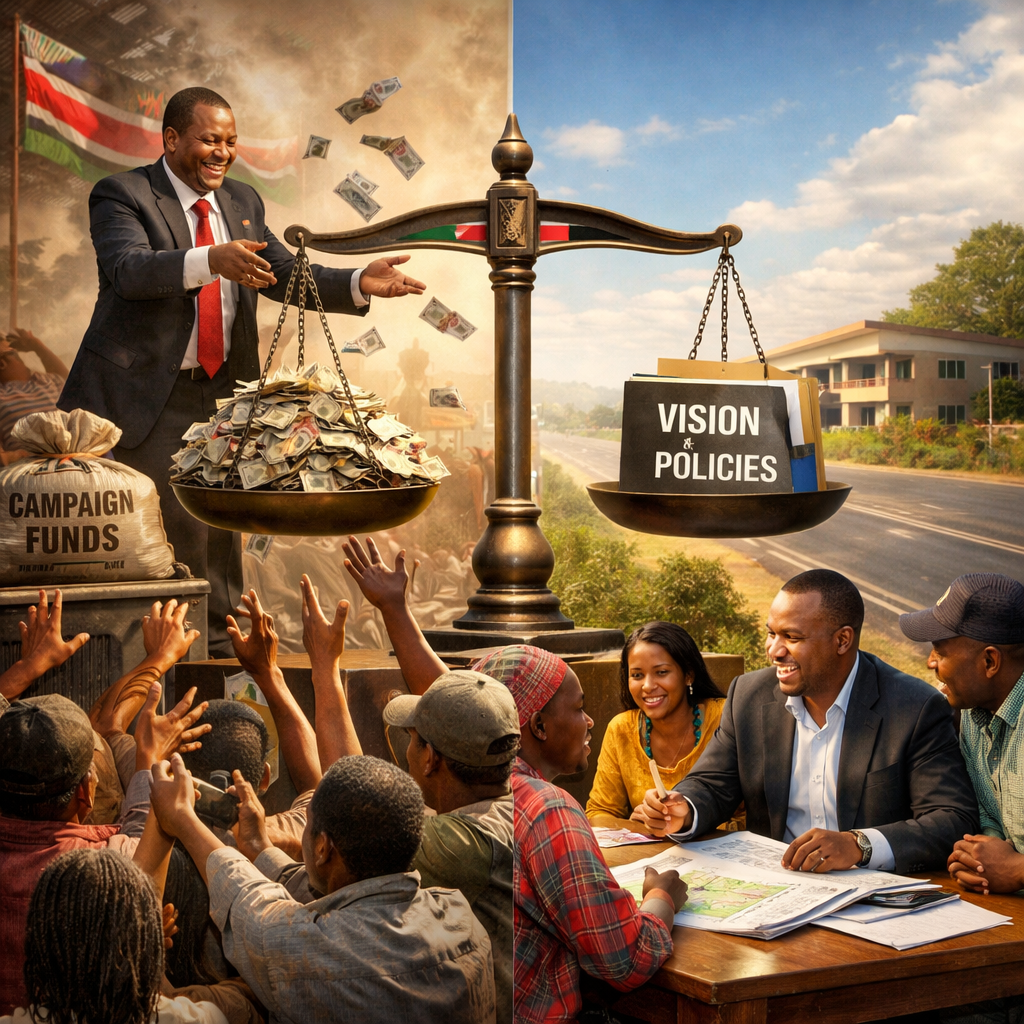
In an ideal democracy, leadership is about service—about presenting ideas, offering solutions, and earning the trust of the people. However, in Kenya today, politics has increasingly drifted from this ideal. For many candidates, elections are no longer a call to serve, but a financial investment.
Across the country, political campaigns are marked by excessive spending. Millions of shillings are poured into rallies, logistics, branding, and, in many cases, direct handouts to voters. In some instances, candidates spend far more than the total salaries and benefits they would earn during their entire term in office.
This raises a critical question:
If leadership is not profitable on paper, why spend so much to get elected?
The Dangerous Cycle of “Return on Investment” Politics
When a candidate spends beyond what the office can legitimately offer, it creates pressure to recover that money. Once elected, some leaders begin to treat public office as a business opportunity rather than a platform for service.
This is where corruption takes root.
Public resources may be misused, contracts inflated, and priorities distorted—not to serve citizens, but to recoup campaign expenses and prepare for the next election cycle. In such a system, the voter becomes secondary, and personal financial recovery becomes the primary goal.
Vote Buying and the Illusion of Loyalty
For years, campaign handouts have been used to influence voters. Money, food, and other incentives are distributed with the expectation of loyalty at the ballot box.
But this culture is beginning to shift.
More Kenyans are realizing that accepting a handout does not create a binding contract. A growing number of voters are separating what they receive during campaigns from how they vote on election day. The long-standing belief that “the highest spender wins” is slowly losing its grip.
This is a powerful and necessary evolution.
The Power and Responsibility of the Voter
Voters hold the ultimate power in a democracy. And with that power comes responsibility.
Kenyans must be courageous enough to break free from transactional politics. Accepting money from a politician should never translate into an obligation to vote for them. That money is often part of a broader strategy to manipulate the democratic process—not a genuine act of goodwill.
The vote must remain sacred.
Choosing Leadership Based on Substance
The future of Kenya’s democracy depends on a shift in mindset:
- From money to merit
- From handouts to honesty
- From short-term gain to long-term vision
Voters should evaluate candidates based on:
- Their ideas and policies
- Their track record and integrity
- Their plans for development and accountability
Not on how much they spend during campaigns.
A Turning Point for Kenya
Kenya stands at a critical moment. The slow shift away from vote-buying and excessive campaign spending is a sign of political maturity. But this progress must be protected and strengthened.
If voters continue to reject the idea that leadership can be bought, the entire political culture will begin to change. Campaigns will become more about ideas than money. Leadership will return to its rightful place as a public trust—not a private investment.
In the end, democracy is not for sale. And leadership should never come with a price tag.

more recommended stories
 THE POWER OF KSH 50: WHY SIFUNA MUST KEEP ASKING KENYANS TO INVEST IN THEIR POLITICAL FUTURE
The Benjamin Franklin Effect, grassroots financing.
-
SIFUNA, LINDA MWANANCHI AND THE SEARCH FOR A NEW POLITICAL CHAPTER: IS KENYA WITNESSING THE EMERGENCE OF A DIFFERENT KIND OF LEADERSHIP?
KENYA POLITICS | 30 OCTOBER 2026.
 Where the Rain Started Beating President Ruto
By Nathaniel Noti, former Taita.
 THE QUESTIONS UHURU KENYATTA CANNOT ESCAPE
Former President Uhuru Kenyatta’s declaration.
 THE POLITICS OF DECEPTION, CONTRADICTION AND POLITICAL REINVENTION OF HON MWASHAKO
A couple of days ago,.
 WHEN ELECTIONS NEAR, THE SAINTS RETURN: HOW KENYA’S CHURCHES BECAME CAMPAIGN ARENAS
Every election cycle in Kenya.
 THE VERMIN OF TRIBALISM & POLITICS OF ENTITLEMENT
The word Murima has forced.
 UDA MUST RETHINK, REPLAN AND RE-EXECUTE ITS STRATEGY IN TAITA TAVETA
Over the past several months, the.
 WHEN GOOD POLICIES DON’T DELIVER: WHY IMPLEMENTATION MATTERS MORE THAN WE THINK
Strong policies create direction, but implementation.
 THE 186 MPs WHO ABSCONDED TO VOTE FOR THE FINANCE BILL 2026/27
Every five years, Kenyans troop.
 SOCIAL MEDIA: THE BATTLEGROUND THAT WILL DEFINE THE 2027 ELECTIONS
The digital revolution has fundamentally.
 CAMPAIGN FINANCING AND THE MYTH OF THE WEALTHY SAVIOUR: WHAT KIND OF LEADERSHIP DOES DEMOCRACY NEED?
As political campaigns gather momentum,.
 Ulimwengu wa Universalism na Kuibuka kwa Ufahamu Mpya wa Kisiasa Afrika: Jinsi Gen Z wa Kenya Wanavyobadilisha Mwelekeo wa Siasa za Afrika
Barani Afrika, dhana ya universality au.
 THE SENATE NEEDS EXPERIENCE, NOT EXPERIMENTS: WHY ENG. JOHN MTUTA MRUTTU IS THE RIGHT CHOICE
In moments when a county stands.
 Mwadime Joins UDA: Strategic Realignment or Political Gamble in Taita Taveta?
The political landscape of Taita Taveta.
 ICHUNG’WAH’S CLAIMS DEEPEN THE CRISIS OF CREDIBILITY
Equally disturbing are remarks by Kimani.
Leave a Comment