

In every election cycle in Kenya, stadiums fill, convoys snake through towns, and social media erupts with images of massive political rallies. The spectacle is impressive. The energy is real. The noise is undeniable.
But rallies do not elect presidents. Ballots do.
A democracy does not count cheers — it counts votes.
The Comfortable Abstainer
A troubling pattern persists: many middle-income professionals and wealthy citizens attend rallies, debate politics intensely, fund campaigns quietly — yet fail to show up at polling stations.
Their reasons vary:
- “My vote won’t change anything.”
- “All candidates are the same.”
- “Politics is dirty.”
- “The system is already decided.”
- “I’m busy.”
Yet these same citizens will later complain about taxation levels, public debt, service delivery, security, infrastructure, corruption, and economic policy.
Abstention is not neutrality. It is silent endorsement of whatever outcome others decide.
When financially stable and educated citizens disengage from the actual vote, they surrender influence to those who do not.
Rallies Are Theater. Voting Is Power.
Political rallies serve important purposes:
- They energize party bases.
- They signal strength.
- They attract media attention.
- They consolidate coalitions.
But they are symbolic instruments.
Voting is a constitutional instrument.
In Kenya’s presidential system, power is determined by valid ballots cast and verified under constitutional thresholds — not by how many people filled a public square.
The gap between spectacle and structure is where elections are won or lost.
The Myth of “My Vote Doesn’t Matter”
Every election is an aggregation of individual decisions. The middle class often underestimates its collective weight. Professionals, entrepreneurs, salaried workers, and property owners represent a decisive economic bloc. Yet turnout among these groups tends to be inconsistent.
When turnout drops among economically influential citizens:
- Policy becomes less responsive to productivity and enterprise.
- Tax burdens are shaped without sufficient input from those who pay the largest share.
- Long-term economic reform loses disciplined advocacy.
- Populism fills the vacuum.
Non-voting is not protest. It is withdrawal from negotiation.
The Cost of Civic Apathy
Democracy rewards organized participation. It punishes indifference.
When middle-income and affluent citizens abstain:
- Political accountability weakens.
- Electoral outcomes skew toward highly mobilized bases.
- Policy becomes reactive instead of strategic.
- Governance becomes less technocratic and more emotional.
A rally attendee who does not vote contributes applause — not authority.
The Positive Power of Active Voting
Voting does more than select a leader. It:
- Legitimizes institutions – High turnout strengthens democratic credibility.
- Shapes policy direction – Economic priorities reflect voter behavior.
- Forces accountability – Politicians respect consistent voting blocs.
- Stabilizes governance – Broad participation reduces post-election volatility.
- Protects personal interests – Taxation, regulation, property rights, and business environments are all downstream of electoral choices.
Voting is the most peaceful and cost-effective way to influence power.
The Discipline of Citizenship
Democracy requires more than opinion. It requires action.
Attending rallies without voting is civic performance without civic responsibility. It creates political noise without political consequence.
If citizens desire better leadership, stronger institutions, and more accountable governance, participation must extend beyond enthusiasm.
The most powerful political statement is not made in a crowd.
It is made quietly — in a polling booth.

more recommended stories
 THE POWER OF KSH 50: WHY SIFUNA MUST KEEP ASKING KENYANS TO INVEST IN THEIR POLITICAL FUTURE
The Benjamin Franklin Effect, grassroots financing.
-
SIFUNA, LINDA MWANANCHI AND THE SEARCH FOR A NEW POLITICAL CHAPTER: IS KENYA WITNESSING THE EMERGENCE OF A DIFFERENT KIND OF LEADERSHIP?
KENYA POLITICS | 30 OCTOBER 2026.
 Where the Rain Started Beating President Ruto
By Nathaniel Noti, former Taita.
 THE QUESTIONS UHURU KENYATTA CANNOT ESCAPE
Former President Uhuru Kenyatta’s declaration.
 THE POLITICS OF DECEPTION, CONTRADICTION AND POLITICAL REINVENTION OF HON MWASHAKO
A couple of days ago,.
 WHEN ELECTIONS NEAR, THE SAINTS RETURN: HOW KENYA’S CHURCHES BECAME CAMPAIGN ARENAS
Every election cycle in Kenya.
 THE VERMIN OF TRIBALISM & POLITICS OF ENTITLEMENT
The word Murima has forced.
 UDA MUST RETHINK, REPLAN AND RE-EXECUTE ITS STRATEGY IN TAITA TAVETA
Over the past several months, the.
 WHEN GOOD POLICIES DON’T DELIVER: WHY IMPLEMENTATION MATTERS MORE THAN WE THINK
Strong policies create direction, but implementation.
 THE 186 MPs WHO ABSCONDED TO VOTE FOR THE FINANCE BILL 2026/27
Every five years, Kenyans troop.
 SOCIAL MEDIA: THE BATTLEGROUND THAT WILL DEFINE THE 2027 ELECTIONS
The digital revolution has fundamentally.
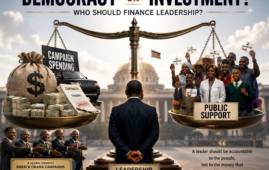 CAMPAIGN FINANCING AND THE MYTH OF THE WEALTHY SAVIOUR: WHAT KIND OF LEADERSHIP DOES DEMOCRACY NEED?
As political campaigns gather momentum,.
 Ulimwengu wa Universalism na Kuibuka kwa Ufahamu Mpya wa Kisiasa Afrika: Jinsi Gen Z wa Kenya Wanavyobadilisha Mwelekeo wa Siasa za Afrika
Barani Afrika, dhana ya universality au.
 WHEN LEADERSHIP BECOMES AN INVESTMENT: WHY KENYA MUST RETHINK CAMPAIGN SPENDING
In an ideal democracy, leadership.
 THE SENATE NEEDS EXPERIENCE, NOT EXPERIMENTS: WHY ENG. JOHN MTUTA MRUTTU IS THE RIGHT CHOICE
In moments when a county stands.
 Mwadime Joins UDA: Strategic Realignment or Political Gamble in Taita Taveta?
The political landscape of Taita Taveta.
Leave a Comment