

When the Cabinet Secretary for Finance suggests that police officers are “very happy” with their pay — particularly because they may not be subject to income tax — the comment cannot be dismissed as casual political talk. It invites scrutiny. It demands facts. And it raises deeper questions about how the State values its frontline security officers.
What Do Police Officers Actually Earn?
Police pay in Kenya is structured by rank under the National Police Service Commission (NPSC), guided by the Salaries and Remuneration Commission (SRC).
At the entry level, a Police Constable earns a basic salary that has historically ranged between the mid-20,000s to low-30,000s (KES), depending on the review cycle and notch progression. With allowances — housing, commuter, risk, and hardship (where applicable) — gross earnings can rise modestly above the basic figure.
However, three realities matter:
-
Basic salary is not take-home pay.
Deductions for pension, statutory contributions, and other payroll obligations reduce net income. -
Allowances vary by posting.
An officer in a hardship or high-risk area may earn more than one stationed in a standard urban post. -
Promotion progression is slow.
Many constables remain in lower pay bands for years before meaningful salary jumps occur.
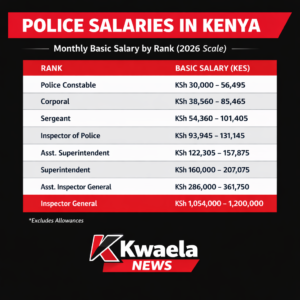 So while it may not be strictly accurate to say all police officers earn “less than KSh 30,000,” it is also misleading to imply that frontline officers enjoy comfortable compensation.
For many junior officers supporting families in high-cost urban centres, the margin is thin.
The Tax Question: Relief or Red Flag?
If an officer falls below the PAYE threshold after reliefs, they may pay minimal or no income tax. But this is not necessarily a triumph of fiscal generosity.
It can also signal low taxable income.
A tax exemption does not equal a pay rise.
It does not improve pensionable earnings.
It does not address structural compensation gaps.
When relief becomes the headline instead of reform, the debate shifts from dignity of pay to survival arithmetic.
The Morale Dimension
Police officers are not ordinary civil servants. They work long hours, face physical danger, endure psychological stress, and often operate under intense public scrutiny.
Compensation in disciplined forces is not just an economic issue — it is a governance issue.
Underpaid security personnel can experience:
-
Low morale,
-
Increased vulnerability to corruption,
-
Reduced operational motivation,
-
Strained public relations.
The State demands integrity, restraint, professionalism, and sacrifice. These expectations must be matched by fair and transparent remuneration policies.
Political Optics Matter
When the country’s chief fiscal policymaker publicly frames officers as satisfied with modest earnings, the message can be interpreted in multiple ways:
-
That welfare concerns are overstated,
-
That structural salary reform is not urgent,
-
Or that fiscal balance outweighs workforce morale.
Even if unintended, such messaging risks alienating rank-and-file officers whose lived reality may differ sharply from official narratives.
The Bigger Question
The debate should not be reduced to whether officers are “happy.”
The real question is this:
Does Kenya’s compensation structure for police officers reflect the risk, responsibility, and economic pressures they face?
Tax relief may cushion the blow.
But dignity of pay requires more than exemption thresholds.
If the government believes current pay is sufficient, it should present transparent data showing how police earnings compare to:
-
Cost-of-living indices,
-
Comparable public service roles,
-
Regional security forces.
Public trust in the police depends partly on institutional morale. And institutional morale depends, in part, on fair compensation.
A serious nation does not merely ask whether its officers are content.
It asks whether its compensation system is just.















Leave a Comment