
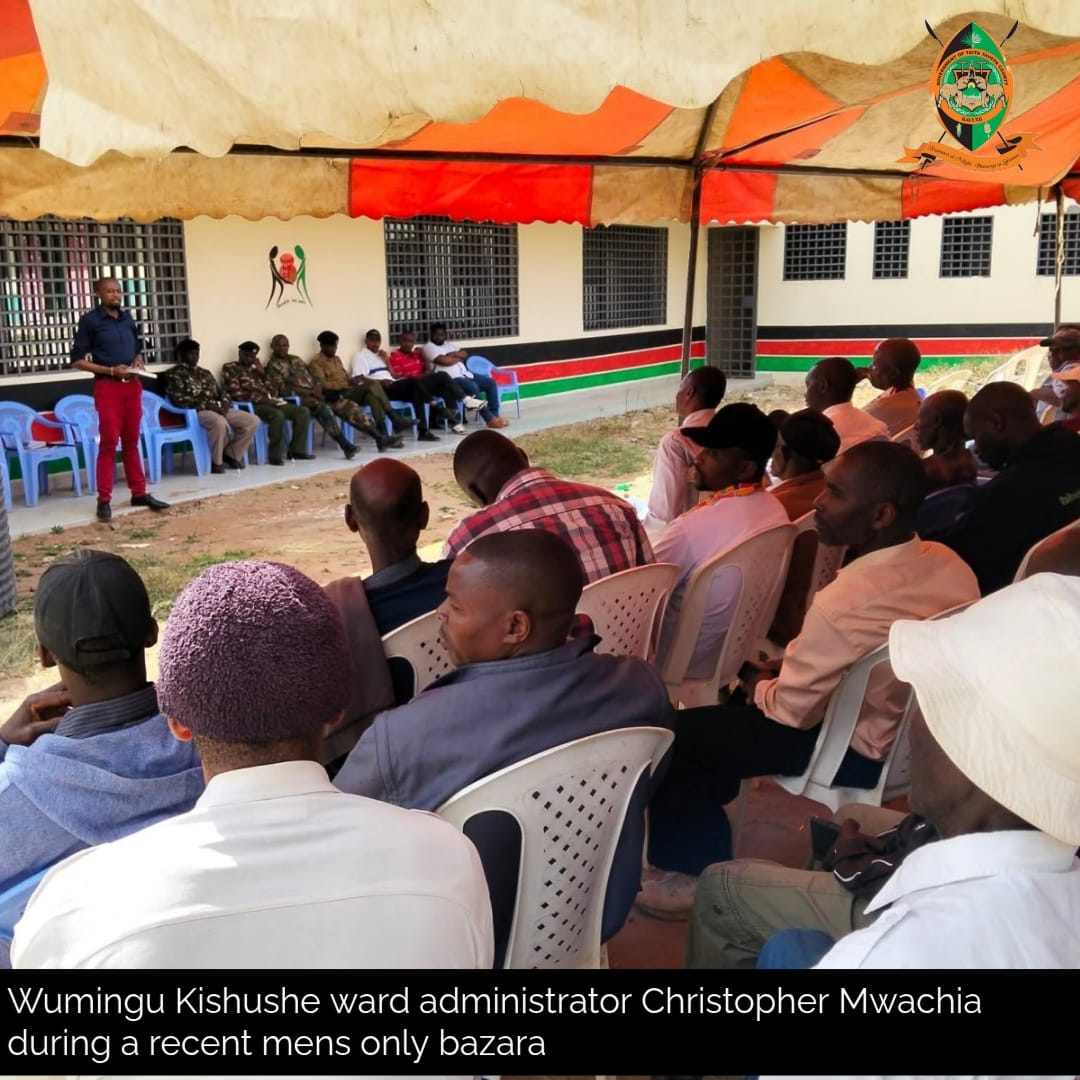
By Christopher Mwachia, Ward Administrator – Wumingu Kishushe Ward
A recent suicide burial ceremony I attended has renewed urgent calls for open conversations on mental health and suicide prevention within our communities. These conversations must begin at the grassroots.
The sombre burial of a civil servant who died by suicide served as a painful reminder of the silent struggles many people endure—often unnoticed until it is too late. Throughout the ceremony, speakers and mourners repeatedly emphasized the need to move beyond whispers and stigma, and instead create safe spaces where people can openly speak about emotional distress.
In Wumingu Kishushe Ward, where I serve as Ward Administrator, one such effort has already shown promise. On 9th September 2025, a men’s baraza dubbed “Ongea Usikike” (Talk and Be Heard) was held, organised jointly by the area chiefs, security officers, the Office of the Member of County Assembly, and the Wumingu Division Assistant County Commissioner. The forum brought together men aged 18 and above and proved to be an eye-opening engagement.
During the meeting, men openly shared personal struggles ranging from economic pressure and family responsibilities to emotional isolation, cultural expectations, and the heavy burden society places on men. Many admitted that cultural norms discourage men from expressing vulnerability, forcing them to suffer in silence even when overwhelmed. Such barazas, participants agreed, should be emulated across the county.
Concern is now mounting across Taita Taveta County following a noticeable rise in suicide-related incidents. Leaders and professionals say the trend points to deeper social and psychological challenges that can no longer be ignored. Families, churches, schools, and community institutions are being urged to actively support those struggling silently.
County health practitioners note that stigma remains a major barrier to seeking help, with many people avoiding assistance due to fear of judgement. In a phone interview, Wesu Sub-County Hospital psychologist Edah Kirombo said delayed help-seeking and lack of family involvement have contributed significantly to suicide cases.
“Seeking help does not only mean going to hospital for medication,” she said. “While medication is important, one-on-one counselling with a psychologist is paramount. Our county health facilities have trained professionals who can help.”
She further stressed the role of families, urging them to treat mental health issues with seriousness.
“Families should not relax assuming that victims will outgrow the situation. They need to be proactive,” she added.
Faith leaders have also echoed the call for compassion and vigilance, urging congregations to look out for one another beyond church walls, alongside spiritual nourishment. Rev. Ben Kibengo, lead pastor of City of Grace Church Voi, observed that changing family dynamics have left many people isolated.
“Unlike before, today families rarely meet to talk, pray, and catch up—partly due to hard economic times. In such moments, who else do you run to apart from God, who is ever close?” he said.
Rev. Kibengo added that the Church must help bring people closer to God as a source of healing and hope.
“We are all created by God, and only Him has our manual,” he said.
He further proposed stronger partnerships between government and faith-based institutions.
“Many people cannot afford to unwind or seek stress-relief options. The Church can be an alternative place to vent—through singing, prayer, fellowship, and counselling. The Church can also serve as a space for mental health therapy. Governments should work with churches to establish mobile counselling and rehabilitation centres. My church plans to establish a rehab centre in the future,” he noted.
Educators and youth mentors in Taita Taveta have also raised alarm over the pressure facing young people, calling for stronger guidance and counselling programmes in schools and community centres.
Stakeholders agree that suicide prevention requires collective responsibility. By encouraging open dialogue, strengthening support systems, and making mental health services accessible at the grassroots, leaders believe the worrying trend can be reversed and lives saved.
Community leaders, health professionals, faith-based organisations, educators, and government agencies must break the silence surrounding suicide—a silence long fuelled by stigma, fear, and misinformation. Recent incidents across different regions underscore the urgent need for coordinated action and honest conversations about mental health.
Mental health advocates warn that silence isolates those who are struggling, making it harder for them to seek help. Families, schools, workplaces, churches, and community groups all have a role to play in recognising early warning signs and offering support.
Let us talk. Every life matters.
#Let’sTalkAboutSuicide #EveryLifeMatters

more recommended stories
 SHOULD CATHOLIC PRIESTS BE ALLOWED TO MARRY?
The Sandro Ferretto case has.
 TAITA TAVETA INA MIRADI, LAKINI HAINA MAJI
Wapo wanaoamini kuwa miradi inayoendelea Taita.
 OFFICIAL REBUTTAL AND CONDEMNATION OF THE APPROVAL OF MR. ALFRED MLOLWA AS COUNTY EXECUTIVE COMMITTEE MEMBER FOR HEALTH SERVICES
Statement by Concerned Citizens of.
 DOES TAITA TAVETA PRIORITIZE PROFESSIONAL EXPERTISE IN HEALTH LEADERSHIP?
A quick comparison of leadership in.
 I Was Fluent in Disappearing
I was a girl who spoke Swahili and Luhya,.
 GENDER-BASED VIOLENCE IN TAITA TAVETA COUNTY: A GROWING CRISIS
Gender-based violence (GBV) in Taita Taveta.
 WHERE THE CHURCH IS GETTING IT WRONG IN DEALING WITH POLITICIANS
By Pastor Cassian Ngotho Mwachanya There.
 MBELE URGED TO RELEASE MASTER PLAN FOR WUNDANYI KMTC
Athanas Mbele Challenged to Release Master.
 BURIALS IN TAITA TAVETA HAVE BEEN REDUCED TO POLITICAL SLAUGHTERHOUSES.
It is both heartbreaking and infuriating.
 MAJOR HEALTH BOOST PROPOSED FOR VOI, EVEN AS TRUST DEFICIT CHALLENGES LOOM
The Taita Taveta County Government, under.
 DRUGS, ILLICIT BREWS, AND THE DEADLY GAMES THE STATE IS PLAYING WITH KENYAN LIVES
By Kwaela News Network | Special.
 CALLS GROW FOR TRADITIONAL BURIAL RITES FOLLOWING DEATH OF CYRUS JIRONGO
Sections of the Luhya community have.
 SUMMARY EXPOSÉ: EMERGING CONCERNS ON THE MANAGEMENT OF TAITA TAVETA COUNTY HEALTH DEPARTMENT
A recent internal communication originating from.
 TAARIFA KWA UMMA KUHUSU UTEPETEVU, UFISADI NA KUTOAJIBIKA KATIKA SEKTA YA AFYA KAUNTI YA TAITA TAVETA – HOSPITALI YA RUFAA YA MOI, VOI
Wananchi wa Kaunti ya Taita.
 SAFETY CONCERNS IN ONGOING RURAL ELECTRIFICATION IN TAVETA CONSTITUENCY
⚠️ PUBLIC AWARENESS STATEMENT ⚠️ We.
 WATER CRISIS HITS MOI COUNTY REFERRAL HOSPITAL
Patients Forced to Bring Own.
Leave a Comment