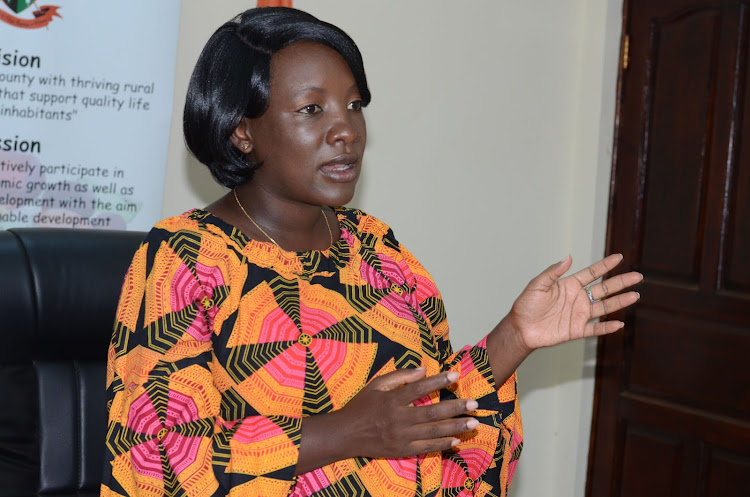
TWO-THIRDS GENDER RULE: Taita Taveta deputy governor Majala Mlagui. She says women should be empowered to equally compete with men in all elective positions so as to attain the Two- Thirds gender rule.

By Solomon Muingi
The high cost of vying for political seats in Kenya has been attributed to the dismal number of elected women.
Taita Taveta deputy governor Majala Mlagui says most women have been unable to mount a big campaign compared to their male counterparts because of the ballooning cost.
Mlagui said women should be empowered to equally compete with men in all elective positions so as to attain the two-thirds gender rule.
“It is necessary to have a clear strategy of how women shall be propelled to power without having to spend a lot of money. Some of them are young women who cannot afford the huge cost,” she said.
Mlagui spoke during a Women in Politics Media Engagement webinar on Wednesday.
According to a report by Mzalendo dubbed ‘The cost of politics in Kenya’, women spend more in election campaigns than their male counterparts do.
Overall, the report states that women in the 2017 general election outspent men in all elective posts except the Senate.
They spent an average of Sh23.6 million running for National Assembly seats, while their male counterparts spent an average of Sh17 million.
Women candidates spent more than double the amount spent by male candidates for MCA seats, they spent an average of Sh6.4 million compared to Sh2.9 million spent by men.
Kenya has struggled to achieve the Two-Thirds gender rule in the 2013 and 2017 general elections as stipulated in the Constitution.
In the 2017 election, 1,336 men were elected to office compared to the 96 women elected. Of those, 47 were elected to the woman representative position.
The report further revealed that the number of elected female MPs in 2017 increased from 16 to 23 while MCAs increased from 75 to 96.
Some three female senators and governors were also elected in 2017. There were no elected female senators and governors in the 2013 general election.
Of 131 female candidates who made it to the ballot for the National Assembly seat in 2017, the report states that only 23 won the race, projected at 18 per cent from a total of roughly 1,800 aspirants.
At the county assembly level, only 96 women won out of the 900 female candidates who came from a total pool of 11,848 aspirants.
Gender CAS Beatrice Elachi further underscored the urgency for the media to change society’s negative stereotype of women who rise up to seek leadership positions.
She said many women should be brought on board during media engagements to create visibility and strengthen their possibility to win elections.
Elachi said some communities have yet to accept the idea of women in leadership, let alone the possibility of them competing for and winning elective positions.
“We have noted low women visibility in media content as experts, commentators and analysts. Women should come out and give their stories,” she added.
The CAS, however, said the growing number of elected women in 2017 as compared to 2013 was evident that the country was making a stride towards having more women leaders.
~ The Star

 THE POWER OF KSH 50: WHY SIFUNA MUST KEEP ASKING KENYANS TO INVEST IN THEIR POLITICAL FUTURE
The Benjamin Franklin Effect, grassroots financing.
SIFUNA, LINDA MWANANCHI AND THE SEARCH FOR A NEW POLITICAL CHAPTER: IS KENYA WITNESSING THE EMERGENCE OF A DIFFERENT KIND OF LEADERSHIP?KENYA POLITICS | 30 OCTOBER 2026.
 Where the Rain Started Beating President Ruto
By Nathaniel Noti, former Taita.
 THE QUESTIONS UHURU KENYATTA CANNOT ESCAPE
Former President Uhuru Kenyatta’s declaration.
 THE POLITICS OF DECEPTION, CONTRADICTION AND POLITICAL REINVENTION OF HON MWASHAKO
A couple of days ago,.
 WHEN ELECTIONS NEAR, THE SAINTS RETURN: HOW KENYA’S CHURCHES BECAME CAMPAIGN ARENAS
Every election cycle in Kenya.
 THE VERMIN OF TRIBALISM & POLITICS OF ENTITLEMENT
The word Murima has forced.
 UDA MUST RETHINK, REPLAN AND RE-EXECUTE ITS STRATEGY IN TAITA TAVETA
Over the past several months, the.
 WHEN GOOD POLICIES DON’T DELIVER: WHY IMPLEMENTATION MATTERS MORE THAN WE THINK
Strong policies create direction, but implementation.
 THE 186 MPs WHO ABSCONDED TO VOTE FOR THE FINANCE BILL 2026/27
Every five years, Kenyans troop.
 SOCIAL MEDIA: THE BATTLEGROUND THAT WILL DEFINE THE 2027 ELECTIONS
The digital revolution has fundamentally.
 CAMPAIGN FINANCING AND THE MYTH OF THE WEALTHY SAVIOUR: WHAT KIND OF LEADERSHIP DOES DEMOCRACY NEED?
As political campaigns gather momentum,.
 Ulimwengu wa Universalism na Kuibuka kwa Ufahamu Mpya wa Kisiasa Afrika: Jinsi Gen Z wa Kenya Wanavyobadilisha Mwelekeo wa Siasa za Afrika
Barani Afrika, dhana ya universality au.
 WHEN LEADERSHIP BECOMES AN INVESTMENT: WHY KENYA MUST RETHINK CAMPAIGN SPENDING
In an ideal democracy, leadership.
 THE SENATE NEEDS EXPERIENCE, NOT EXPERIMENTS: WHY ENG. JOHN MTUTA MRUTTU IS THE RIGHT CHOICE
In moments when a county stands.
 Mwadime Joins UDA: Strategic Realignment or Political Gamble in Taita Taveta?
The political landscape of Taita Taveta.
Leave a Comment