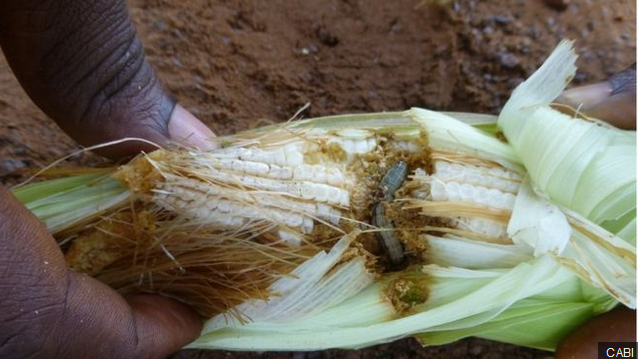
The effective parasitoids have been released to five counties

The International Centre of Insect Physiology and Ecology (ICIPE) has launched mass releases of indigenous natural enemies to control fall armyworm.
Fall Armyworm (FAW) or Spodoptera frugiperda , is an invasive pest that is wreaking havoc in Kenya and many other parts of the world, causing huge losses to farmers and impacting food security.
FAW was first detected in West and Central Africa early in 2016 and quickly spread across Sub-Saharan Africa.
Since the first detection of FAW in East Africa, ICIPE, jointly with national and international partners have embarked on basic and applied research to understand the ecology of the pest in Africa to guide the development of sustainable management strategies suited for African conditions.
Read Also
HOW AFRICAN COUNTRIES USED SPACE TECHNOLOGIES TO SOLVE DEVELOPMENTAL CHALLENGES IN 2020
Technologies such as the use of ICIPE’s Push-pull technology, maize-legume intercropping and biopesticides have proven to be a key part of sustainable management strategy for FAW, particularly under smallholder maize production systems in Africa.
“These technologies are eco-friendly and compatible with the use of biological control agents” says icipe.
So far over 140,000 wasps each of Telenomus remus and Trichogramma chilonis that parasitize FAW eggs; and 5,000 wasps of Cotesia ICIPE that parasitize early larval stages of FAW have been released in five counties (Taita-Taveta, Machakos, Embu, Meru, and Nyeri) of Kenya with very encouraging results.
In Africa, the cultivation of maize represents one of the most important sources of food security, income generation and employment for over 300 million people.
However, the recent invasion by FAW has led to yield losses of 8 – 20 million tonnes of maize on the continent.
The worm attacks all the developmental stages of the maize plant attracting an unprecedented scale of broad-spectrum application of chemical insecticides by the growers.
Also Read
YOUNG ASPIRING MOVEMENT OFFICIAL POSITION ON THE SAMBOJA ADMINISTRATION ON HEALTH WORKERS
In Ethiopia and Kenya, more than 50% of maize growers that applied chemical pesticides for FAW control reported that they only provide marginal control or they are completely ineffective. These chemical pesticides are not only ineffective but expensive and pose serious detrimental effects to humans, biodiversity and the environment.
“Though FAW is an alien invasive pest, our research has unravelled significant information on widely distributed native parasitoid species in Africa (namely Telenomus remus, Trichogramma chilonis and Cotesia icipe) and their ability to successfully parasitize and kill the invasive pest” explained, Dr Samira Mohamed, Senior Scientist, icipe
“Our approach focusses on evaluating the performance of these native parasitoids on various life stages of the FAW to identify the most effective one. Further we intend to mass-produce these effective parasitoids and release them in the FAW hotspots along with other eco-friendly management technologies to effectively manage the pest and improve maize yield”, added Dr Mohamed.
Also Read
STATEMENT ON THE EVICTION OF TAITA TAVETA HEALTH WORKERS FROM THEIR HOMES
The initial post-release field assessments revealed that parasitism rates of FAW in the field increased by 55%, 50% and 38%, for Trichogramma chilonis, Telenomus remus and Cotesia icipe, respectively.
“The released parasitoids work synergistically to bring down the population of FAW by attacking different developmental stages (eggs and larvae) of the pest. However, for these parasitoids to be able to effectively contribute to the suppression of pest, they need to be conserved by minimizing application of broad-spectrum chemical insecticides”, added Dr Mohamed.
“There are further plans for mass releases of these beneficial insects in other major maize growing zones across Kenya. Also, plans are underway with the national partners to expand the releases of these natural enemies to other eastern and southern African countries”, concluded Dr Sevgan Subramanian, Principal Scientist, icipe.

 MIASENYI CRASH REKINDLES PUBLIC OUTRAGE OVER DELAYED DUALLING OF NAIROBI–MOMBASA HIGHWAY
TAITA TAVETA, Kenya — A.
 WITO WA UWAZI KUHUSU MATUMIZI YA KSH 78 MILIONI KATIKA WODI ZA TAITA TAVETA
Taita Taveta, 29 Septemba 2025.
 LEVERAGING QUANTITATIVE FINANCE FOR COUNTY FISCAL SUSTAINABILITY IN KENYA
Summary County governments in Kenya.
 HOW SOLAR IS POWERING SMILES ON TAITA WOMEN’S FACES
Before July this year, health workers.
 A GREAT MIND TO INCUBATE
By George Mwafusi NASIR KICHINDA,the high.
 GOVERNMENT COMMITS TO EMPOWER YOUTHS THROUGH DIGITAL INCUBATION
The youth in Taita Taveta have.
 MAN WHO INVENTED SAFARICOM’S ‘PLEASE CALL ME’ DEMANDS KSH45 BILLION COMPENSATION
Kenneth Makate the brains behind Safaricom’s.
 HOW AFRICAN COUNTRIES USED SPACE TECHNOLOGIES TO SOLVE DEVELOPMENTAL CHALLENGES IN 2020
By Njeri Purity African countries.
 KEY INVENTIONS MADE BY KENYANS IN 2020
By JOHN MBATI In June 2020,.
 SH 3 BILLION FIBRE OPTIC CABLE LINK SET TO OPEN UP NORTHERN KENYA
The State has launched the construction.
 Kenyan Space Agency awards nanosatellite development grants to local universities
The Research Chairs (RC) programme aims.
 VOI CONSTITUENCY OPENS FIRST ICT HUB TO ENGAGE YOUTHS IN ONLINE JOBS
Voi Member of Parliament Johnes Mlolwa.
 18 CLEAN ENERGY SUPPLIERS GET $4.6 MILLION UNDER KOSAP
At least 18 companies operating in.
 KSHS 500M RELEASED FOR 14 COUNTIES IN OFF-GRID SOLAR PROJECT
Residents from 14 counties will now.
 MINI GRID ELECTRICITY THE ONLY WAY TO GET MILLIONS OUT OF DARKNESS
Over the past six months, millions.
 JKUAT STUDENTS MICHAEL MWAISAKENYI AND KENNETH GICHIRA WIN KSH.854K MICROSOFT DIGITAL AWARD
Two students, Michael Mwaisakenyi and Kenneth.
Leave a Comment