

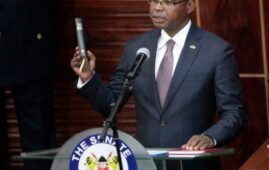
Perhaps one of the most ironic moments of Governor Andrew Mwadime’s appearance before the Senate was his suggestion that Parliament should enact legislation prohibiting county governments from initiating new projects before settling their existing pending bills.
The Governor went further, declaring that his administration was not initiating new projects because it intended to concentrate on clearing outstanding obligations.
On the surface, this sounds like responsible financial management. Governments should not continually accumulate new financial commitments while neglecting contractors, suppliers and other creditors who have already delivered goods and services.
But there is an uncomfortable question that the Governor must answer: Why has it taken almost four years in office to discover the importance of this principle?
Governor Mwadime has been in charge of Taita Taveta County throughout this administration. He has had the authority and responsibility to establish financial discipline, prioritise expenditure, strengthen internal controls and ensure that existing obligations are progressively addressed.
He has not been a spectator in the affairs of the County. He has been its chief executive.
The suggestion that the Senate should legislate on a matter that responsible leadership ought to recognise as a basic principle of financial management is, therefore, somewhat ironic.
There is also a distinction between announcing that no new projects will be initiated and demonstrating that the County has a credible strategy for resolving its existing financial obligations.
Residents need more than declarations. They need a clear account of the outstanding liabilities, the resources available to settle them, the repayment priorities and a realistic implementation timetable.
Furthermore, this is the final stretch of the current administration’s term before the next General Election. The Governor has already had several years to make the necessary institutional and financial reforms. Residents are entitled to ask why such measures are only now being presented as a priority.
But perhaps the bigger lesson goes beyond Governor Mwadime.
Kenya does not necessarily suffer from a shortage of laws. It suffers from a persistent deficit of integrity, responsible leadership and the political will to implement the laws and principles already in place.
We cannot legislate our way out of every leadership failure.
A Governor should not need an Act of Parliament to understand that employees’ statutory deductions must be remitted, that suppliers should be paid for services rendered, that public money must be properly accounted for and that public resources must be managed prudently.
These are elementary obligations of public office.
Leadership should be guided by integrity, prudence, foresight and a genuine commitment to improving the lives of ordinary citizens. Laws provide the framework, but it is the character and commitment of those entrusted with public responsibility that determine whether institutions actually work.
The people of Taita Taveta did not elect a Governor merely to preside over government offices, explain inherited problems or announce administrative intentions. They elected a leader to identify challenges, develop solutions and deliver measurable improvements in their lives.
A leader’s responsibility is not simply to explain why things went wrong. It is to demonstrate what has been done to put them right.
The question is no longer whether the County needs another law. The question is whether the people entrusted with governing it have the integrity, competence and determination to do what is already required of them.

more recommended stories
 SHAKAHOLA: 200 YEARS FOR MACKENZIE, BUT WHO WILL ANSWER FOR THE STATE’S FAILURE?
Kwaela News Network | Editorial.
 WHO IS THIS GOVERNOR TAITA-TAVETA COUNTY IS LOOKING FOR BEYOND 2027?
As the 2027 General Election.
 COURT HALTS COAST WATER DISCONNECTIONS AS EJF CHALLENGES SH6 BILLION DEBT CLAIM
Kwale, 29 August 2026 —.
 THE LEGENDARY 70-YEAR-OLD MZIMA PIPELINE LIVES TO BURST ANOTHER DAY
Government Celebrates Repairing What It Failed.
 TRAGIC LOSS OF JOHN KALAGHE JOSHUA LEAVES FAMILY AND COMMUNITY IN MOURNING
It is with profound sorrow and.
 THE NAIROBI–MOMBASA EXPRESSWAY: A DECADE OF PROMISES, YET NO HIGHWAY IN SIGHT
The Highway That Exists Only.
 FROM FUEL TO DRINKING WATER: HOW A BILLION-SHILLING PIPELINE DREAM RAN AGROUND
A Lesson in Why Politics Should.
 LIKONI BRIDGE: WHAT HAPPENED TO RUTO’S KSH 100 BILLION PROMISE?
For years, residents of Mombasa and.
 MZIMA PHASE TWO: SIX DECADES OF PROMISES, DELAYS AND GOVERNMENT FAILURE
Coast Residents Continue to Suffer as.
 ABSENT LEADERSHIP OR CALCULATED DISRESPECT? QUESTIONS MOUNT OVER KINGI’S NO-SHOW AT MGANGE NYIKA FUNDRAISER.
Serious questions are emerging following the.
 ATHANAS MBELE’S “BIG 7 AGENDA” VISION POSITIONS WUNDANYI FOR TRANSFORMATIONAL GROWTH
Wundanyi is emerging at the center.
 POLITICS ON OVERDRIVE
Kenya is not a permanent.
 WHY TAITA TAVETA NEEDS ITS OWN POLITICAL VEHICLE
By Geoffrey Kimonge (GK) The Case.
 HAS GREED CONSUMED THE TAITA TAVETA COUNTY ASSEMBLY?
By Geoffrey Kimonge (GK) Has the.
 THE COLLAPSE OF PAA: AMASON KINGI’S POLITICAL HOLLOWING EXPOSED IN MAGARINI AND TAITA TAVETA
By any political measure, Pamoja.
 WHIRLWIND INTERRUPTS MASHUJAA DAY FÊTE IN TAITA TAVETA — ELDERS SAY SPIRITS ARE SENDING A MESSAGE
By Mwachere Shuma | Kwaela.
Leave a Comment