

Kenya’s education system is once again under intense national scrutiny—not because of curriculum reforms or infrastructure gaps, but due to a more fundamental question: has basic education quietly become unaffordable for ordinary citizens?
At the center of this debate is the explosive issue of school uniform cartelism, now openly acknowledged within the National Assembly of Kenya as a systemic problem distorting access to education.
The Rise of “Uniform Cartels”
Recent parliamentary discussions reveal a troubling reality: what was once a simple requirement for school identity has evolved into a multi-billion shilling commercial enterprise.
- Lawmakers estimate the school uniform sector to be worth over KSh 40 billion annually.
- Parents report being forced to buy uniforms at 2–3 times market prices.
- Some schools allegedly maintain exclusive supplier arrangements, effectively locking out competition
This is not just inefficiency — it is structured exploitation.
In many cases, schools prescribe:
- Specific fabric shades unavailable in open markets
- Mandatory branded items (blazers, tracksuits, sweaters)
- Approved vendors only, eliminating price competition
The result? A manufactured monopoly, where uniforms are no longer about discipline or identity—but about profit.
Affordability Crisis: When Uniforms Block Education
The consequences are severe and immediate.
- Some families reportedly spend KSh 18,000–25,000 per child on uniforms alone
- Equivalent non-branded alternatives cost as low as KSh 4,000–6,000
- Students are sent home or denied entry due to lack of proper uniform
For a country where many households survive on less than KSh 500 per day, this creates a brutal contradiction:
Education is declared “free,” yet access is quietly priced out through hidden costs.
Uniforms have effectively become a gatekeeping tool, undermining Kenya’s constitutional commitment to universal education.
Parliament’s Ultimatum: Reform or Abolish
Faced with mounting public anger, MPs have taken a decisive stance.
They have issued a deadline of July 2026 for the Ministry of Education to dismantle uniform cartels—or risk complete abolition of mandatory uniforms.
This is not a symbolic warning. It reflects:
- Frustration with policy inaction
- Recognition that regulation has failed
- Willingness to pursue radical structural change
The debate has now shifted from “How do we regulate uniforms?” to
👉 “Should uniforms exist at all?”
The Counterargument: Equality vs Reality
Defenders of uniforms argue they:
- Promote equality among students
- Enhance discipline and identity
- Reduce visible class differences
But this argument is increasingly being challenged.
Because in practice:
- Uniforms no longer equalize—they stratify access
- Poor students are excluded entirely, not equalized within school
- The system reinforces inequality before learning even begins
In short:
A uniform cannot create equality if it prevents entry into school.
A Deeper Problem: The Collapse of “Free Education”
This crisis exposes a broader structural failure.
When Mwai Kibaki introduced Free Primary Education in 2003, it was transformative:
- Enrollment surged dramatically
- Millions of children entered school for the first time
- Education became a national equalizer
However, over time, hidden costs have crept back in:
- Uniforms
- Activity fees
- Development levies
- Boarding requirements
What was once “free” has become conditionally accessible.
The Political Promise vs Present Reality
During his campaign, William Samoei Ruto positioned himself as a champion of the “bottom-up economic model”, promising relief for ordinary citizens.
Education affordability was central to that promise.
Yet today:
- Parents face rising costs
- Parliament is battling cartels
- Students are still excluded due to poverty
This creates a widening gap between political commitment and lived reality.
What Needs to Happen Now
Kenya stands at a crossroads. Three clear paths exist:
1. Full Enforcement of Anti-Cartel Policies
- Ban schools from prescribing specific vendors
- Allow open-market purchasing
- Standardize simple, affordable designs
2. Radical Simplification or Abolition
- Optional uniforms
- Generic color-based dressing
- Removal of branded exclusivity
3. Return to Genuine Free Basic Education
A serious reset is needed:
- Reinforce the original vision of universal, barrier-free education
- Eliminate hidden costs that contradict policy
- Protect education from commercial capture
Conclusion: Education or Enterprise?
The uniform debate is not really about clothing.
It is about who controls access to education:
- The state?
- Schools?
- Or profit-driven networks operating within the system?
If left unresolved, uniform cartelism risks turning education into a privilege disguised as a right.
Kenya must decide:
Will education remain a public good—as envisioned under Kibaki—or continue drifting into a commercialized system that excludes the very citizens it is meant to uplift?
The July 2026 deadline is more than a policy marker.
It is a test of political will—and a measure of national priorities.

more recommended stories
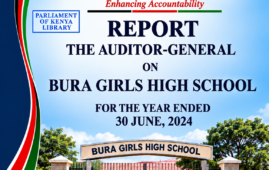 BURA GIRLS HIGH SCHOOL AUDIT RAISES QUESTIONS OVER KSH 2.79 MILLION KESSHA PAYMENTS, UNIFORM SALES AND FINANCIAL CONTROLS
KWAELA NEWS NETWORK (KNN) | INVESTIGATIVE.
 TTU SET TO DEVELOP 1,000 ACRES IN MAKTAU: ISANGAIWISHI LAND PROJECT EXPECTED TO BOOST EDUCATION AND LOCAL ECONOMY
By Kwaela News Network (KNN) MAKTAU,.
 AFTER RUTO’S INTERVENTION, FRESH QUESTIONS EMERGE OVER MANAGEMENT OF KENYATTA HIGH
By KNN Investigations Desk A senior.
 WUMINGU HOSTEL: HOW MANY TIMES MUST KENYA LAUNCH THE SAME PROJECT?
A foundation stone laid in 2026.
 BEATING CHILDREN IS NOT EDUCATION REFORMS
The growing calls to reintroduce corporal.
 A TEACHER’S CRY FOR JUSTICE
By an ECDE Teacher Tonight, many.
 RESPECT ECDE TEACHERS: THE COUNTY GOVERNMENT MUST STOP MANAGING SYMPTOMS AND START SOLVING THE PROBLEM
By Kwaela News Network Editorial Desk.
 RESPECT ECDE TEACHERS: TAITA TAVETA COUNTY MUST ACT BEFORE THE CRISIS DEEPENS
A society that neglects its.
-
QUESTIONS MOUNT AS NEW PETITION RAISES FRESH ALLEGATIONS AGAINST KENYATTA HIGH SCHOOL ADMINISTRATION
MWATATE, TAITA TAVETA — A.
 MDUMIKI’S EDUCATION PROMISES: WHEN WORDS BECOME A BURDEN TO THE POOR
Few things are more painful than.
 FORM THREE PARENTS PETITION KENYATTA HIGH SCHOOL OVER STUDENT WELFARE AND SERVICE DELIVERY CONCERNS
By Kwaela News Network Reporter.
-
QUESTIONS MOUNT OVER GOVERNANCE AND FINANCIAL MANAGEMENT AT KENYATTA HIGH SCHOOL
Stakeholders Call for Independent Probe.
 UNANSWERED QUESTIONS: THE CHRISTINE ZIGHE DEGREE CONTROVERSY AND THE SILENCE OF TAITA TAVETA COUNTY GOVERNMENT
For months now, a controversy surrounding.
 DR. GEOFFREY WILLIAM GRIFFIN: THE VISIONARY WHO BUILT MORE THAN A SCHOOL
To understand why Starehe Boys’ Centre.
 WHAT OTHER SCHOOLS CAN LEARN FROM STAREHE BOYS CENTRE ON FIRE PREPAREDNESS
In light of the numerous fire.
 TAITA TAVETA NATIONAL POLYTECHNIC: A NATIONAL INSTITUTION SLOWLY DYING IN SILENCE
A storm is now gathering around.
Leave a Comment