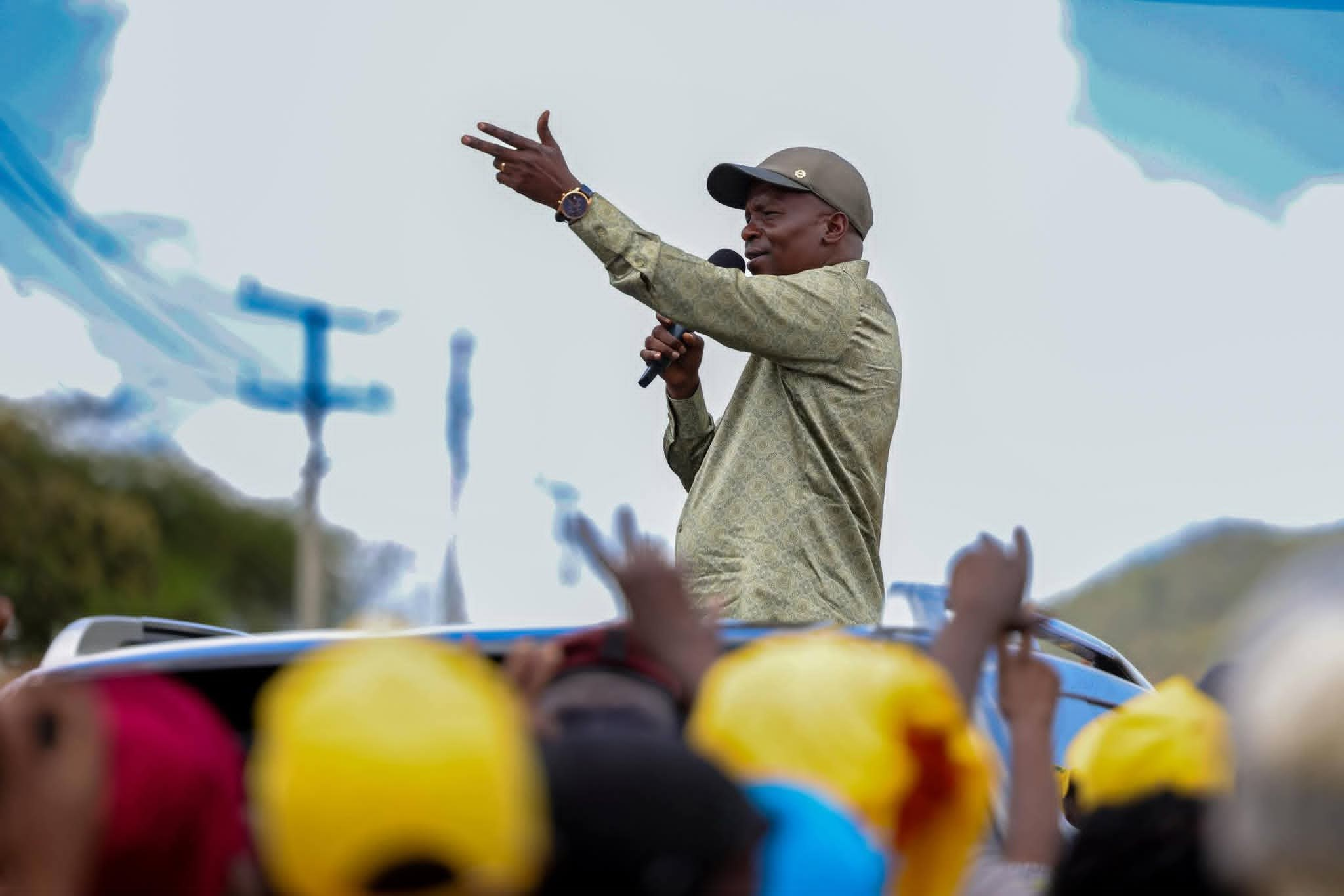
DP Kithure Kindiki in Mwatate - Taita Taveta

The arrival of Kithure Kindiki in Taita Taveta County on March 3, 2026 has reignited an old debate in the county: is development being delivered based on need — or deployed for political mileage?
At the centre of the visit was the inspection of the long-delayed Mto Mwagodi–Msau–Mbale–Wundanyi–Bura road and the near-complete Mwatunge ESP Market. Residents gathered, local leaders accompanied the Deputy President, and optimism briefly dominated the mood.
But beneath the applause lies a deeper and more uncomfortable conversation.
The 55-kilometre Mto Mwagodi corridor has been under construction for years. It stalled. It slowed. At times, it appeared abandoned.
Now revived, heavy machinery is back on site and progress is visible.
For many residents, the resumption is a relief. The road promises improved connectivity, lower transport costs, and greater economic integration across the county’s interior.
Yet critics ask a sharp question:
Why now?
The timing, they argue, coincides with intensified political mobilisation in the Coast region by leaders aligned with President William Ruto.
Publicly funded projects, they say, are being repackaged as political gifts — as though they are favors from individuals rather than constitutional obligations financed by taxpayers.
Infrastructure funded through the national budget is not a campaign tool. It is a public right.
The Mwatunge ESP Market stands 99% complete — a modern structure designed to formalize trade and uplift small businesses. It is part of the broader national modernization drive.
But on the ground, a competing priority dominates public discourse: water.
The long-awaited Mzima Phase Two water project remains incomplete. For many residents, reliable water supply is not a secondary concern — it is existential.
In several wards, water scarcity affects households, agriculture, and small enterprises daily. Without water security, critics argue, roads and markets cannot deliver their full economic promise.
The government’s Affordable Housing Programme has also drawn skepticism locally. Taita Taveta does not face the intense urban congestion seen in larger cities. Many residents say affordable housing was not a pressing grassroots demand. Instead, they perceive it as a centrally driven policy imposed without adequate local consultation.
The central question emerging is not whether development is welcome — it is whether it reflects local priorities.
A growing section of civil voices in the county are openly challenging leaders aligned with the ruling administration. Their concern is not with infrastructure itself — it is with its political packaging.
When public projects are showcased as personal achievements of politicians, democratic accountability weakens.
When stalled projects are revived in politically strategic seasons, suspicion grows.
When empowerment forums blur the line between state resources and partisan mobilisation, trust erodes.
Development must not become a backdrop for political choreography.
To be fair, national oversight of projects is legitimate. Monitoring, inspection and acceleration of works are core executive responsibilities. The revival of the road is tangible progress. The market will benefit traders.
But legitimacy depends on consistency, transparency and prioritisation.
Residents are asking:
Why did the road stall for years?
What guarantees exist that it will not stall again?
When will Mzima Phase Two receive equal urgency?
Who determines what qualifies as “priority development” for Taita Taveta?
These are not partisan questions. They are governance questions.
If leaders truly seek public confidence, the answer is not louder rallies or more frequent tours. It is sustained delivery — especially on water infrastructure that directly transforms daily life.
Taita Taveta is not rejecting development. It is demanding relevance.
The revival of the Mto Mwagodi road may mark progress. But unless water security, transparent budgeting, and non-partisan implementation follow, the perception that public funds are being leveraged for political consolidation will persist.
In the end, voters distinguish between development that empowers and development that campaigns.
The coming months will reveal which path prevails.

 TAITA TAVETA: CAN THE DCI CRACK THE NUT? DORCAS MLGHU’S PUBLIC OUTBURST PUTS COUNTY EXECUTIVE UNDER FRESH PRESSURE
The growing controversy surrounding the.
 NDARA B LAND DISPUTE: 63 RESIDENTS SERVED WITH THREE-MONTH EVICTION NOTICE FOLLOWING COURT RULING
Affected families in Mlambenyi, Golani and.
 TAITA TAVETA: WILL DEBORAH WAKESHO SUCCEED THE LATE MARGARET KAWUKI, OR WILL POLITICAL CARTELS INTERFERE?
Questions emerge over Jubilee Party’s.
 CHRISTOPHER MWAMBINGU: EACC INVESTIGATES ALLEGED FORGED DEGREE USED TO SECURE DIRECTOR OF ADMINISTRATION POSITION
A third case raises further.
 MWATATE MP RACE: RICHARD LUKINDO’S AMBITIONS AND THE UNANSWERED DEGREE QUESTION
The political stakes surrounding former.
 TAITA TAVETA: PRISONS OFFICER, NINE OTHERS ARRESTED IN MOTORCYCLE THEFT SYNDICATE PROBE
Serious questions emerge over alleged security.
 ALLEGATIONS OF HARASSMENT RETURN ALONG VOI-CALTEX ROAD CORRIDOR
Residents, motorists, and public transport operators.
 CHURU CHURU PROJECTS HAZIJENGI TAIFA
Kuna tofauti kubwa kati ya.
 BWIRE: ACCESS TO POWER IS NOT A POLITICAL MANDATE
Hon. John Bwire’s declaration that.
 RESIDENTS RAISE CONCERNS OVER ALLEGED MOTORIST HARASSMENT ALONG VOI-MOMBASA ROAD
Residents and motorists in Voi.
 THE TAITA TAVETA COUNTY ASSEMBLY’S VETTING PROCESS MUST UPHOLD THE CONSTITUTION AND PUBLIC TRUST
We, the concerned citizens of Taita.
 THE STRUCTURED POVERTY IN TAITA TAVETA
Residents demand answers after thousands.
 Taita Taveta Workers Demand Immediate Payment of Salaries and Allowances
Frustration is mounting among employees in.
 Nepotism Concerns Intensify as Family Links Dominate Senior Appointments in Taita Taveta County
Calls for transparency and fairness in.
 UNGA, POLITICS AND 2027: PS MWAMODO’S JORA VISIT SPARKS DEBATE
A food distribution exercise led by.
 Taita Taveta Residents Increasingly Question Leaders’ Priorities Amid Unresolved Challenges
What was billed as a development.
Leave a Comment