
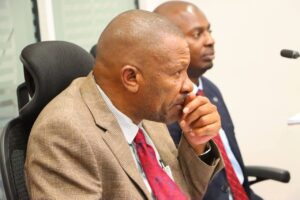
Senator Johnes Mwaruma

The statement by Taita Taveta Senator Johnes Mwaruma on the financial audit of TAVEVO Water and Sewerage Company has triggered intense debate across social media platforms, with residents expressing anger, suspicion, and deep concern over possible corruption at the county-owned utility.
The senator’s disclosure of unexplained variances running into hundreds of millions of shillings, understated electricity expenses, inflated supplier accounts, and non-revenue water standing at 50% has reopened long-standing questions about governance, accountability, and impunity within TAVEVO—issues previously raised by Kwaela News Network without any visible action from investigative agencies such as EACC or DCI.
Many residents interpreted the audit findings as confirmation of long-suspected malpractice.
One commentator remarked sarcastically:
“TAVEVO wamepatwa pants 🩳 down sio? Why did they overestimate expenses while underestimating electricity costs? How long have they been doing this?”
Others went further, alleging deliberate inflation of supplier accounts and systemic manipulation of bills:
“Why should an employee overstate suppliers’ accounts by millions? This is not a mistake—it’s a system.”
Some residents claimed to possess direct evidence, including meter readings allegedly manipulated to overbill consumers:
“I am a witness. I have photos of wrong readings versus true readings. I advise everyone to check their meters.”
Such testimonies, while anecdotal, paint a disturbing picture of a utility whose customers feel routinely exploited.
A section of commentators placed responsibility squarely on Governor Andrew Mwadime (Wakujaa), accusing his administration of tolerating incompetence, nepotism, and corruption.
Claims were made that unqualified individuals were employed due to family connections, weakening internal controls and enabling financial abuse. While these allegations remain unproven, they reflect a growing perception problem for the county leadership.
Not all reactions were supportive of Senator Mwaruma. Some residents viewed the timing and tone of his statement as politically motivated, given widespread speculation that he may seek the governor’s seat in 2027.
One dissenting voice argued:
“Being governor is not easy. Wakujaa is the best governor Taita has had. Instead of fighting, Mwaruma should team up with him.”
Others accused the senator of opportunism, questioning his silence in previous regimes and framing his intervention as a late political awakening rather than principled oversight.
Another strand of debate focused on Coast Water Services Board, with residents questioning why Taita Taveta should pay for water sourced from Mzima Springs, a natural resource located within the county.
This revived broader grievances over historical resource sharing arrangements, land injustices, and perceived exploitation of Taita Taveta by neighboring counties and national agencies.
During his September 2022 inauguration, Governor Wakujaa publicly vowed not to tolerate corruption, warning officials to “shape up or ship out.” However, critics argue that this pledge remained rhetorical.
No senior officials from either previous or current administrations have been forwarded for prosecution, nor has there been a serious recovery effort for lost public funds. The governor was previously quoted saying that “even the corrupt are fathers and mothers with families,” a statement many interpreted as softening the county’s stance on corruption.
High-profile scandals—including the Pilau Scandal and the disappearance of statutory deductions—have reinforced perceptions of impunity. In some cases, instead of disciplinary action, implicated officers were reportedly reshuffled to other departments.
The prevailing public sentiment suggests that corruption persists not because it is hidden, but because there are no consequences. Many residents believe that officials are emboldened by the absence of arrests, prosecutions, or dismissals—even when irregularities are documented.
Some have gone as far as alleging that senior political leadership could be complicit or, at minimum, deliberately indifferent.
Beyond personalities and political rivalries, the TAVEVO audit revelations raise a fundamental question for Taita Taveta residents:
If documented audit queries, public complaints, and eyewitness claims cannot trigger investigations or corrective action, then who protects public resources?
As the debate rages on, one thing is clear: the TAVEVO issue has struck a nerve, and residents are no longer willing to accept silence, excuses, or recycled speeches on corruption.
Whether this moment leads to genuine accountability—or dissolves into yet another political standoff—will depend on the actions taken next by oversight institutions, county leadership, and investigative agencies.

 TAITA TAVETA: CAN THE DCI CRACK THE NUT? DORCAS MLGHU’S PUBLIC OUTBURST PUTS COUNTY EXECUTIVE UNDER FRESH PRESSURE
The growing controversy surrounding the.
 NDARA B LAND DISPUTE: 63 RESIDENTS SERVED WITH THREE-MONTH EVICTION NOTICE FOLLOWING COURT RULING
Affected families in Mlambenyi, Golani and.
 TAITA TAVETA: WILL DEBORAH WAKESHO SUCCEED THE LATE MARGARET KAWUKI, OR WILL POLITICAL CARTELS INTERFERE?
Questions emerge over Jubilee Party’s.
 CHRISTOPHER MWAMBINGU: EACC INVESTIGATES ALLEGED FORGED DEGREE USED TO SECURE DIRECTOR OF ADMINISTRATION POSITION
A third case raises further.
 MWATATE MP RACE: RICHARD LUKINDO’S AMBITIONS AND THE UNANSWERED DEGREE QUESTION
The political stakes surrounding former.
 TAITA TAVETA: PRISONS OFFICER, NINE OTHERS ARRESTED IN MOTORCYCLE THEFT SYNDICATE PROBE
Serious questions emerge over alleged security.
 ALLEGATIONS OF HARASSMENT RETURN ALONG VOI-CALTEX ROAD CORRIDOR
Residents, motorists, and public transport operators.
 CHURU CHURU PROJECTS HAZIJENGI TAIFA
Kuna tofauti kubwa kati ya.
 BWIRE: ACCESS TO POWER IS NOT A POLITICAL MANDATE
Hon. John Bwire’s declaration that.
 RESIDENTS RAISE CONCERNS OVER ALLEGED MOTORIST HARASSMENT ALONG VOI-MOMBASA ROAD
Residents and motorists in Voi.
 THE TAITA TAVETA COUNTY ASSEMBLY’S VETTING PROCESS MUST UPHOLD THE CONSTITUTION AND PUBLIC TRUST
We, the concerned citizens of Taita.
 THE STRUCTURED POVERTY IN TAITA TAVETA
Residents demand answers after thousands.
 Taita Taveta Workers Demand Immediate Payment of Salaries and Allowances
Frustration is mounting among employees in.
 Nepotism Concerns Intensify as Family Links Dominate Senior Appointments in Taita Taveta County
Calls for transparency and fairness in.
 UNGA, POLITICS AND 2027: PS MWAMODO’S JORA VISIT SPARKS DEBATE
A food distribution exercise led by.
 Taita Taveta Residents Increasingly Question Leaders’ Priorities Amid Unresolved Challenges
What was billed as a development.
Leave a Comment