
The leaking of the Taita Taveta County Supplementary Budget has triggered widespread public debate — and rightfully so. While supplementary budgets are normal tools for adjusting county finances, the scale of the reallocations, the dramatic spikes in recurrent expenditures, and the introduction of vague new programmes raise legitimate questions about the county’s priorities, transparency, and financial discipline.
Below is a merged analysis drawn from multiple observers, highlighting the major concerns.
1. Budget Size and Why It Is Being Revised
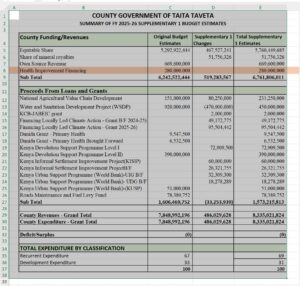
Last year’s budget stood at Ksh 8.18 billion.
This year’s initial budget was Ksh 7.85 billion, but the supplementary budget revises it upward to Ksh 8.34 billion.
Reasons for the revision include:
Ksh 467 million in additional Equitable Share
Ksh 52 million from mineral royalties
Ksh 437 million in additional project funds from agencies and conditional grants
A Ksh 470 million shortfall from the Water & Sanitation Development Project
In total, the county expects Ksh 519 million in new cashflow, but also faces reduced external funding.
2. Unrealistic Revenue Projections
Own Source Revenue targets have doubled:
Last year’s actual collection: Ksh 318.6M
New projection: Ksh 660M
No major reforms or revenue expansion strategies have been announced that justify this dramatic increase. Such unrealistic projections often lead to cashflow crises and more pending bills.
Health Facility collections (FIF) are projected at Ksh 280M, which may be achievable, but the broader AiA target seems overly ambitious.
3. Severe Red Flags in Recurrent Administrative Spending
Several departments have recorded suspiciously steep increases:
• Civic Education & Public Participation
From Ksh 1.7M to 7.7M (almost 400% increase).
No clear programme has been shared to justify this.
• Administrative Support Services
From Ksh 48M to 351M — a staggering 500%+ increase.
This is one of the clearest indications of ballooning bureaucracy.
• Finance & Economic Planning
From Ksh 392M to 873M, an increase of Ksh 268M.
Shockingly, Ksh 332M of this is for “General Administration, Planning & Support.”
This means more money is going into offices, tea, allowances, and internal operations than into actual development.
4. County Attorney’s Office Increase
An additional Ksh 5M raises the department’s budget to Ksh 12.92M.
Is this for increased litigation or to settle old legal pending bills?
The public deserves clarity.
5. The Explosion of Pending Bills
Pending bills are the county’s biggest threat to financial stability.
First two regimes (9 years): Ksh 950M pending bills
Current regime (last three years): Ksh 1.1B pending bills
In just three years, the county has accumulated more pending bills than the previous two governments combined.
The supplementary budget sets aside:
Ksh 400M for Executive pending bills
Ksh 17M for Assembly pending bills
This is a step in the right direction, but the underlying causes of this rapid accumulation remain unaddressed.
6. Positive Allocations Worth Acknowledging
Not all reallocations are problematic. Some deserve credit:
Ksh 12M for the completion of the rice milling plant
Ksh 39M for staff medical insurance
Ksh 56M for VTC scholarships
Ksh 31.5M for County Health Promoters
Ksh 10M for ECDE school feeding
Ksh 15M for Disaster Preparedness
Ksh 5M for Ikanga Airstrip.
These are people-centered interventions that will directly benefit residents.
7. But Several Additions Have No Clear Logic
Other allocations are difficult to justify:
• Ksh 20M for electricity in Finance
This makes it the department with the highest electricity budget — even more than the Ministry of Health.
• Ksh 25M in “donations” under the Governor’s Office
This exceeds the entire budget for Special Programmes responsible for disaster management.
• Ksh 187M added to Finance for items including catering
If these figures are accurate, the Finance department consumes more tea and snacks than all other departments combined.
• New County Empowerment Programme
Allocations of Ksh 4–5M per ward, plus Ksh 9M at HQ, without any public policy framework.
What exactly is this programme?
Without guidelines, it risks becoming a political slush fund.
8. County Assembly’s Allocation Increased by Ksh 85M
Assembly budget rises from Ksh 711M to 816M.
This creates a serious oversight dilemma.
An Assembly that gains financially from a budget loses moral ground to interrogate it objectively.
9. Special Programmes: From Ksh 21M to 38M, with Ksh 24M for Donations
The department remains vague, and questioning its functions often attracts threats.
Yet this department now handles one of the largest donation budgets in the county.
If the county has this much money to give away, why do key sectors like water, agriculture and markets remain neglected?
Conclusion: Taita Taveta Does Not Lack Money — It Lacks Discipline
Despite significant inflows, the county continues to:
Inflate administrative votes
Underfund essential services
Accumulate pending bills at record speed
Introduce vague, loosely defined programmes
Increase its own political allocations
Project unrealistic revenue targets
The problem is not insufficient funding — it is mismanagement, poor prioritization, and lack of transparency.
Before this supplementary budget is passed, both the Executive and County Assembly owe the residents of Taita Taveta a full and honest explanation.

more recommended stories
 TAITA TAVETA: CAN THE DCI CRACK THE NUT? DORCAS MLGHU’S PUBLIC OUTBURST PUTS COUNTY EXECUTIVE UNDER FRESH PRESSURE
The growing controversy surrounding the.
 NDARA B LAND DISPUTE: 63 RESIDENTS SERVED WITH THREE-MONTH EVICTION NOTICE FOLLOWING COURT RULING
Affected families in Mlambenyi, Golani and.
 TAITA TAVETA: WILL DEBORAH WAKESHO SUCCEED THE LATE MARGARET KAWUKI, OR WILL POLITICAL CARTELS INTERFERE?
Questions emerge over Jubilee Party’s.
 CHRISTOPHER MWAMBINGU: EACC INVESTIGATES ALLEGED FORGED DEGREE USED TO SECURE DIRECTOR OF ADMINISTRATION POSITION
A third case raises further.
 MWATATE MP RACE: RICHARD LUKINDO’S AMBITIONS AND THE UNANSWERED DEGREE QUESTION
The political stakes surrounding former.
 TAITA TAVETA: PRISONS OFFICER, NINE OTHERS ARRESTED IN MOTORCYCLE THEFT SYNDICATE PROBE
Serious questions emerge over alleged security.
 ALLEGATIONS OF HARASSMENT RETURN ALONG VOI-CALTEX ROAD CORRIDOR
Residents, motorists, and public transport operators.
 CHURU CHURU PROJECTS HAZIJENGI TAIFA
Kuna tofauti kubwa kati ya.
 BWIRE: ACCESS TO POWER IS NOT A POLITICAL MANDATE
Hon. John Bwire’s declaration that.
 RESIDENTS RAISE CONCERNS OVER ALLEGED MOTORIST HARASSMENT ALONG VOI-MOMBASA ROAD
Residents and motorists in Voi.
 THE TAITA TAVETA COUNTY ASSEMBLY’S VETTING PROCESS MUST UPHOLD THE CONSTITUTION AND PUBLIC TRUST
We, the concerned citizens of Taita.
 THE STRUCTURED POVERTY IN TAITA TAVETA
Residents demand answers after thousands.
 Taita Taveta Workers Demand Immediate Payment of Salaries and Allowances
Frustration is mounting among employees in.
 Nepotism Concerns Intensify as Family Links Dominate Senior Appointments in Taita Taveta County
Calls for transparency and fairness in.
 UNGA, POLITICS AND 2027: PS MWAMODO’S JORA VISIT SPARKS DEBATE
A food distribution exercise led by.
 Taita Taveta Residents Increasingly Question Leaders’ Priorities Amid Unresolved Challenges
What was billed as a development.
Leave a Comment