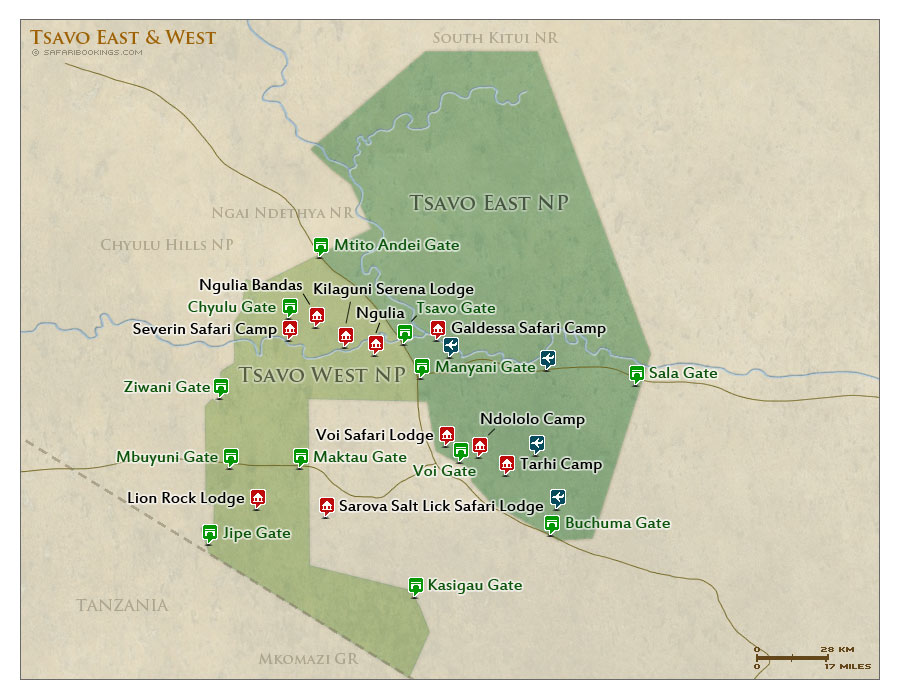
Map of Ysavo National Park

By Mwachere Shuma — Kwaela News Network
TAVETA & THE COAST REGION – Across the windswept plains of Tsavo East and West, Kenya’s largest national park complex, billions of shillings flow annually in park entry fees, tourism levies and wildlife‑conservation funds. And yet, for the residents of Taita Taveta County – the host region covering over 60 % of the park landmass – the financial dividends are slow to arrive, and critical infrastructure projects remain unfinished.
1. The revenue promise
In July 2023, President William Ruto publicly acceded to a petition by Taita Taveta County to secure a “50 / 50” revenue‑sharing framework for Tsavo National Park.
Reports state: “President Ruto has officially handed over… Taita Taveta to retain 50 per cent of revenues raised from Tsavo National Park.”
Local media confirm of Taita Taveta urged the President to fulfil this commitment, emphasising that the county hosts the two parks and the neighbouring Mzima Springs catchment area.
Read Also: TSAVO, PROMISES, AND POWER: IS TAITA TAVETA BEING LEFT BEHIND AGAIN?
2. The myth of Queen Elizabeth’s ‘shares’
A persistent local myth claims Queen Elizabeth II once held shares or ownership rights in Tsavo National Park or its revenues. However, public records show that Tsavo East and West are under the management of the Kenya Wildlife Service (KWS) – a state agency – and are not private companies with shareholders. The myth likely stems from colonial ‑ era land tenure confusion, but remains unsubstantiated by legal documentation.
While it is true that Crown lands in the UK once included the seabed and large real ‑ estate portfolios, no credible evidence links the British monarchy to formal share rights in Kenyan national parks.
Read Also: GOVERNOR MWADIME WANTS PRESIDENT RUTO TO FULFIL TSAVO 50/50 REVENUE SHARING PLEDGE
3. The petition, the gap and the numbers
Taita Taveta residents and leadership have flagged long ‑ standing concerns:
4. The Mzima Phase Two question
Adjacent to the Tsavo ecosystem is the proposed Mzima Phase Two bulk ‑ water project – intended to channel water from the Mzima Springs through Taita Taveta into the Coast region and support local development. The project was repeatedly promised during campaign trails (notably KSh 40 billion) but later declared “unviable” by the national government due to cost and investor hesitancy.
Given the scale of revenue generated from Tsavo, one must ask:
Why has the government not allocated a meaningful fraction of park ‑ derived revenues to this local water ‑ security initiative?
If the land and ecosystem hosting Tsavo generate substantial income, it seems logical (and equitable) that a portion be reinvested locally, yet the pipeline remains stalled.
Read Also: “THIRST AND DECEIT: WHAT HAPPENED TO THE KSH 40 BILLION MZIMA PROJECT?”
5. Accountability & the way forward
For transparency and justice to prevail, the following steps are critical:
Read Also: LEGALISE BUSH MEAT TO CAB HUMAN-WILDLIFE CONFLICTS IN TSAVO
In conclusion
The plains of Tsavo may roar with elephants, but for many residents of Taveta the sound is of drought ‑ dry wells, broken promises and unanswered petitions. The revenue flows; the pipeline doesn’t. The park operations thrive; local development lags. The myth of foreign ownership fades, but the reality of local marginalisation persists. As Kenya seeks to grow wildlife tourism and ecological revenues, it must equally deliver local value, fairness and justice to the communities who host its natural treasures.

 TAITA TAVETA COUNTY GOVERNMENT’S SHAME ON DISPLAY
When a county’s Chief Executive.
 GODOMA TITLE DEEDS: A HISTORIC MILESTONE MARRED BY QUESTIONS OVER ACCURACY
GODOMA – BURA, TAITA TAVETA, Residents.
 QUESTIONS MOUNT OVER APPOINTMENT OF NEW COUNTY INSPECTORATE DIRECTOR IN TAITA TAVETA
A cloud of uncertainty is.
 FROM COUNTY HALL TO PPCK: GRANTON SAMBOJA’S LEADERSHIP RECORD FACES RENEWED SCRUTINY
Former Taita Taveta Governor Granton Samboja.
 WHO IS JUSTICE AMRAPHAEL MBOGHOLI MSAGHA? THE TAITA SON WHO ROSE TO THE SUMMIT OF KENYA’S JUDICIARY
In the hills of Taita Taveta.
 Decisive Leadership, Not Polite Governance, Is What Taita Taveta Needs
By all accounts, leadership is not.
 MWANGEKA WA MALOWA
Kufuma konkala Wadawida ndewerekoghe na.
 TAITA TAVETA LANDS CECM MOVES TO COURT OVER SALARY ARREARS AND REMOVAL DISPUTE
MOMBASA, KENYA — Taita Taveta.
 MRAMBA COMMUNITY LAND: COMMUNITY DEMANDS SWIFT REGISTRATION AS LEGAL AND GOVERNANCE DISPUTES CONTINUE
Residents of the eight communities that.
 WHOSE LAND? WHOSE MONEY?
Members Demand Answers Over Qwetu Sacco’s.
 Analysis of the Auditor-General’s Findings on the County Executive of Taita Taveta (FY 2024/2025)
The Auditor-General issued a Qualified Opinion,.
 SH320 MILLION, SH8,000 A DAY: THE COSTLY FAILURE OF MAUNGU LORRY PARK
The story of Maungu Lorry.
 EACC REPORT EXPOSES IRREGULAR SPENDING AND PROCUREMENT VIOLATIONS AT TAITA TAVETA COUNTY ASSEMBLY
Voi, Kenya – The latest quarterly.
 EXPOSÉ | WATER PAID, SERVICE DENIED
Inside the payment breakdown linking TAVEVO.
 50 YEARS OF DRY TAPS: THE SHAME OF MWASOKO WATER PROJECT
How a 1975 Government Water Scheme.
 KSH 500 MILLION IN QUESTION: AUDIT EXPOSES DEEP FINANCIAL CRACKS AT TAVEVO
By Kwaela News Network Investigations Desk.
Leave a Comment