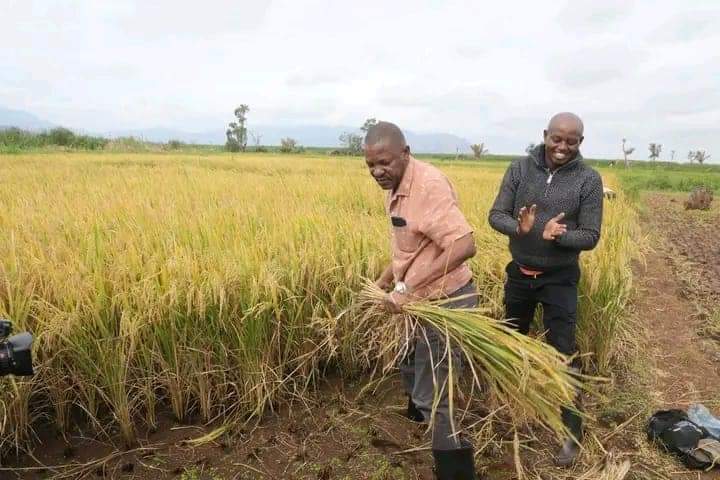
Governor Andrew Mwadime working in a rice farm in Taveta

Unbundled By Peter NJenga
Robert Kiyosaki, the author of the best-selling book – Rich Dad Poor Dad – says in one of his famous quotes that “the best way to predict the future is to study the past……”. The past stores the outcomes of all our actions and inactions and only fools can ignore lessons learnt or derived from studying the past.
Last year, the Controller of Budget published a report on the performance of counties on how they implemented their previous years budgets. It’s a huge volume covering over 700 pages with Taita Taveta county allocated 20 pages. In this article, I will endeavor to simplify the data and presentation thereby making it easier for many to understand and appreciate its contents and also make some fundamental observations from the statistics.
Background
The projections for last year’s budget (2022/2023) were as follows
Recurrent. : Ksh 5.0 Billions
Developments: Ksh 2.2 Billions
Total : Ksh 7.2 Billions
This budget was to be financed from various revenue sources as follows:
Equitable Share: Ksh 4.84 Billions
Local Revenue: Ksh 390 Millions
BCF: Ksh 387 Millions
Donor funding : Ksh 1.42 Billion
Other sources : Ksh 151 Millions
Expenditure observations
How did the county perform on expenditure?
First, the County did receive the full equitable share amounting to Ksh 4.84 billion. Interestingly, we spent a similar amount ~ Ksh 4.87 billion ~ on Salaries (Ksh 3.31 billion) and Operations and Maintenance (Ksh 1.56 billion).
It’s sad but the conclusion that can be made here is that all the cash that we got from the National Treasury was spent on salaries and operations. It’s therefore not rocket science to link salary delays and grounded vehicles with delayed exchequer releases.
Secondly , it’s a fact that our development budget is 30% and therefore meets the statutory requirement. But that is a statistic that hides many truths.
Our development budget satisfies that threshold basically because we are benefiting from funding from donor agencies such as the World Bank, Danish and Swedish governments in the Agriculture, Water and Health Sectors.
If you exclude contributions of these institutions from the budget, the percentage for development drops down to a paltry 11%.
In the last financial year, out of the Ksh 1.42 billion expected from donors, only Ksh 874 million was received and all of this cash went into specific donor funded projects. These projects are wholly implemented by the county but they come with stringent conditions attached to the funds utilization.
Thirdly, the money that was at hand for development was as follows:
BCF: Ksh 387 m (out of which Ksh 348 m was spent on pending bills)
Local Revenue: Ksh 265 m
AiA. : Ksh 161 m
Total Ksh 813
If you exclude the Ksh 387 million which ideally should be for payment of pending bills, only Ksh 462 million was left being a mere 7% of the actual budget being set aside for development. Any figures above 7%s are based on computations factoring in donor funds and BCF meant for settling pending bills.
In summary , it can be concluded that:
1. 100% of recurrent budget was funded by the equitable share
2. 65 % of the county projects were donor funded while 35% were locally funded.
3. Without donor funding, our development budget drops down to 7% of the actual budget.
Painful as it is, we must analyse these past expenditures if we are to make any meaningful decisions for a better future.
Going forward , its extremely important that the county
1. Urgently addresses the huge wage bill matters
2. Rationalizes its structural organization and priorities
3. Increases its revenue streams and seals revenue loss loopholes
4. Moves away from seeking donor partners to attracting investors (both local and foreign)

 TAITA TAVETA: CAN THE DCI CRACK THE NUT? DORCAS MLGHU’S PUBLIC OUTBURST PUTS COUNTY EXECUTIVE UNDER FRESH PRESSURE
The growing controversy surrounding the.
 NDARA B LAND DISPUTE: 63 RESIDENTS SERVED WITH THREE-MONTH EVICTION NOTICE FOLLOWING COURT RULING
Affected families in Mlambenyi, Golani and.
 TAITA TAVETA: WILL DEBORAH WAKESHO SUCCEED THE LATE MARGARET KAWUKI, OR WILL POLITICAL CARTELS INTERFERE?
Questions emerge over Jubilee Party’s.
 CHRISTOPHER MWAMBINGU: EACC INVESTIGATES ALLEGED FORGED DEGREE USED TO SECURE DIRECTOR OF ADMINISTRATION POSITION
A third case raises further.
 MWATATE MP RACE: RICHARD LUKINDO’S AMBITIONS AND THE UNANSWERED DEGREE QUESTION
The political stakes surrounding former.
 TAITA TAVETA: PRISONS OFFICER, NINE OTHERS ARRESTED IN MOTORCYCLE THEFT SYNDICATE PROBE
Serious questions emerge over alleged security.
 ALLEGATIONS OF HARASSMENT RETURN ALONG VOI-CALTEX ROAD CORRIDOR
Residents, motorists, and public transport operators.
 CHURU CHURU PROJECTS HAZIJENGI TAIFA
Kuna tofauti kubwa kati ya.
 BWIRE: ACCESS TO POWER IS NOT A POLITICAL MANDATE
Hon. John Bwire’s declaration that.
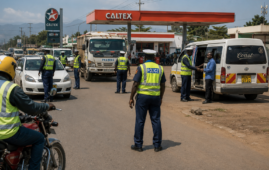 RESIDENTS RAISE CONCERNS OVER ALLEGED MOTORIST HARASSMENT ALONG VOI-MOMBASA ROAD
Residents and motorists in Voi.
 THE TAITA TAVETA COUNTY ASSEMBLY’S VETTING PROCESS MUST UPHOLD THE CONSTITUTION AND PUBLIC TRUST
We, the concerned citizens of Taita.
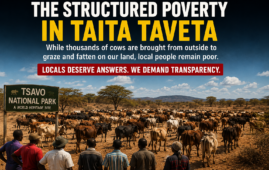 THE STRUCTURED POVERTY IN TAITA TAVETA
Residents demand answers after thousands.
 Taita Taveta Workers Demand Immediate Payment of Salaries and Allowances
Frustration is mounting among employees in.
 Nepotism Concerns Intensify as Family Links Dominate Senior Appointments in Taita Taveta County
Calls for transparency and fairness in.
 UNGA, POLITICS AND 2027: PS MWAMODO’S JORA VISIT SPARKS DEBATE
A food distribution exercise led by.
 Taita Taveta Residents Increasingly Question Leaders’ Priorities Amid Unresolved Challenges
What was billed as a development.
Leave a Comment